Wilson J. Moses - Böcker
Visar alla böcker från författaren Wilson J. Moses. Handla med fri frakt och snabb leverans.
4 produkter
4 produkter
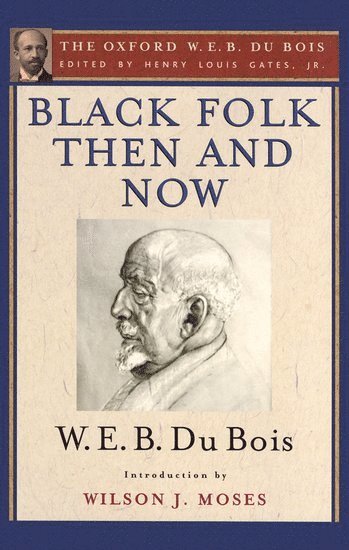
Black Folk Then and Now (The Oxford W.E.B. Du Bois)
An Essay in the History and Sociology of the Negro Race
Häftad, Engelska, 2014
412 kr
Skickas inom 7-10 vardagar
W. E. B. Du Bois was a public intellectual, sociologist, and activist on behalf of the African American community. He profoundly shaped black political culture in the United States through his founding role in the NAACP, as well as internationally through the Pan-African movement. Du Bois's sociological and historical research on African-American communities and culture broke ground in many areas, including the history of the post-Civil War Reconstruction period. Du Bois was also a prolific author of novels, autobiographical accounts, innumerable editorials and journalistic pieces, and several works of history.In Black Folk Then and Now, W. E. B. Du Bois embarks on a mission to correct the omissions, misinterpretations, and deliberate lies he detected in previous depictions of black history. An exemplary revisionist exploration of history and sociology, this essay reflects Du Bois's lifelong mission to bring to light the truths of Black history and expose the African peoples' noble heritage.W. E. B. Du Bois writes extensively about the color line, which he believed at the time of publication to be the defining problem of the twentieth century. In 1946, following the Holocaust, Du Bois revised his arguments, reshaping them into the narrative we find in The World and Africa. With a series introduction by editor Henry Louis Gates, Jr., and an introduction by Wilson Moses, this edition is essential for anyone interested in African American history.
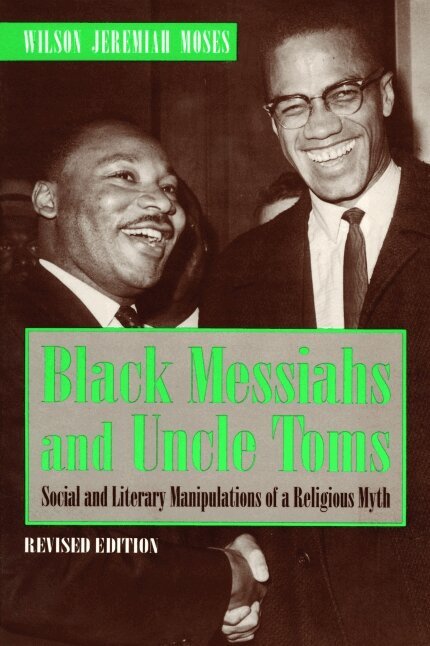
Black Messiahs and Uncle Toms
Social and Literary Manipulations of a Religious Myth. Revised Edition
Häftad, Engelska, 1993
501 kr
Skickas inom 7-10 vardagar
“Martin Luther King is dead and the millenarian integrationalism that he symbolized sleeps with him,” but messianic Christian rhetoric still characterizes black oratory both from the pulpit and on the hustings. Dead, too, are the chief American prophets of Pan-Islam, but the Ethiopian Hebrews and Moorish Science Temple are still active. “As black messianic myths die out,” this book argues, “new ones spring up to take their places.”Dr. Moses views black messianism as “a powerful and, in many respects, a beautiful myth, permeating the thinking of both white and black Americans since the late 18th century.” But, he points out, black messianism was evident as early as 1788 in the writings of “Othello,” or 1791, when Benjamin Banneker wrote to Thomas Jefferson of the Negro’s divine right to share the new nation’s “peculiar blessing of the heaven.” The author carefully defines the concept of messianism, and considers “redemptive mission” as a key attribute of the conception—one with which Harriet Beecher Stowe endowed Uncle Tom (despite activists’ mistaken notion of him as servile).The mythic black hero as messiah is a pervasive theme in literary and social expressions as disparate as the writings of Booker T. Washington, Marcus Garvey, W.E.B. Dubois, and Ralph Ellison, and the cults that developed around Joe Louis, Malcolm X, and others. Following the methodology used by Henry Nash Smith in Virgin Land: The American West as Symbol and Myth, Dr. Moses presents a “new angle of vision on many of the issues of black messianism and on the leading figures in the movement.” The author concludes that—despite the frequent excesses and even absurdities of black messianism—the American traditions of “evangelical reform, perfectionism, and the social gospel” offer more promise than today’s widespread “narcissistic anarchism.”Reviewers commented that “[Dr. Moses’] analysis is as probing as anything “ and that the book “will stir controversy as well as praise by other scholars in the field.”
914 kr
Skickas inom 10-15 vardagar
Examines the evolution of black nationalist thought from its earliest proto-nationalistic phase in the 1700s to the Garvey movement in the 1920sRecent years have seen a resurgence of interest in modern black nationalist leaders such as Stokely Carmichael and Malcolm X. But what of the ideological precursors to these modern leaders, the writers, and leaders from whose intellectual legacy modern black nationalism emerged? Wilson Jeramiah Moses, whom the Village Voice called one of the foremost historians of black nationalism, has here collected the most influential speeches, articles, and letters that inform the intellectual underpinnings of contemporary black nationalism, returning our focus to black nationalism at its inception.The goal of early black nationalists was the return of the African-American population to Africa to create a sovereign nation-state and to formulate an ideological basis for a concept of national culture. Most early black nationalists believed that this return was directed by the hand of God. Moses examines the evolution of black nationalist thought through several phases, from its proto-nationalisic phase in the late 1700s through a hiatus in the 1830s, through its flourishing in the 1850s, its eventual eclipse in the 1870s, and its resurgence in the Garvey movement of the 1920s.Moses provides us with documents that illustrate the motivations of both whites and blacks as they sought the removal of the black population. We hear from Thomas Jefferson, who held that it was self-evident that black and white populations could not intermingle on an equal basis or merge to form one happy society, and who toyed with the idea of a mass deportation of the black American population. We see that the profit motive is an important motive behind any nationalist movement in the letters between African American capitalists Paul Cuffe and James Forten. Among the more difficult selections to classify in this collection, Robert Alexander Young's Ethiopian Manifesto prophesied the coming of a prophetic liberator of the African race. The Christian nature of nineteenth century black nationalism is evident in Blyden's The Call of Providence.Moses rounds out the volume with contributions from more well- known voices such as those of Marcus Garvey, W.E.B. Dubois, and others. Classical Black Nationalism will serve as a point of departure for anyone interested in gaining a foundational knowledge of the disparate voices behind this often discussed but seldom understood movement.
402 kr
Skickas inom 7-10 vardagar
Examines the evolution of black nationalist thought from its earliest proto-nationalistic phase in the 1700s to the Garvey movement in the 1920sRecent years have seen a resurgence of interest in modern black nationalist leaders such as Stokely Carmichael and Malcolm X. But what of the ideological precursors to these modern leaders, the writers, and leaders from whose intellectual legacy modern black nationalism emerged? Wilson Jeramiah Moses, whom the Village Voice called one of the foremost historians of black nationalism, has here collected the most influential speeches, articles, and letters that inform the intellectual underpinnings of contemporary black nationalism, returning our focus to black nationalism at its inception.The goal of early black nationalists was the return of the African-American population to Africa to create a sovereign nation-state and to formulate an ideological basis for a concept of national culture. Most early black nationalists believed that this return was directed by the hand of God. Moses examines the evolution of black nationalist thought through several phases, from its proto-nationalisic phase in the late 1700s through a hiatus in the 1830s, through its flourishing in the 1850s, its eventual eclipse in the 1870s, and its resurgence in the Garvey movement of the 1920s.Moses provides us with documents that illustrate the motivations of both whites and blacks as they sought the removal of the black population. We hear from Thomas Jefferson, who held that it was self-evident that black and white populations could not intermingle on an equal basis or merge to form one happy society, and who toyed with the idea of a mass deportation of the black American population. We see that the profit motive is an important motive behind any nationalist movement in the letters between African American capitalists Paul Cuffe and James Forten. Among the more difficult selections to classify in this collection, Robert Alexander Young's Ethiopian Manifesto prophesied the coming of a prophetic liberator of the African race. The Christian nature of nineteenth century black nationalism is evident in Blyden's The Call of Providence.Moses rounds out the volume with contributions from more well- known voices such as those of Marcus Garvey, W.E.B. Dubois, and others. Classical Black Nationalism will serve as a point of departure for anyone interested in gaining a foundational knowledge of the disparate voices behind this often discussed but seldom understood movement.