Winfried Heinemann - Böcker
Visar alla böcker från författaren Winfried Heinemann. Handla med fri frakt och snabb leverans.
11 produkter
11 produkter
Germany and the Second World War
Volume IX/I: German Wartime Society 1939-1945: Politicization, Disintegration, and the Struggle for Survival
Häftad, Engelska, 2015
1 152 kr
Skickas inom 7-10 vardagar
The Second World War affected the lives and shaped the experience of millions of individuals in Germany - soldiers at the front, women, children and the elderly sheltering in cellars, slave labourers toiling in factories, and concentration-camp prisoners and POWs clearing rubble in the Reich's devastated cities. Taking a 'history from below' approach, the volume examines how the minds and behaviour of individuals were moulded by the Party as the Reich took the road to Total War. The ever-increasing numbers of German workers conscripted into the Wehrmacht were replaced with forced foreign workers and slave labourers and concentration camp prisoners. The interaction in everyday life between German civilian society and these coerced groups is explored, as is that society's relationship to the Holocaust. From early 1943, the war on the home front was increasingly dominated by attack from the air. The role of the Party, administration, police, and courts in providing for the vast numbers of those rendered homeless, in bolstering civilian morale with 'miracle revenge weapons' propaganda, and in maintaining order in a society in disintegration is reviewed in detail. For society in uniform, the war in the east was one of ideology and annihilation, with intensified indoctrination of the troops after Stalingrad. The social profile of this army is analysed through study of a typical infantry division. The volume concludes with an account of the various forms of resistance to Hitler's regime, in society and the military, culminating in the failed attempt on his life in July 1944.
Germany and the Second World War
Volume IX/I: German Wartime Society 1939-1945: Politicization, Disintegration, and the Struggle for Survival
Inbunden, Engelska, 2008
6 161 kr
Skickas inom 5-8 vardagar
The Second World War affected the lives and shaped the experience of millions of individuals in Germany - soldiers at the front, women, children and the elderly sheltering in cellars, slave labourers toiling in factories, and concentration-camp prisoners and POWs clearing rubble in the Reich's devastated cities. Taking a 'history from below' approach, the volume examines how the minds and behaviour of individuals were moulded by the Party as the Reich took the road to Total War. The ever-increasing numbers of German workers conscripted into the Wehrmacht were replaced with forced foreign workers and slave labourers and concentration camp prisoners. The interaction in everyday life between German civilian society and these coerced groups is explored, as is that society's relationship to the Holocaust. From early 1943, the war on the home front was increasingly dominated by attack from the air. The role of the Party, administration, police, and courts in providing for the vast numbers of those rendered homeless, in bolstering civilian morale with 'miracle revenge weapons' propaganda, and in maintaining order in a society in disintegration is reviewed in detail. For society in uniform, the war in the east was one of ideology and annihilation, with intensified indoctrination of the troops after Stalingrad. The social profile of this army is analysed through study of a typical infantry division. The volume concludes with an account of the various forms of resistance to Hitler's regime, in society and the military, culminating in the failed attempt on his life in July 1944.
589 kr
Skickas inom 3-6 vardagar
Del 2 - De Gruyter Studies in Military History
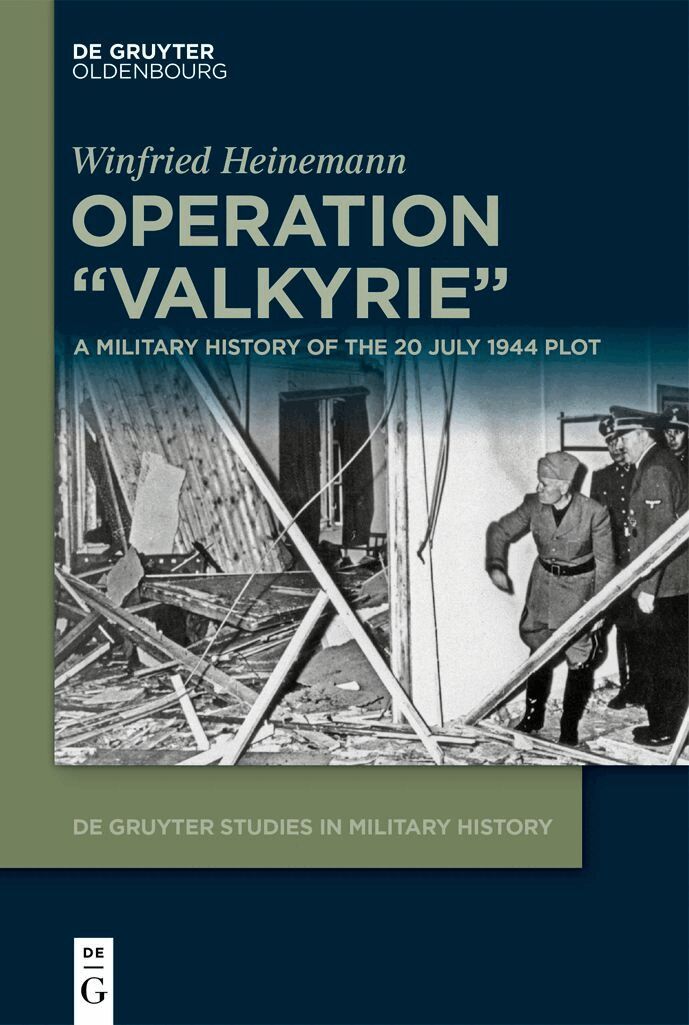
Operation "Valkyrie"
A Military History of the 20 July 1944 Plot
Inbunden, Engelska, 2021
589 kr
Skickas inom 3-6 vardagar
20 July 1944 is usually associated with the bomb plot to murder Hitler. However, what distinguishes Colonel Stauffenberg’s plan from all others is that the attempt on the Führer’s life was only to be the initial stage of a full military coup d’état. The aim was to overthrow the murderous regime, and to end the war as soon as possible. The conspiracy has long been analyzed from political, social, religious, or moral points of view. This book asks what the military dimension of the plan was. What traditions in the German army were at work, how was planning and preparation done, and why did the plot fail eventually? What is more: how did the conspiracy affect the German armies created in East and West after World War II, and also the Austrian Army? As the politicians among the conspirators thought in categories of Imperial Germany or at least the Weimar Republic, the officers among them were conditioned by the Reichswehr. Yet, Stauffenberg and some others were also bright intellectuals who were willing to incorporate their war experience into their plans, rendering them surprisingly modern at times. The coup d’état had been planned as meticulously as circumstances in war-torn Berlin allowed. However, as most officers had foreseen, once it became public knowledge that Hitler had survived Stauffenberg’s bomb, army units refused to act. The myth surrounding the "Führer" effectively prevented any military action against him. Still, the failed uprising had its effects: the regime took the opportunity to tilt the balance of power further in favor of Himmler and his fiefdom (SS, Gestapo, Police), to the detriment of the army which Hitler felt was too reactionary anyway. The leadership of the West German Bundeswehr always saw the failed uprising as part of its tradition, but it took time for this attitude to percolate down to the rank and file. For decades, some of the former Wehrmacht soldiers viewed Stauffenberg and his friends as "traitors". The book is the first to approach this important event in German history from a specifically military point of view, and that results in some surprising new results.
359 kr
Skickas inom 7-10 vardagar
425 kr
Skickas inom 7-10 vardagar
The GDR always claimed it was a sovereign state. Did it provide for its own security, or to what extent did it depend on Soviet guarantees and military support? This is one of the guiding questions orienting this volume. A chronological overview, placing the essential stages of the GDR’s military history within the context of the period, is followed by a systematic analysis of the most relevant aspects: the book covers, among other topics, the organization of the armed forces, the military as an educational agency, or the effects of the hypermilitarization on the East German state’s economy and society. Finally, the book asks why all the armed formations together failed to protect the GDR’s Socialist Party regime when, in 1989, the citizens took to the streets and demanded reforms. It is meant for students who need a swift introduction into the topic, and for a general readership interested in GDR history and military history.
Del 1 - Entstehung Und Probleme Des Atlantischen Bündnisses
Vom Zusammenwachsen des Bündnisses
Inbunden, Tyska, 1998
629 kr
Skickas inom 7-10 vardagar
853 kr
Skickas inom 5-8 vardagar
Del 3 - Beiträge Zur Militärgeschichte - Militärgeschichte Kompakt
Die DDR Und Ihr Militär
Häftad, Tyska, 2011
329 kr
Skickas inom 5-8 vardagar
333 kr
Skickas inom 5-8 vardagar
138 kr
Skickas inom 3-6 vardagar