Wojciech P. Ziarko – författare
Visar alla böcker från författaren Wojciech P. Ziarko. Handla med fri frakt och snabb leverans.
4 produkter
4 produkter
E-bok
PDF, Engelska, 2012708 kr
Läs direkt efter köp
The objective of this book is two-fold. Firstly, it is aimed at bringing to gether key research articles concerned with methodologies for knowledge discovery in databases and their applications. Secondly, it also contains articles discussing fundamentals of rough sets and their relationship to fuzzy sets, machine learning, management of uncertainty and systems of logic for formal reasoning about knowledge. Applications of rough sets in different areas such as medicine, logic design, image processing and expert systems are also represented. The articles included in the book are based on selected papers presented at the International Workshop on Rough Sets and Knowledge Discovery held in Banff, Canada in 1993. The primary methodological approach emphasized in the book is the mathematical theory of rough sets, a relatively new branch of mathematics concerned with the modeling and analysis of classification problems with imprecise, uncertain, or incomplete information. The methods of the theory of rough sets have applications in many sub-areas of artificial intelligence including knowledge discovery, machine learning, formal reasoning in the presence of uncertainty, knowledge acquisition, and others. This spectrum of applications is reflected in this book where articles, although centered around knowledge discovery problems, touch a number of related issues. The book is intended to provide an important reference material for students, researchers, and developers working in the areas of knowledge discovery, machine learning, reasoning with uncertainty, adaptive expert systems, and pattern classification.
Häftad, Engelska, 1994
544 kr
Skickas inom 10-15 vardagar
This volume contains papers from the International Workshop on Rough Sets and knowledge Discovery, held in Banff, Alberta, Canada, from the 12 - 15 October 1993. It includes application reports and theory oriented papers by leading professionals in both. of these important areas of research. There are comprehensive sections on the following topics: knowledge discovery methodologies and applications; fundamental research in the theory of rough sets and its extensions; machine learning applications of the rough sets approach (including presentation of some new learning methods); reasoning from uncertain information using a combination of fuzzy and rough sets methods; and applications of the methodologies , areas such as market analysis, medical diagnosis, and image processing. The resulting volume will be of interest to researchers and developers of systems for knowledge acquisition, decision support and machine discovery.
Häftad, Engelska, 2008
561 kr
Skickas inom 10-15 vardagar
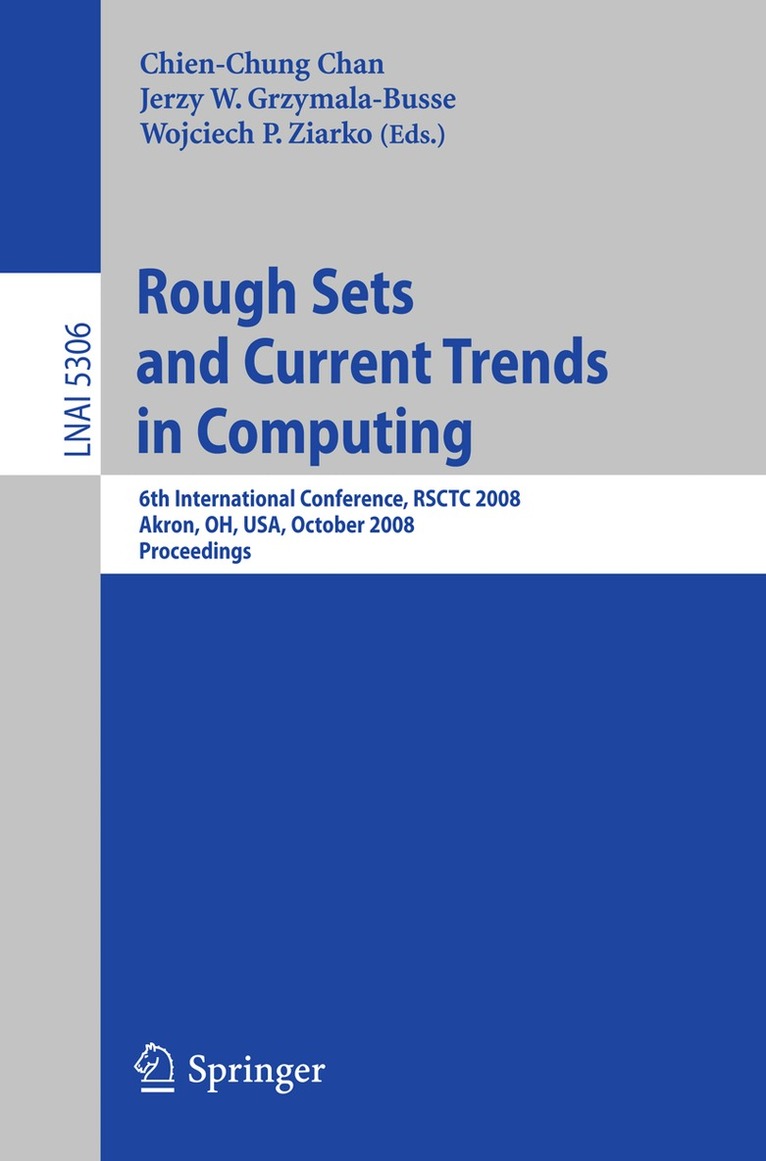
The articles in this volume were selected for presentation at the Sixth Inter- tional Conference on Rough Sets and Current Trends in Computing (RSCTC 2008), which took place on October 23–25 in Akron, Ohio, USA. The conference is a premier event for researchersand industrial professionals interested in the theory and applications of rough sets and related methodo- gies. Since its introduction over 25 years ago by Zdzislaw Pawlak, the theory of rough sets has grown internationally and matured, leading to novel applications and theoretical works in areas such as data mining and knowledge discovery, machine learning, neural nets, granular and soft computing, Web intelligence, pattern recognition and control. The proceedings of the conferences in this - ries, as well as in Rough Sets and Knowledge Technology (RSKT), and the Rough Sets, Fuzzy Sets, Data Mining and Granular Computing (RSFDGrC) series report a variety of innovative applications of rough set theory and of its extensions. Since its inception, the mathematical rough set theory was closely connected to application ?elds of computer science and to other areas, such as medicine, which provided additional motivation for its further development and tested its real-life value. Consequently, rough set conferences emphasize the - teractionsandinterconnectionswith relatedresearchareas,providingforumsfor exchanging ideas and mutual learning. The latter aspect is particularly imp- tant since the development of rough set-related applications usually requires a combination of often diverse expertise in rough sets and an application ?eld.
E-bok
PDF, Engelska, 2008708 kr
Läs direkt efter köp
The articles in this volume were selected for presentation at the Sixth Inter- tional Conference on Rough Sets and Current Trends in Computing (RSCTC 2008), which took place on October 23–25 in Akron, Ohio, USA. The conference is a premier event for researchersand industrial professionals interested in the theory and applications of rough sets and related methodo- gies. Since its introduction over 25 years ago by Zdzislaw Pawlak, the theory of rough sets has grown internationally and matured, leading to novel applications and theoretical works in areas such as data mining and knowledge discovery, machine learning, neural nets, granular and soft computing, Web intelligence, pattern recognition and control. The proceedings of the conferences in this - ries, as well as in Rough Sets and Knowledge Technology (RSKT), and the Rough Sets, Fuzzy Sets, Data Mining and Granular Computing (RSFDGrC) series report a variety of innovative applications of rough set theory and of its extensions. Since its inception, the mathematical rough set theory was closely connected to application ?elds of computer science and to other areas, such as medicine, which provided additional motivation for its further development and tested its real-life value. Consequently, rough set conferences emphasize the - teractionsandinterconnectionswith relatedresearchareas,providingforumsfor exchanging ideas and mutual learning. The latter aspect is particularly imp- tant since the development of rough set-related applications usually requires a combination of often diverse expertise in rough sets and an application ?eld.