Wolfgang Fauth – författare
Visar alla böcker från författaren Wolfgang Fauth. Handla med fri frakt och snabb leverans.
2 produkter
2 produkter
Del 74 - Studien und Texte zu Antike und Christentum / Studies and Texts in Antiquity and Christianity
Jao-Jahwe und seine Engel
Jahwe-Appellationen und zugehörige Engelnamen in griechischen und koptischen Zaubertexten
Häftad, Tyska, 2014
1 743 kr
Tillfälligt slut
Die Onomastik spätantiker Zaubertexte präsentiert eine Vielzahl von Varianten des jüdischen Gottesnamens Jahwe, darunter primär die graphische Form J/Iao. Wolfgang Fauth befasst sich mit ihrer morphologischen Eigenart, ihrer Erweiterung oder ihrem Ersatz durch die Jao-Appellative Sabaoth, Adonai, Eloai, Abrasax, sowie durch Komposita (Jasabaoth) oder Intensiva (Arbatha Jao). Er beleuchtet die Ergänzung dieses Arrangements aus dem reichhaltigen Fundus jüdisch-hebräischer Engelnamen nebst dem daraus abzuleitenden Rangwechsel Jao-Jahwes zwischen einem Status angelicus und der Hochposition des Allherrschers (Pantrokrator). Aus dem nominalem Kontakt mit graecoägyptischen Gottheiten und der personalen Fusion mit dem Salvator Jesus Christus ergibt sich ein komplexes Gesamtbild seines Wesens im Umfeld magischer Anrufungen, Beschwörungen und Verfluchungen, erzeugt von speziellen subliterarischen Dokumenten der antiken Spätzeit.
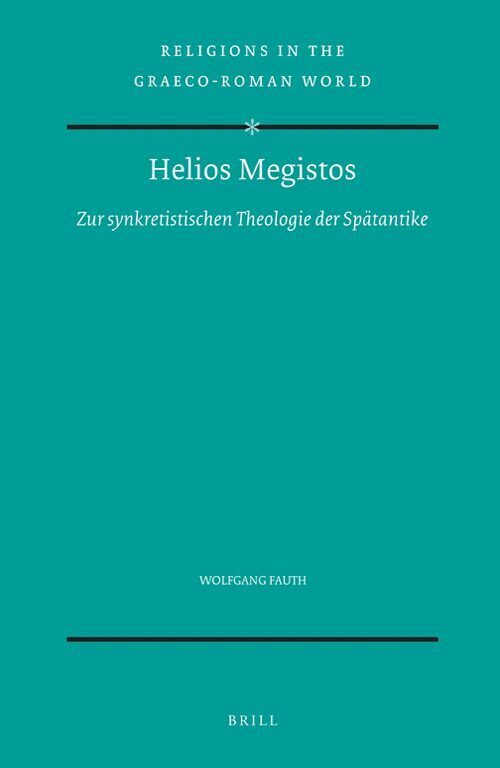
Del 125 - Religions in the Graeco-Roman World
Helios Megistos
Zur synkretistischen Theologie der Spätantike
Inbunden, Tyska, 1995
4 121 kr
Skickas inom 3-6 vardagar
Helios Megistos deals with conceptions of the Greek sun-god Helios in some selected works of late antique literature. The syncretistic picture is characterized by the heterogenous contours and polyvalent functions that were assigned to the god.The main part of the book presents Helios in the Orphic hymns, in the Greek-Egyptian Magical Papyri, in Neoplatonic philosophy and in the Dionysiac epic of Nonnos. The introduction gives a summary of the importance attached to Helios in the older Greek literary tradition, and the appendix contains a sketch of the roles attributed to Ancient Near Eastern sun-deities. Both sections shed light on the conditions that gave rise to the phenomenon of late antique sun theology.These texts, analysed for the first time from the point of view of that sun theology, rather than on the basis only of cultic or political data, extend and enrich our picture of a post-Christian sun religion that reflects strong classical and oriental influences.