Wolfgang Sproig – författare
Visar alla böcker från författaren Wolfgang Sproig. Handla med fri frakt och snabb leverans.
4 produkter
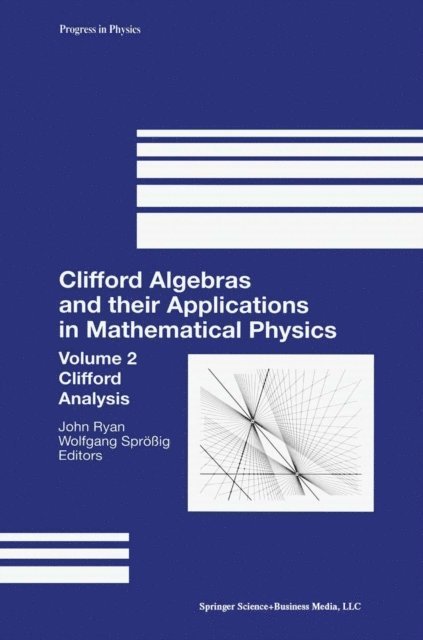
Clifford Algebras and their Applications in Mathematical Physics
Volume 2: Clifford Analysis
E-bok, 2012
734 kr
Lägg i varukorg
Real Quaternionic Calculus Handbook
Av Wolfgang Sproig, Svetlin Georgiev m. fl.
E-bok, 2014
897 kr
Lägg i varukorg
Real quaternion analysis is a multi-faceted subject. Created to describe phenomena in special relativity, electrodynamics, spin etc., it has developed into a body of material that interacts with many branches of mathematics, such as complex analysis, harmonic analysis, differential geometry, and …
Application of Holomorphic Functions in Two and Higher Dimensions
Av Wolfgang Sproig, Klaus Habetha m. fl.
E-bok, 2016
1622 kr
Lägg i varukorg
This book presents applications of hypercomplex analysis to boundary value and initial-boundary value problems from various areas of mathematical physics. Given that quaternion and Clifford analysis offer natural and intelligent ways to enter into higher dimensions, it starts with quaternion and …
Holomorphic Functions in the Plane and n-dimensional Space
Av Wolfgang Sproig, Klaus Habetha m. fl.
E-bok, 2007
710 kr
Lägg i varukorg
Complex analysis nowadays has higher-dimensional analoga: the algebra of complex numbers is replaced then by the non-commutative algebra of real quaternions or by Clifford algebras. During the last 30 years the so-called quaternionic and Clifford or hypercomplex analysis successfully developed to a …