W.S. Hall – författare
Visar alla böcker från författaren W.S. Hall. Handla med fri frakt och snabb leverans.
6 produkter
6 produkter
E-bok
PDF, Engelska, 20072 049 kr
Läs direkt efter köp
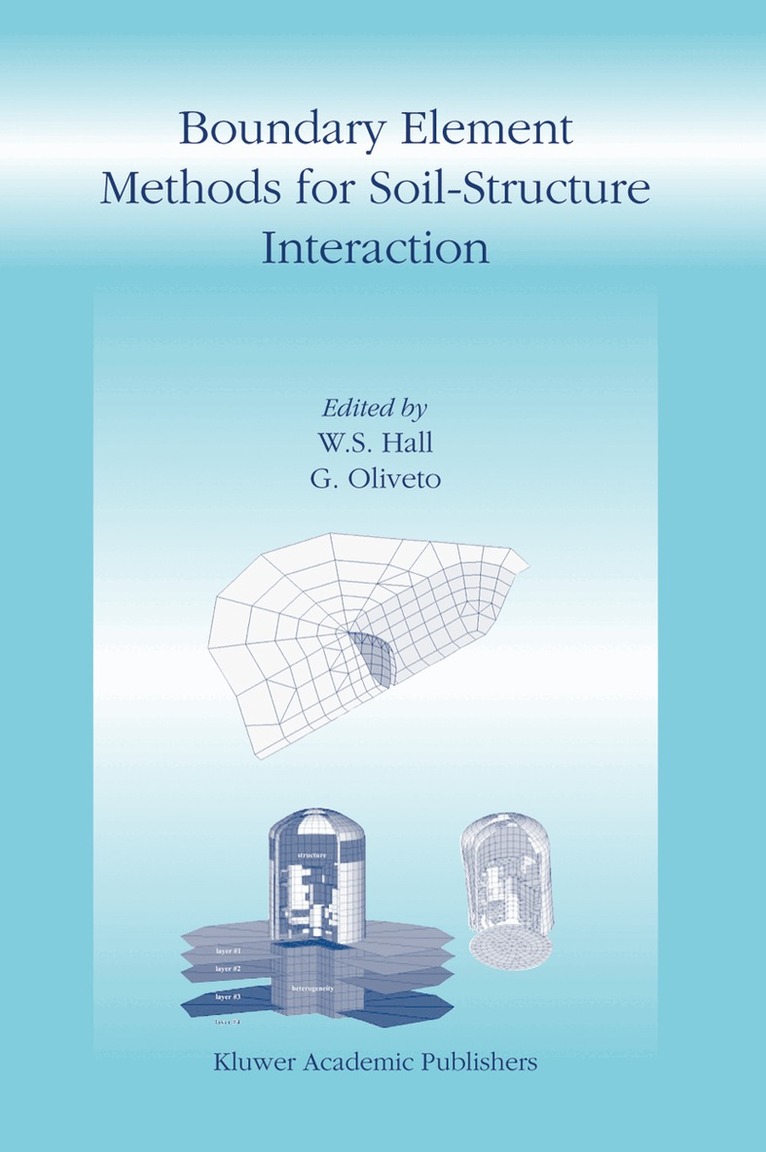
W S HALL School of Computing and Mathematics, University of Teesside, Middlesbrough, TS1 3BA UK G OLIVETO Division of Structural Engineering, Department of Civil and Environmental Engineering, University of Catania, Viale A. Doria 6, 95125 Catania, Italy Soil-Structure Interaction is a challenging multidisciplinary subject which covers several areas of Civil Engineering. Virtually every construction is connected to the ground and the interaction between the artefact and the foundation medium may affect considerably both the superstructure and the foundation soil. The Soil-Structure Interaction problem has become an important feature of Structural Engineering with the advent of massive constructions on soft soils such as nuclear power plants, concrete and earth dams. Buildings, bridges, tunnels and underground structures may also require particular attention to be given to the problems of Soil-Structure Interaction. Dynamic Soil-Structure Interaction is prominent in Earthquake Engineering problems. The complexity of the problem, due also to its multidisciplinary nature and to the fact of having to consider bounded and unbounded media of different mechanical characteristics, requires a numerical treatment for any application of engineering significance. The Boundary Element Method appears to be well suited to solve problems of Soil- Structure Interaction through its ability to discretize only the boundaries of complex and often unbounded geometries. Non-linear problems which often arise in Soil-Structure Interaction may also be treated advantageously by a judicious mix of Boundary and Finite Element discretizations.
Inbunden, Engelska, 1993
2 158 kr
Skickas inom 10-15 vardagar
The Boundary Element Method is a simple, efficient and cost effective computational technique which provides numerical solutions - for objects of any shap- for a wide range of scientific and engineering problems. In dealing with the development of the mathematics of the Boundary Element Method the aim has been at every stage, only to present new material when sufficient experience and practice of simpler material has been gained. Since the usual background of many readers will be of differential equations, the connection of differential equations with integral equations is explained in Chapter 1, together with analytical and numerical methods of solution. This information on integral equations provides a base for the work of subsequent chapters. The mathematical formulation of boundary integral equations for potential problems - derived from the more familiar Laplace partial differential equation which governs many important physical problems - is set out in Chapter 2. It should be noted here that this initial formulation of the boundary integral equations reduces the dimensionality of the problem. In the key Chapter 3, the essentials of the Boundary Element Method are presented. This first presentation of the Boundary Element Method is in its simplest and most approachable form - two dimensional, with the shape of the boundary approximated by straight lines and the functions approximated by constants over each of the straight lines.
Inbunden, Engelska, 2003
1 620 kr
Skickas inom 10-15 vardagar
W S HALL School of Computing and Mathematics, University of Teesside, Middlesbrough, TS1 3BA UK G OLIVETO Division of Structural Engineering, Department of Civil and Environmental Engineering, University of Catania, Viale A. Doria 6, 95125 Catania, Italy Soil-Structure Interaction is a challenging multidisciplinary subject which covers several areas of Civil Engineering. Virtually every construction is connected to the ground and the interaction between the artefact and the foundation medium may affect considerably both the superstructure and the foundation soil. The Soil-Structure Interaction problem has become an important feature of Structural Engineering with the advent of massive constructions on soft soils such as nuclear power plants, concrete and earth dams. Buildings, bridges, tunnels and underground structures may also require particular attention to be given to the problems of Soil-Structure Interaction. Dynamic Soil-Structure Interaction is prominent in Earthquake Engineering problems. The complexity of the problem, due also to its multidisciplinary nature and to the fact of having to consider bounded and unbounded media of different mechanical characteristics, requires a numerical treatment for any application of engineering significance. The Boundary Element Method appears to be well suited to solve problems of Soil- Structure Interaction through its ability to discretize only the boundaries of complex and often unbounded geometries. Non-linear problems which often arise in Soil-Structure Interaction may also be treated advantageously by a judicious mix of Boundary and Finite Element discretizations.
Häftad, Engelska, 2010
1 616 kr
Skickas inom 10-15 vardagar
W S HALL School of Computing and Mathematics, University of Teesside, Middlesbrough, TS1 3BA UK G OLIVETO Division of Structural Engineering, Department of Civil and Environmental Engineering, University of Catania, Viale A. Doria 6, 95125 Catania, Italy Soil-Structure Interaction is a challenging multidisciplinary subject which covers several areas of Civil Engineering. Virtually every construction is connected to the ground and the interaction between the artefact and the foundation medium may affect considerably both the superstructure and the foundation soil. The Soil-Structure Interaction problem has become an important feature of Structural Engineering with the advent of massive constructions on soft soils such as nuclear power plants, concrete and earth dams. Buildings, bridges, tunnels and underground structures may also require particular attention to be given to the problems of Soil-Structure Interaction. Dynamic Soil-Structure Interaction is prominent in Earthquake Engineering problems. The complexity of the problem, due also to its multidisciplinary nature and to the fact of having to consider bounded and unbounded media of different mechanical characteristics, requires a numerical treatment for any application of engineering significance. The Boundary Element Method appears to be well suited to solve problems of Soil- Structure Interaction through its ability to discretize only the boundaries of complex and often unbounded geometries. Non-linear problems which often arise in Soil-Structure Interaction may also be treated advantageously by a judicious mix of Boundary and Finite Element discretizations.
Häftad, Engelska, 2012
2 152 kr
Skickas inom 10-15 vardagar
The Boundary Element Method is a simple, efficient and cost effective computational technique which provides numerical solutions - for objects of any shap- for a wide range of scientific and engineering problems. In dealing with the development of the mathematics of the Boundary Element Method the aim has been at every stage, only to present new material when sufficient experience and practice of simpler material has been gained. Since the usual background of many readers will be of differential equations, the connection of differential equations with integral equations is explained in Chapter 1, together with analytical and numerical methods of solution. This information on integral equations provides a base for the work of subsequent chapters. The mathematical formulation of boundary integral equations for potential problems - derived from the more familiar Laplace partial differential equation which governs many important physical problems - is set out in Chapter 2. It should be noted here that this initial formulation of the boundary integral equations reduces the dimensionality of the problem. In the key Chapter 3, the essentials of the Boundary Element Method are presented. This first presentation of the Boundary Element Method is in its simplest and most approachable form - two dimensional, with the shape of the boundary approximated by straight lines and the functions approximated by constants over each of the straight lines.
E-bok
PDF, Engelska, 20122 840 kr
Läs direkt efter köp
The Boundary Element Method is a simple, efficient and cost effective computational technique which provides numerical solutions - for objects of any shap- for a wide range of scientific and engineering problems. In dealing with the development of the mathematics of the Boundary Element Method the aim has been at every stage, only to present new material when sufficient experience and practice of simpler material has been gained. Since the usual background of many readers will be of differential equations, the connection of differential equations with integral equations is explained in Chapter 1, together with analytical and numerical methods of solution. This information on integral equations provides a base for the work of subsequent chapters. The mathematical formulation of boundary integral equations for potential problems - derived from the more familiar Laplace partial differential equation which governs many important physical problems - is set out in Chapter 2. It should be noted here that this initial formulation of the boundary integral equations reduces the dimensionality of the problem. In the key Chapter 3, the essentials of the Boundary Element Method are presented. This first presentation of the Boundary Element Method is in its simplest and most approachable form - two dimensional, with the shape of the boundary approximated by straight lines and the functions approximated by constants over each of the straight lines.