Xiangmin Xu – författare
1 290 kr
Skickas inom 10-15 vardagar
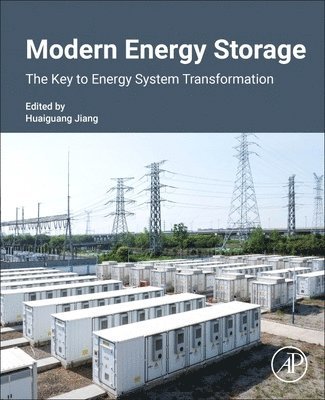
Modern Energy Storage - The Key to Energy System Transformation provides a comprehensive overview of energy storage technologies.The book lays out essential principles, operating modes, classification methods, and safety considerations, highlighting their crucial function in balancing renewable energy variability and enhancing grid resilience. It then details mechanical and thermal storage, including pumped hydro, compressed air, flywheels, and diverse thermal approaches, and describes how engineering innovations strengthen system flexibility.The book covers electrochemical storage, ranging from early chemistries to lithium-ion, sodium-ion, and redox flow systems. Material design, interfacial optimization, and system-level strategies are examined to improve energy density, safety, and long-term performance. Hydrogen storage is introduced as a key component of low-carbon pathways, covering production routes, storage media, fuel-cell utilization, and infrastructure challenges.The book also discusses applications across modern power networks and transportation, demonstrating the role of storage in renewable integration, grid stability, intelligent mobility, and system efficiency. Building on these applications, it examines emerging aqueous-ion battery technologies and future parallel systems, which enable coordinated operation across cyber-physical-social architectures, advanced large language-model, multi-energy networks, and blockchain-enabled services. Ultimately, this guide serves as a valuable reference for students, researchers, engineers, and innovators committed to advancing next-generation energy storage.
Designed to be a suitable text for Energy, Energy Storage, and Power System-related courses for post-graduate students. Provides an integrated understanding of mechanical, thermal, electrochemical, hydrogen-based, and emerging intelligent storage systems.Bridges theory and real-world practice through extensive case studies, technology comparisons, and system-level analyses to support research, engineering design, and policy decisions.