Xiangyun Zhou - Böcker
Visar alla böcker från författaren Xiangyun Zhou. Handla med fri frakt och snabb leverans.
3 produkter
3 produkter
1 551 kr
Skickas inom 10-15 vardagar
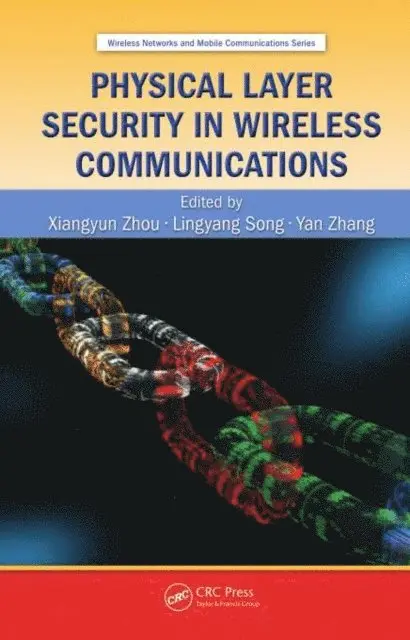
Physical layer security has recently become an emerging technique to complement and significantly improve the communication security of wireless networks. Compared to cryptographic approaches, physical layer security is a fundamentally different paradigm where secrecy is achieved by exploiting the physical layer properties of the communication system, such as thermal noise, interference, and the time-varying nature of fading channels.Written by pioneering researchers, Physical Layer Security in Wireless Communications supplies a systematic overview of the basic concepts, recent advancements, and open issues in providing communication security at the physical layer. It introduces the key concepts, design issues, and solutions to physical layer security in single-user and multi-user communication systems, as well as large-scale wireless networks.The book starts with a brief introduction to physical layer security. The rest of the book is organized into four parts based on the different approaches used for the design and analysis of physical layer security techniques: Information Theoretic Approaches: introduces capacity-achieving methods and coding schemes for secure communication, as well as secret key generation and agreement over wireless channelsSignal Processing Approaches: covers recent progress in applying signal processing techniques to design physical layer security enhancementsGame Theoretic Approaches: discusses the applications of game theory to analyze and design wireless networks with physical layer security considerationsGraph Theoretic Approaches: presents the use of tools from graph theory and stochastic geometry to analyze and design large-scale wireless networks with physical layer security constraintsPresenting high-level discussions along with specific examples, illustrations, and references to conference and journal articles, this is an ideal reference for postgraduate students, researchers, and engineers that need to obtain a macro-level understanding of physical layer security and its role in future wireless communication systems.
1 486 kr
Skickas inom 5-8 vardagar
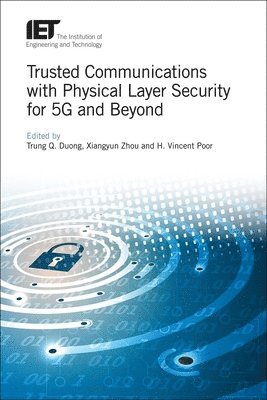
Physical layer security is emerging as a promising means of ensuring secrecy in wireless communications. The key idea is to exploit the characteristics of wireless channels such as fading or noise to transmit a message from the source to the intended receiver while keeping this message confidential from eavesdroppers.Topics covered in Trusted Communications with Physical Layer Security for 5G and Beyond include secrecy metrics for physical layer security over fading channels; trusted wireless communications with spatial multiplexing; directional modulation enabled physical layer wireless security; secure waveform for 5G systems; confidential and energy efficient communications using physical layer security; secure data networks with channel uncertainty; antenna selection strategies for wiretap channels; physical layer security for massive MIMO systems, millimeter wave cellular networks, non-orthogonal multiple access, multiuser relay networks, cognitive radio networks, MIMOME-OFDM systems; wirelessly powered communication systems and D2D-enabled cellular networks; and security solutions and applications at the physical layer, including case studies of secret key generation and secrecy coding in communication nodes and terminals.
1 872 kr
Skickas inom 3-6 vardagar
6G networks are expected to provide one-microsecond latency communication with a billion devices competing for resources 1000 times faster than current standards. Increases in network speed, heterogeneity, virtualization, better radio requirements and adaptive communications will place new demands on physical layer security. Moreover, IoT, blockchain, and artificial intelligence are enabling technologies that require rapid data rates, raising a significant burden on the network's physical layer, requiring that security must be attained at a fast pace, and that the network must be resilient to accommodate sudden changes to the configurations or the load.Physical layer (PHY) security solutions are needed that have the capacity to handle the new demands of 6G networks, whilst protecting those networks against risk factors such as interference, data spoofing, replay attacks, side-channel attacks, jamming, traffic analysis, and cyber-vandalism attacks. This comprehensive book addresses the PHY security challenges and proposes efficient and resilient physical layer security solutions for beyond 5G networks leading to 6G. Several topics have emerged that rely on PHY security in solving real-world network challenges such as ultra-dense networks, adaptive communication, distributed technology, and artificial intelligence.Physical Layer Security for 6G Networks helps readers understand the expectations of 6G's physical layer security in supporting pervasive and integrated communication networks, AI convergence and utility, and develop better sensing solutions, which go beyond cognitive radio, device-to-device or mm-wave communications.