Xiaobo Hu - Böcker
Visar alla böcker från författaren Xiaobo Hu. Handla med fri frakt och snabb leverans.
3 produkter
3 produkter
1 216 kr
Skickas inom 10-15 vardagar
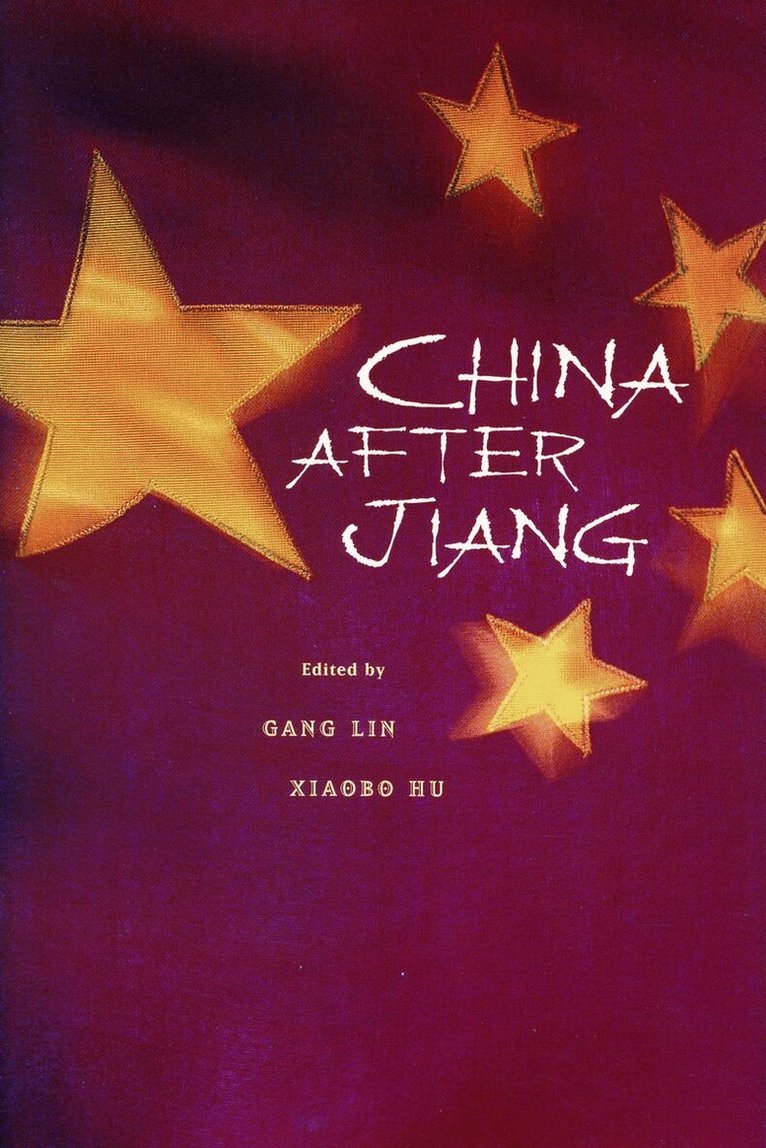
Because power in China is so concentrated at the top, changes in leadership usually mean changes in many other domains as well. In this study, based on documents released around the time Jiang Zemin left office in November 2002 and interviews with Chinese officials, the authors concentrate on more fundamental institutional changes, both those under way well before Jiang stepped down and those still urgently needed if China is to remain stable and prosperous in the 21st century. Topics addressed include the role of ideology, the issue of legitimacy, rule-making and -breaking, Party governance, the use of state power for economic ends, state-society relations, and decision making in foreign policy.The authors ask how changing concepts of property rights have influenced China's development, and whether present and future leaders will be able to maintain the Party's monopoly on political power by partially democratizing the party itself. They conclude that strengthened institutions are critical to China's future well-being.Contributors include Gang Lin, Xiaobo Hu, David Bachman, Lowell Dittmer, and Richard Madsen.
291 kr
Skickas inom 7-10 vardagar
Because power in China is so concentrated at the top, changes in leadership usually mean changes in many other domains as well. In this study, based on documents released around the time Jiang Zemin left office in November 2002 and interviews with Chinese officials, the authors concentrate on more fundamental institutional changes, both those under way well before Jiang stepped down and those still urgently needed if China is to remain stable and prosperous in the 21st century. Topics addressed include the role of ideology, the issue of legitimacy, rule-making and -breaking, Party governance, the use of state power for economic ends, state-society relations, and decision making in foreign policy.The authors ask how changing concepts of property rights have influenced China's development, and whether present and future leaders will be able to maintain the Party's monopoly on political power by partially democratizing the party itself. They conclude that strengthened institutions are critical to China's future well-being.Contributors include Gang Lin, Xiaobo Hu, David Bachman, Lowell Dittmer, and Richard Madsen.
Del 6 - East Asian Institute Contemporary China Series
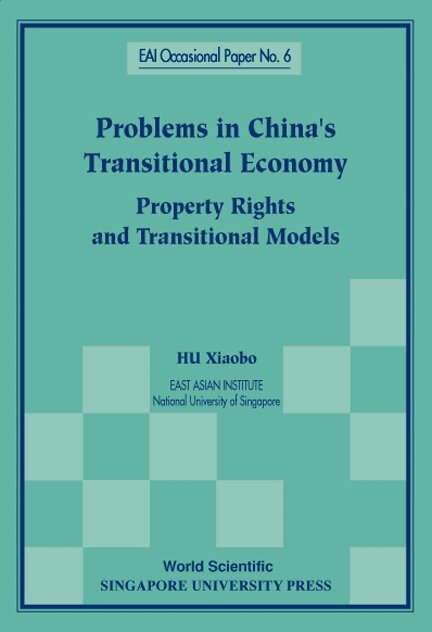
Problems In China's Transitional Economy: Property Rights And Transitional Models
Häftad, Engelska, 1998
308 kr
Tillfälligt slut
1997 saw a major reform in China which signaled the move away from its traditional economy, when Jiang Zemin called off the debate on public versus private ownership. However, none of the existing theories can fully explain the transformation of the property rights system during the post-Mao reforms. The first part of this volume will reconceptualize the property rights reform in post-Mao China to provide a political economy explanation of why the transformation of property rights in China appears piece-meal.The success of the post-Mao reforms can be attributed to China's ability to integrate the experience of a variety of transition models. The second part of the paper investigates two distinct transition models, in light of the lessons from current Vietnamese reform. It explores the dynamics of political actions and analyzes the political reasons for economic reform.