Xin M. Tu - Böcker
Visar alla böcker från författaren Xin M. Tu. Handla med fri frakt och snabb leverans.
2 produkter
2 produkter
1 177 kr
Skickas inom 10-15 vardagar
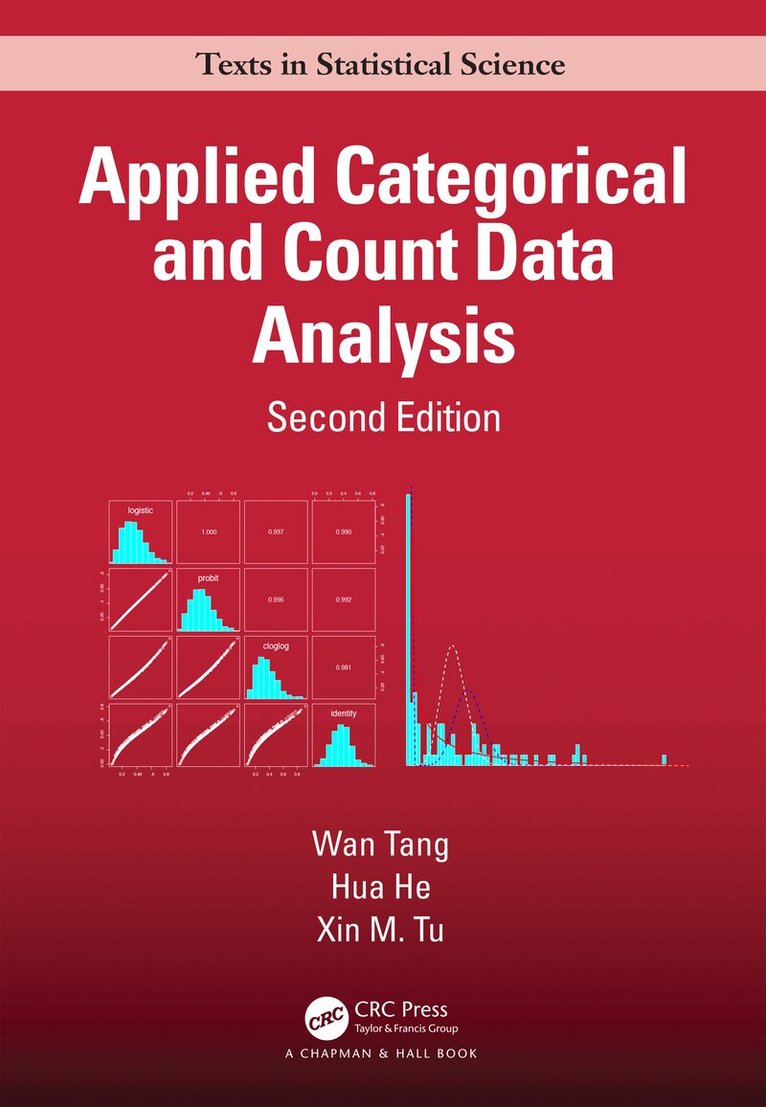
Developed from the authors’ graduate-level biostatistics course, Applied Categorical and Count Data Analysis, Second Edition explains how to perform the statistical analysis of discrete data, including categorical and count outcomes. The authors have been teaching categorical data analysis courses at the University of Rochester and Tulane University for more than a decade. This book embodies their decade-long experience and insight in teaching and applying statistical models for categorical and count data. The authors describe the basic ideas underlying each concept, model, and approach to give readers a good grasp of the fundamentals of the methodology without relying on rigorous mathematical arguments.The second edition is a major revision of the first, adding much new material. It covers classic concepts and popular topics, such as contingency tables, logistic regression models, and Poisson regression models, along with modern areas that include models for zero-modified count outcomes, parametric and semiparametric longitudinal data analysis, reliability analysis, and methods for dealing with missing values. As in the first edition, R, SAS, SPSS, and Stata programming codes are provided for all the examples, enabling readers to immediately experiment with the data in the examples and even adapt or extend the codes to fit data from their own studies.Designed for a one-semester course for graduate and senior undergraduate students in biostatistics, this self-contained text is also suitable as a self-learning guide for biomedical and psychosocial researchers. It will help readers analyze data with discrete variables in a wide range of biomedical and psychosocial research fields.Features:Describes the basic ideas underlying each concept and modelIncludes R, SAS, SPSS and Stata programming codes for all the examplesFeatures significantly expanded Chapters 4, 5, and 8 (Chapters 4-6, and 9 in the second editionExpands discussion for subtle issues in longitudinal and clustered data analysis such as time varying covariates and comparison of generalized linear mixed-effect models with GEE
Del 714 - Wiley Series in Probability and Statistics
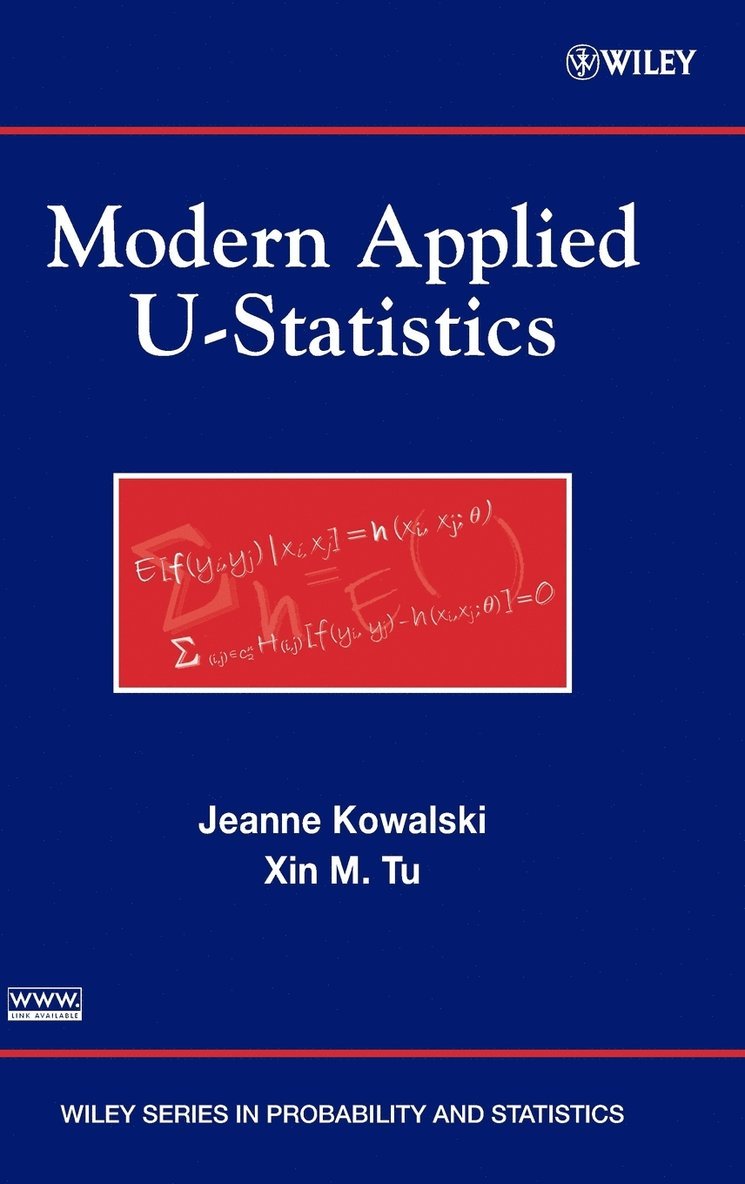
Modern Applied U-Statistics
Inbunden, Engelska, 2008
1 709 kr
Skickas inom 7-10 vardagar
A timely and applied approach to the newly discovered methods and applications of U-statistics Built on years of collaborative research and academic experience, Modern Applied U-Statistics successfully presents a thorough introduction to the theory of U-statistics using in-depth examples and applications that address contemporary areas of study including biomedical and psychosocial research. Utilizing a "learn by example" approach, this book provides an accessible, yet in-depth, treatment of U-statistics, as well as addresses key concepts in asymptotic theory by integrating translational and cross-disciplinary research. The authors begin with an introduction of the essential and theoretical foundations of U-statistics such as the notion of convergence in probability and distribution, basic convergence results, stochastic Os, inference theory, generalized estimating equations, as well as the definition and asymptotic properties of U-statistics. With an emphasis on nonparametric applications when and where applicable, the authors then build upon this established foundation in order to equip readers with the knowledge needed to understand the modern-day extensions of U-statistics that are explored in subsequent chapters. Additional topical coverage includes: Longitudinal data modeling with missing data Parametric and distribution-free mixed-effect and structural equation models A new multi-response based regression framework for non-parametric statistics such as the product moment correlation, Kendall's tau, and Mann-Whitney-Wilcoxon rank tests A new class of U-statistic-based estimating equations (UBEE) for dependent responses Motivating examples, in-depth illustrations of statistical and model-building concepts, and an extensive discussion of longitudinal study designs strengthen the real-world utility and comprehension of this book. An accompanying Web site features SAS? and S-Plus? program codes, software applications, and additional study data. Modern Applied U-Statistics accommodates second- and third-year students of biostatistics at the graduate level and also serves as an excellent self-study for practitioners in the fields of bioinformatics and psychosocial research.