Xingshe Zhou – författare
Visar alla böcker från författaren Xingshe Zhou. Handla med fri frakt och snabb leverans.
6 produkter
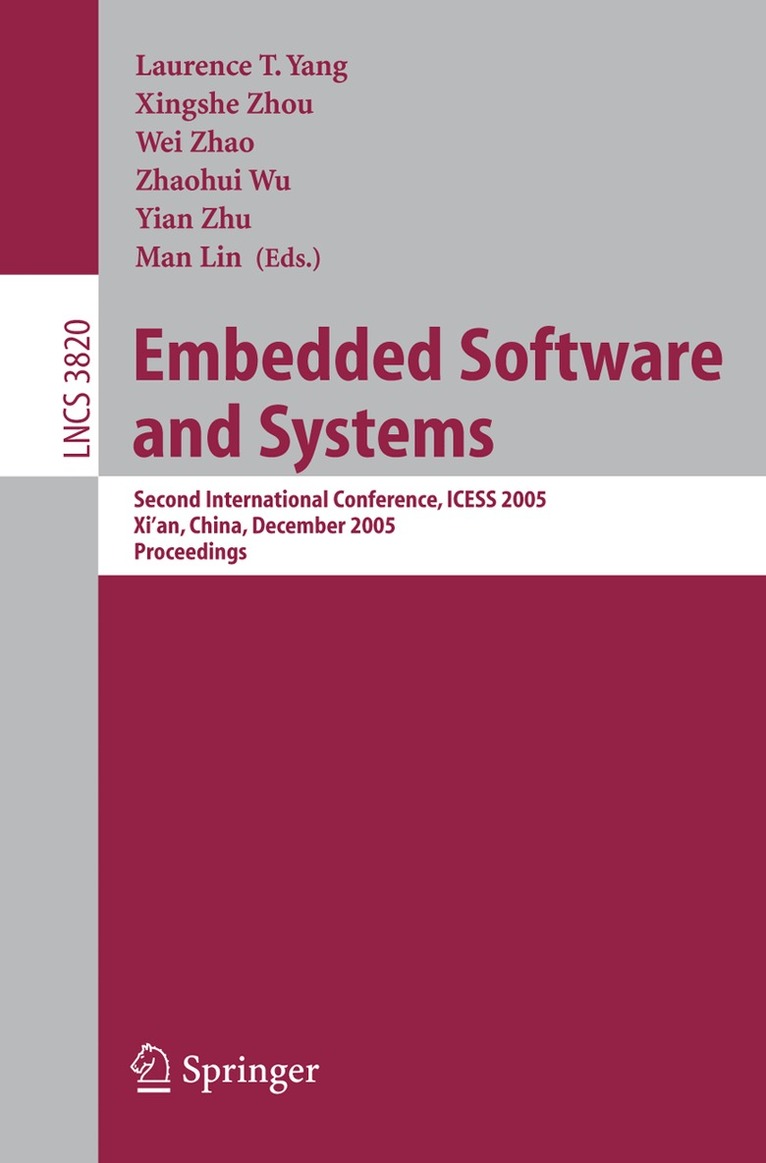
Embedded Software and Systems
Second International Conference, ICESS 2005, Xi'an, China, December 16-18, 2005, Proceedings
Av Laurence T. Yang, Xingshe Zhou m. fl.
Häftad, 2005
1128 kr
Lägg i varukorg
Welcome to the proceedings of the 2005 International Conference on Emb- ded Software and Systems (ICESS 2005) held in Xian, China, December 16-18, 2005. With the advent of VLSI system level integration and system-on-chip, the center of gravity of the computer industry is now moving from personal c- …
Embedded Software and Systems
Second International Conference, ICESS 2005, Xi''an, China, December 16-18, 2005, Proceedings
E-bok, 2005
1502 kr
Lägg i varukorg
Welcome to the proceedings of the 2005 International Conference on Emb- ded Software and Systems (ICESS 2005) held in Xian, China, December 16-18, 2005. With the advent of VLSI system level integration and system-on-chip, the center of gravity of the computer industry is now moving from personal c- …
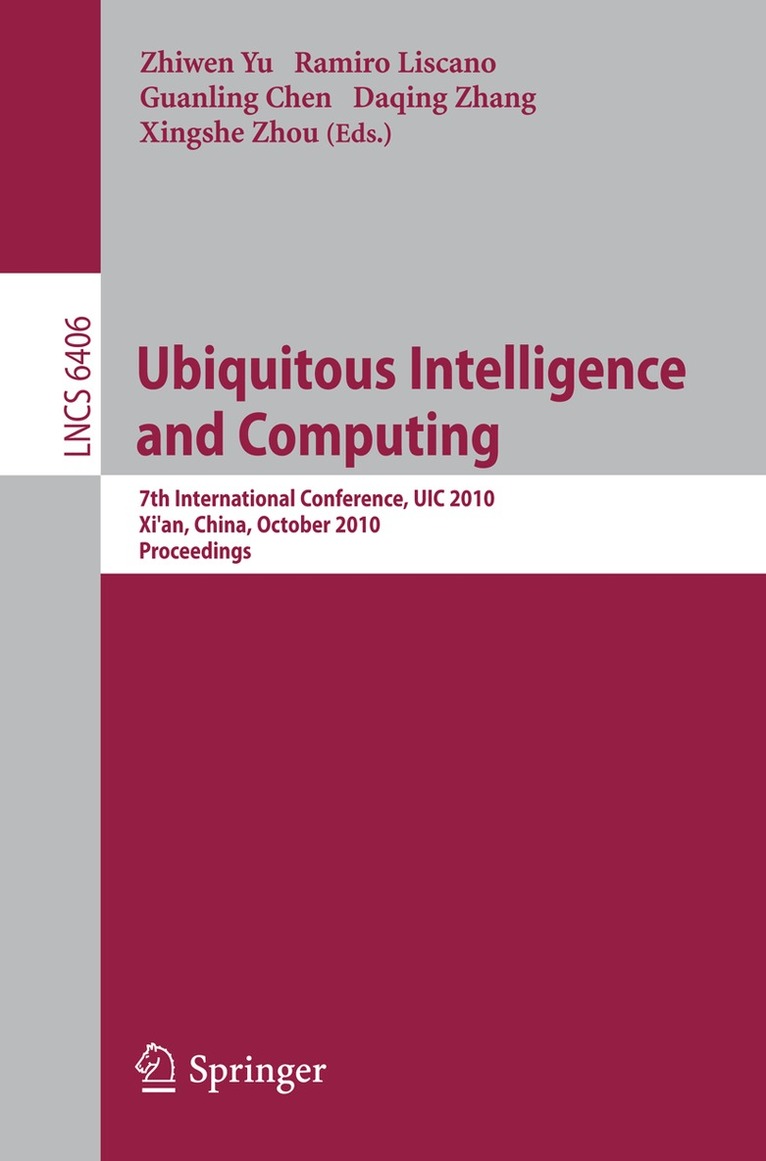
Ubiquitous Intelligence and Computing
7th International Conference, UIC 2010, Xi'an, China, October 26-29, 2010, Proceedings
Av Zhiwen Yu, Ramiro Liscano m. fl.
Häftad, 2010
1128 kr
Lägg i varukorg
Ubiquitous sensors, devices, networks and information are paving the way toward a smart world in which computational intelligence is distributed throughout the physical environment to provide reliable and relevant services to people. This ubiquitous intelligence will change the computing landscape …
Ubiquitous Intelligence and Computing
7th International Conference, UIC 2010, Xi''an, China, October 26-29, 2010, Proceedings
Av Xingshe Zhou, Daqing Zhang m. fl.
E-bok, 2010
1459 kr
Lägg i varukorg
Ubiquitous sensors, devices, networks and information are paving the way toward a smart world in which computational intelligence is distributed throughout the physical environment to provide reliable and relevant services to people. This ubiquitous intelligence will change the computing landscape …
Autonomic and Trusted Computing
7th International Conference, ATC 2010, Xi'an, China, October 26-29, 2010, Proceedings
Av Bing Xie, Juergen Branke m. fl.
Häftad, 2010
567 kr
Lägg i varukorg
Computing systems including hardware, software, communication, and networks are becoming increasingly large and heterogeneous. In short, they have become - creasingly complex. Such complexity is getting even more critical with the ubiquitous permeation of embedded devices and other pervasive …
Autonomic and Trusted Computing
7th International Conference, ATC 2010, Xi''an, China, October 26-29, 2010, Proceedings
Av Xingshe Zhou, Daqing Zhang m. fl.
E-bok, 2010
755 kr
Lägg i varukorg
Computing systems including hardware, software, communication, and networks are becoming increasingly large and heterogeneous. In short, they have become - creasingly complex. Such complexity is getting even more critical with the ubiquitous permeation of embedded devices and other pervasive …