Y. F. Li - Böcker
Visar alla böcker från författaren Y. F. Li. Handla med fri frakt och snabb leverans.
4 produkter
4 produkter
1 577 kr
Skickas inom 10-15 vardagar
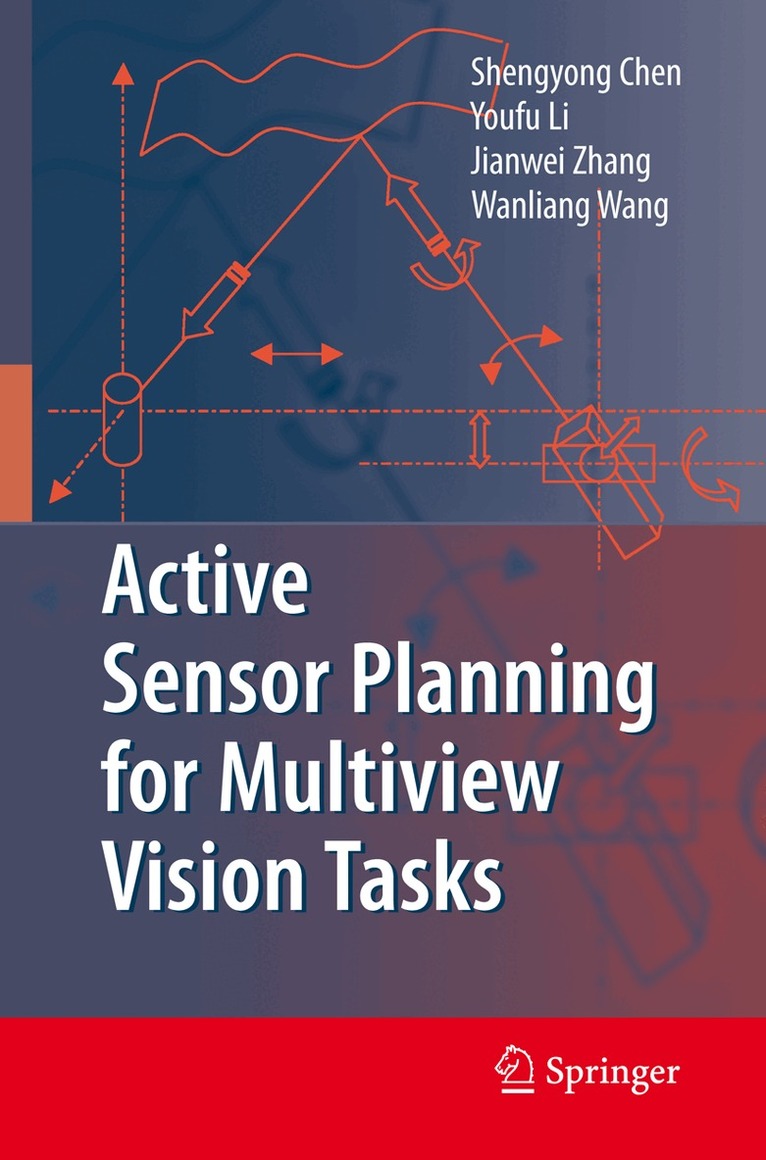
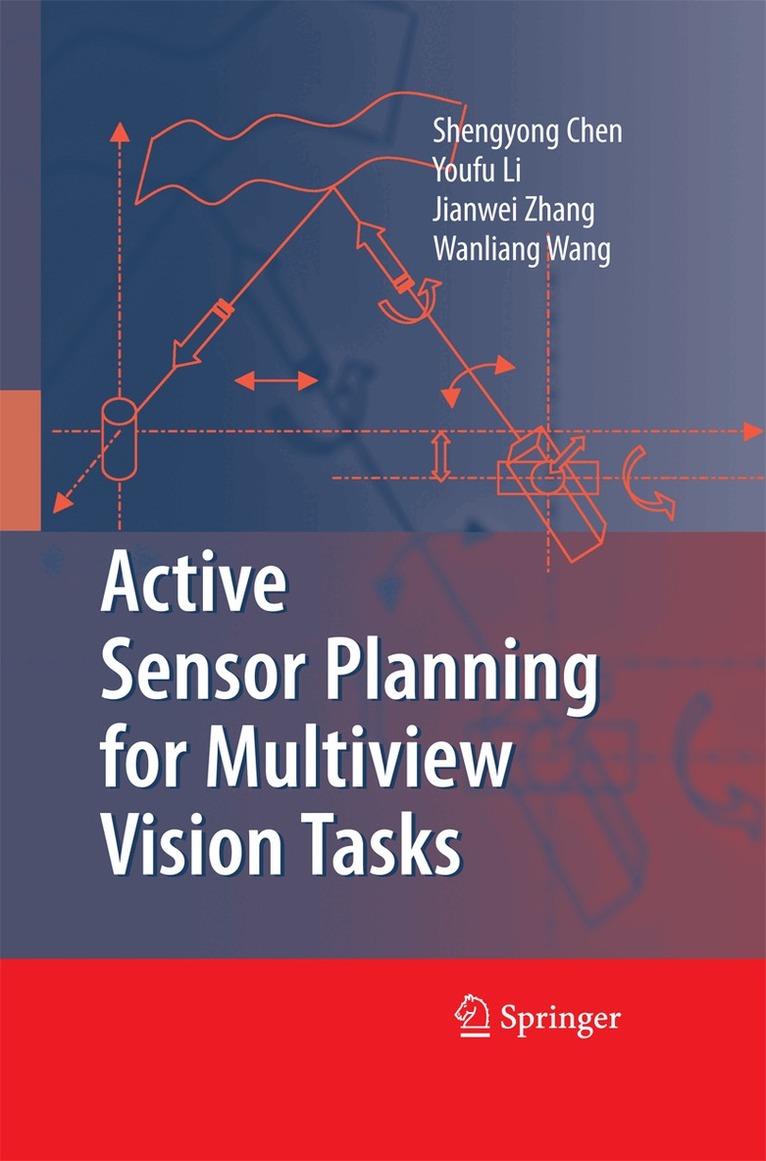
An active robot system can change its visual parameters in an intentional manner and perform its sensing actions purposefully. A general vision task thus can be performed in an efficient way by means of strategic control of the perception process. The controllable processes include 3D active sensing, sensor configuration and recalibration, automatic sensor placement, and 3D sensing. This book explores these important issues in studying for active visual perception.Vision sensors have limited fields of views and can only "see" a portion of a scene from a single viewpoint. To make the entire object visible, the sensor has to be moved from one place to another around the object to observe all features of interest. The sensor planning presented in this book describes an effective strategy to generate a sequence of viewing poses and sensor settings for optimally completing a perception task. Several methods are proposed to solve the problems in both model-based and nonmodel-based vision tasks. For model-based applications, the method involves determination of the optimal sensor placements and a shortest path through these viewpoints for automatic generation of a perception plan. A topology of viewpoints is achieved by a genetic algorithm in which a min-max criterion is used for evaluation. A shortest path is also determined by graph algorithms. For nonmodel-based applications, the method involves determination of the best next view and sensor settings. The trend surface is proposed as the cue to predict the unknown portion of an object or environment.The 11 chapters in Active Vision Planning draw on recent work in robot vision over ten years, particularly in the use of new concepts of active sensing, reconfiguration, recalibration, sensor model, sensing constraints, sensing evaluation, viewpoint decision, sensor placement graph, model based planning, path planning, planning for robot in unknown environment, dynamic 3D construction,surface prediction, etc. Implementation examples are also provided with theoretical methods for testing in a real robot system. With these optimal sensor planning strategies, this book will give the robot vision system the adaptability needed in many practical applications.
1 577 kr
Skickas inom 10-15 vardagar
An active robot system can change its visual parameters in an intentional manner and perform its sensing actions purposefully. A general vision task thus can be performed in an efficient way by means of strategic control of the perception process. The controllable processes include 3D active sensing, sensor configuration and recalibration, automatic sensor placement, and 3D sensing. This book explores these important issues in studying for active visual perception.Vision sensors have limited fields of views and can only "see" a portion of a scene from a single viewpoint. To make the entire object visible, the sensor has to be moved from one place to another around the object to observe all features of interest. The sensor planning presented in this book describes an effective strategy to generate a sequence of viewing poses and sensor settings for optimally completing a perception task. Several methods are proposed to solve the problems in both model-based and nonmodel-based vision tasks. For model-based applications, the method involves determination of the optimal sensor placements and a shortest path through these viewpoints for automatic generation of a perception plan. A topology of viewpoints is achieved by a genetic algorithm in which a min-max criterion is used for evaluation. A shortest path is also determined by graph algorithms. For nonmodel-based applications, the method involves determination of the best next view and sensor settings. The trend surface is proposed as the cue to predict the unknown portion of an object or environment.The 11 chapters in Active Vision Planning draw on recent work in robot vision over ten years, particularly in the use of new concepts of active sensing, reconfiguration, recalibration, sensor model, sensing constraints, sensing evaluation, viewpoint decision, sensor placement graph, model based planning, path planning, planning for robot in unknown environment, dynamic 3D construction,surface prediction, etc. Implementation examples are also provided with theoretical methods for testing in a real robot system. With these optimal sensor planning strategies, this book will give the robot vision system the adaptability needed in many practical applications.
Del 57 - Intelligent Systems, Control and Automation: Science and Engineering
Automatic Calibration and Reconstruction for Active Vision Systems
Inbunden, Engelska, 2012
1 064 kr
Skickas inom 10-15 vardagar
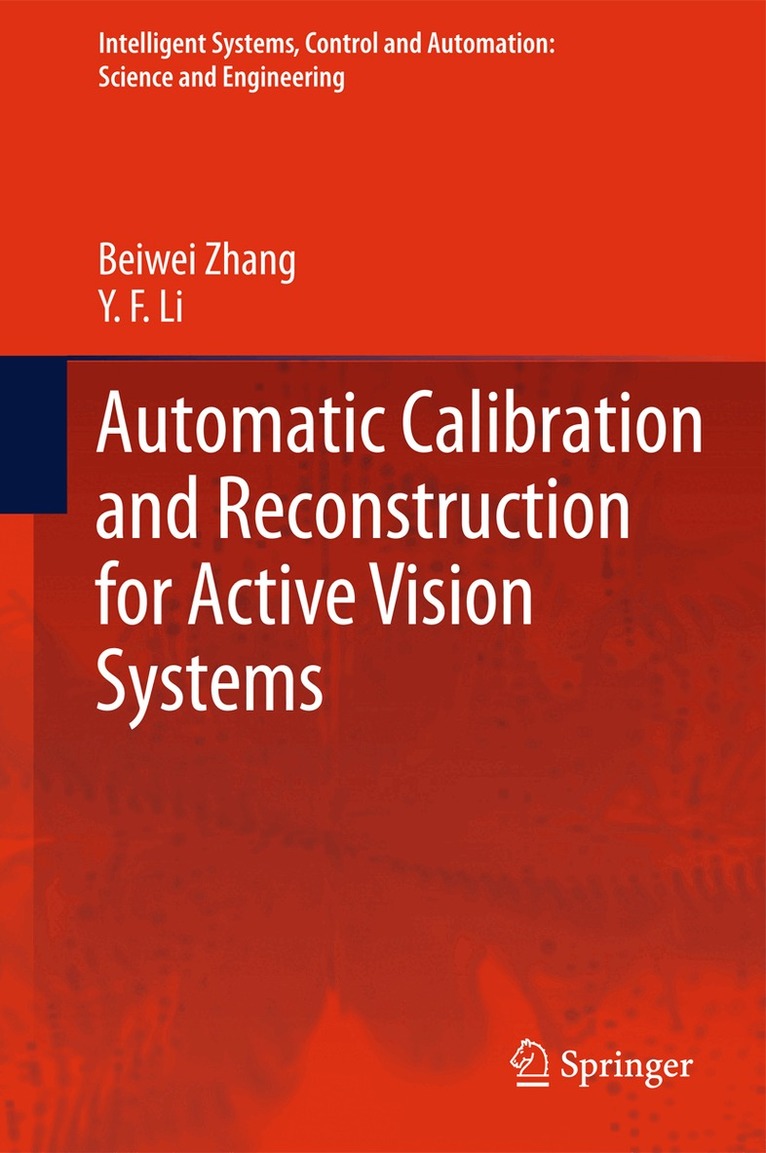
In this book, the design of two new planar patterns for camera calibration of intrinsic parameters is addressed and a line-based method for distortion correction is suggested. The dynamic calibration of structured light systems, which consist of a camera and a projector is also treated. Also, the 3D Euclidean reconstruction by using the image-to-world transformation is investigated. Lastly, linear calibration algorithms for the catadioptric camera are considered, and the homographic matrix and fundamental matrix are extensively studied. In these methods, analytic solutions are provided for the computational efficiency and redundancy in the data can be easily incorporated to improve reliability of the estimations. This volume will therefore prove valuable and practical tool for researchers and practioners working in image processing and computer vision and related subjects.
Del 57 - Intelligent Systems, Control and Automation: Science and Engineering
Automatic Calibration and Reconstruction for Active Vision Systems
Häftad, Engelska, 2014
1 064 kr
Skickas inom 10-15 vardagar
In this book, the design of two new planar patterns for camera calibration of intrinsic parameters is addressed and a line-based method for distortion correction is suggested. The dynamic calibration of structured light systems, which consist of a camera and a projector is also treated. Also, the 3D Euclidean reconstruction by using the image-to-world transformation is investigated. Lastly, linear calibration algorithms for the catadioptric camera are considered, and the homographic matrix and fundamental matrix are extensively studied. In these methods, analytic solutions are provided for the computational efficiency and redundancy in the data can be easily incorporated to improve reliability of the estimations. This volume will therefore prove valuable and practical tool for researchers and practioners working in image processing and computer vision and related subjects.