Yan-xia Lin – författare
Visar alla böcker från författaren . Handla med fri frakt och snabb leverans.
2 produkter
2 produkter
Inbunden, Engelska, 2000
1 265 kr
Skickas inom 5-8 vardagar
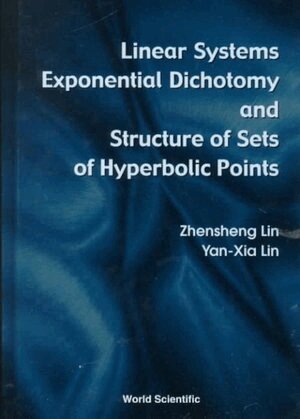
Historically, the theory of stability is based on linear differential systems, which are simple and important systems in ordinary differential equations. The research on differential equations and on the theory of stability will, to a certain extent, be influenced by the research on linear differential systems. For differential linear equation systems, there are still many historical open questions attracting mathematicians. This book deals with the theory of linear differential systems developed around the notion of exponential dichotomies. The first author advanced the theory of stability through his research in this field.Several new important results on linear differential systems are presented. They concern exponential dichotomy and the structure of the sets of hyperbolic points. The book has five chapters: Chapter 1 introduces some necessary classical results on the linear differential systems, and the following chapters discuss exponential dichotomy, spectra of almost periodic linear systems, the Floquet theory for quasi periodic linear systems and the structure of sets of hyperbolic points. This book is a very useful reference in the area of the stability theory of ordinary differential equations and the theory of dynamic systems.
Inbunden, Engelska, 2002
2 444 kr
Tillfälligt slut
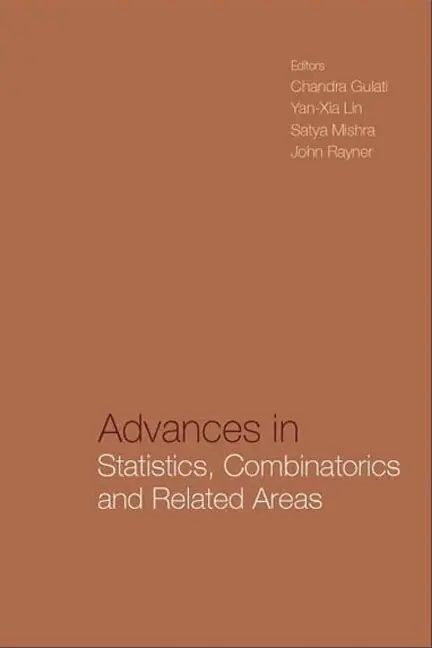
This book is a collection of selected refereed papers presented at the International Conference on Statistics, Combinatorics and Related Areas, and the Eighth International Conference of the Forum for Interdisciplinary Mathematics. It includes contributions from eminent statisticians such as Joe Gani, Clive Granger, Chris Heyde, R Nishii, C R Rao, P K Sen and Sue Wilson. By exploring and investigating deeper, these papers enlarge the reservoir in the represented areas of research, such as bioinformatics, estimating functions, financial statistics, generalized linear models, goodness of fit, image analysis, industrial data analysis, multivariate statistics, neural networks, quasi-likelihood, sample surveys, statistical inference, stochastic models, and time series.