
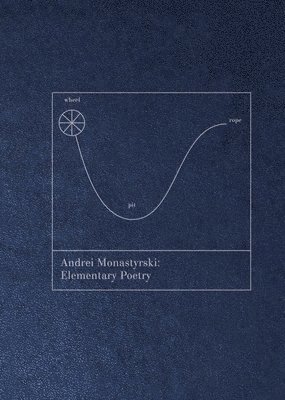
The early experimental work of one of the founders of Russian conceptualismRussian poet, author, artist and art theorist Andrei Monastyrski (born 1949) is, along with Ilya Kabakov, one of the founders of conceptualism in Russia, and a protagonist of Collective Actions, a group of artists who have organized participatory actions on the outskirts of Moscow since 1976. Though his poetry is less well known, poetry is where he began. After writing in the manner of the Russian modernists (who were newly available to Soviet readers during Khrushchev's thaw), Monastyrski's interest in John Cage and ideas about consciousness from Western and Eastern philosophical traditions led him to conduct experiments with sound, form and the creation of artistic situations involving constructed objects that required viewer engagement to complete. Elementary Poetry collects poems, books and action objects from the '70s and '80s, tracing a genealogy of the art action in poetry.
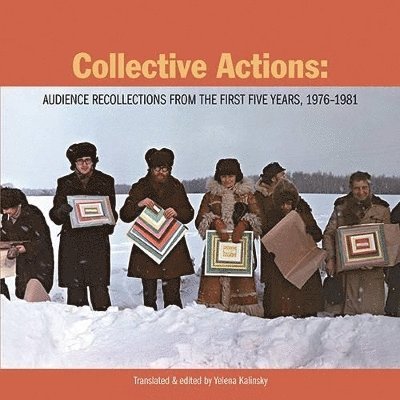
Active in Moscow since 1976, the Collective Actions group played a key role in the development of conceptual and performance art in the Soviet Union. Inspired by the work of John Cage, the organizers invited audiences to take part in minimal, outdoor actions in fields and forests on the edges of the city that explored the nature of the aesthetic event. These spatio-temporal events directed viewers’ attention to the pure contemplation of their own perceptions, and over time, the actions produced masses of documentary material. Collective Actions: Audience Recollections from the First Five Years, 1976-1981 concentrates on the early period of field actions when the problems of documentation—how to capture and convey ephemeral action to non-participants—were just beginning to be considered.Appearing for the first time in English, the subjective recollections presented here provide a counterpoint to the group’s better-known descriptive texts and theoretical writings, a selection of which are also included. Composed by several of Collective Actions’ regular audience members, the generously illustrated recollections share the author-participants’ idiosyncratic attempts to remember and give narrative to their own experiences of actions, and they illustrate the group’s ongoing investigation into the status of documentation in participatory art.
The early experimental work of one of the founders of Russian conceptualismRussian poet, author, artist and art theorist Andrei Monastyrski (born 1949) is, along with Ilya Kabakov, one of the founders of conceptualism in Russia, and a protagonist of Collective Actions, a group of artists who have organized participatory actions on the outskirts of Moscow since 1976. Though his poetry is less well known, poetry is where he began. After writing in the manner of the Russian modernists (who were newly available to Soviet readers during Khrushchev's thaw), Monastyrski's interest in John Cage and ideas about consciousness from Western and Eastern philosophical traditions led him to conduct experiments with sound, form and the creation of artistic situations involving constructed objects that required viewer engagement to complete. Elementary Poetry collects poems, books and action objects from the '70s and '80s, tracing a genealogy of the art action in poetry.
Active in Moscow since 1976, the Collective Actions group played a key role in the development of conceptual and performance art in the Soviet Union. Inspired by the work of John Cage, the organizers invited audiences to take part in minimal, outdoor actions in fields and forests on the edges of the city that explored the nature of the aesthetic event. These spatio-temporal events directed viewers’ attention to the pure contemplation of their own perceptions, and over time, the actions produced masses of documentary material. Collective Actions: Audience Recollections from the First Five Years, 1976-1981 concentrates on the early period of field actions when the problems of documentation—how to capture and convey ephemeral action to non-participants—were just beginning to be considered.Appearing for the first time in English, the subjective recollections presented here provide a counterpoint to the group’s better-known descriptive texts and theoretical writings, a selection of which are also included. Composed by several of Collective Actions’ regular audience members, the generously illustrated recollections share the author-participants’ idiosyncratic attempts to remember and give narrative to their own experiences of actions, and they illustrate the group’s ongoing investigation into the status of documentation in participatory art.