Yilin Wang – författare
Visar alla böcker från författaren . Handla med fri frakt och snabb leverans.
3 produkter
3 produkter
Häftad, Engelska, 2026
618 kr
Kommande
AI is accelerating creative production at an unprecedented scale. As architects, designers, filmmakers, musicians, and writers delegate more to generative systems, meaning erodes through our deteriorating expectations. Creation requires effort, experimentation, and uncertainty. Relinquishing these embodied experiences risks the replacement of creators and the loss of our ways to understand ourselves, remain attuned to the world, and affirm our agency.Agentic Creative Intelligence responds to this crisis by arguing that creativity can be rejuvenated by configuring our relationships with agents. We propose intelligent intermediaries called dæmons to raise aesthetic awareness, extend engagement, adapt intention, and express influence. Together they converge into a Creative Council that enables a new chain of co-creation: practitioner, dæmon, agent.Grounded in the practices of iconic practitioners and drawing on Chinese philosophy, the book explores how these capacities can be sustained in speculative scenarios across seven creative disciplines. It then examines human agency where innovators, educators, and changemakers apply the framework for systemic change.We are in an agentic era, a new Pandæmonium of industry and intelligence, where creation is shared with non-humans. Agentic Creative Intelligence asks designers, innovators, and educators: will we proactively define our relationship between human and machine, or relinquish our agency for good?
Inbunden, Engelska, 2026
2 627 kr
Kommande
AI is accelerating creative production at an unprecedented scale. As architects, designers, filmmakers, musicians, and writers delegate more to generative systems, meaning erodes through our deteriorating expectations. Creation requires effort, experimentation, and uncertainty. Relinquishing these embodied experiences risks the replacement of creators and the loss of our ways to understand ourselves, remain attuned to the world, and affirm our agency.Agentic Creative Intelligence responds to this crisis by arguing that creativity can be rejuvenated by configuring our relationships with agents. We propose intelligent intermediaries called dæmons to raise aesthetic awareness, extend engagement, adapt intention, and express influence. Together they converge into a Creative Council that enables a new chain of co-creation: practitioner, dæmon, agent.Grounded in the practices of iconic practitioners and drawing on Chinese philosophy, the book explores how these capacities can be sustained in speculative scenarios across seven creative disciplines. It then examines human agency where innovators, educators, and changemakers apply the framework for systemic change.We are in an agentic era, a new Pandæmonium of industry and intelligence, where creation is shared with non-humans. Agentic Creative Intelligence asks designers, innovators, and educators: will we proactively define our relationship between human and machine, or relinquish our agency for good?
Häftad, Engelska, 2024
180 kr
Skickas inom 5-8 vardagar
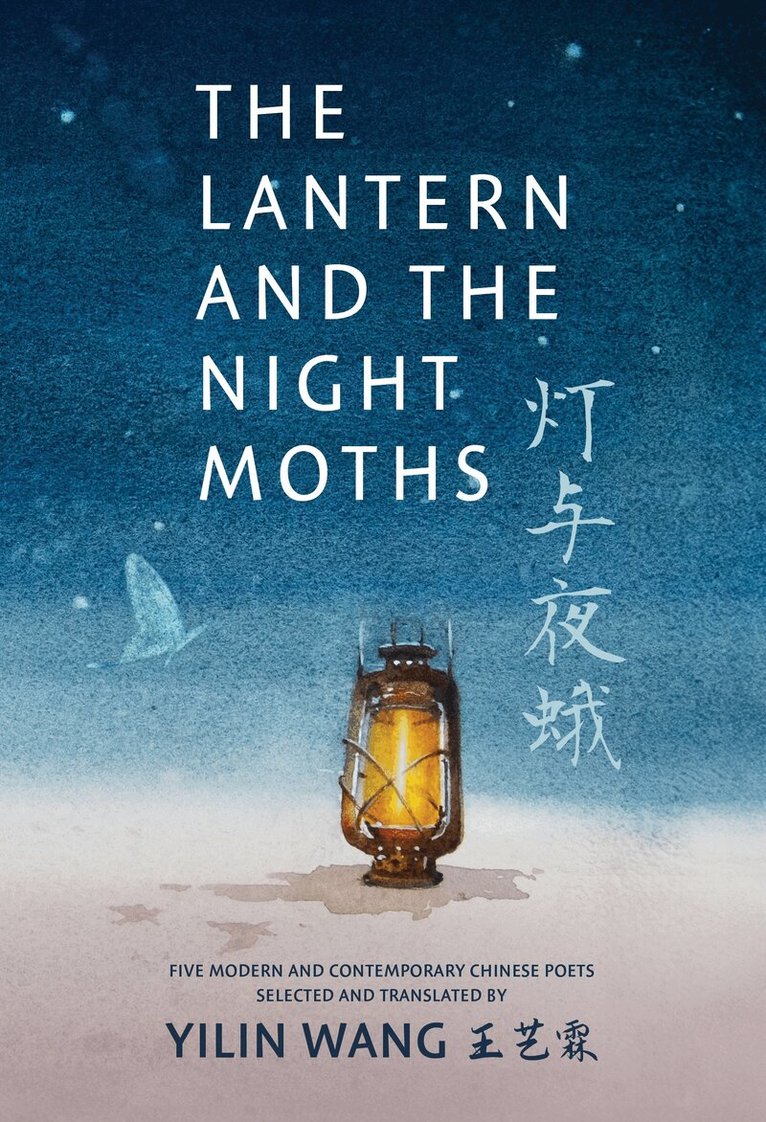
Winner of the John Glassco Translation Prize from the Literary Translators Association of Canadathe lantern light seems to have written a poem;they feel lonesome since i won’t read them.—“lantern” by Fei MingThe work of Tang Dynasty Classical Chinese poets such as Li Bai, Du Fu, and Wang Wei has long been celebrated in both China and internationally, and various English translations and mistranslations of their work played a pivotal yet often unacknowledged role in shaping the emergence and evolution of modern Anglophone poetry.In The Lantern and the Night Moths, Chinese diaspora poet-translator Yilin Wang has selected and translated poems by five of China’s most innovative modern and contemporary poets: Qiu Jin, Fei Ming, Dai Wangshu, Zhang Qiaohui, and Xiao Xi. Expanding on and subverting the long lineage of Classical Chinese poetry that precedes them, their work can be read collectively as a series of ars poeticas for modern Sinophone poetry.Wang’s translations are featured alongside the original Chinese texts, and accompanied by Wang’s personal essays reflecting on the art, craft, and labour of poetry translation. Together, these poems and essays chart the development of a myriad of modernist poetry traditions in China that parallel, diverge from, and sometimes intersect with their Anglophone and Western counterparts.