Yousef Saad – författare
Visar alla böcker från författaren Yousef Saad. Handla med fri frakt och snabb leverans.
7 produkter
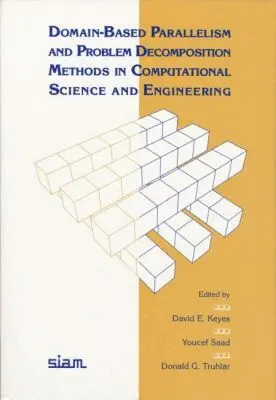
Domain-Based Parallelism and Problem Decomposition Methods in Computational Science and Engineering
Av David E. Keyes, Youcef Saad m. fl.
Häftad, 1995
1141 kr
Lägg i varukorg
This refereed volume arose from the editors' recognition that physical scientists, engineers, and applied mathematicians are developing, in parallel, solutions to problems of parallelization. The cross-disciplinary field of scientific computation is bringing about better communication between …
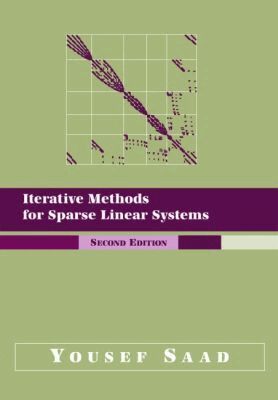
Iterative Methods for Sparse Linear Systems
Av Yousef Saad
Häftad, 2003
1547 kr
Lägg i varukorg
Tremendous progress has been made in the scientific and engineering disciplines regarding the use of iterative methods for linear systems. The size and complexity of linear and nonlinear systems arising in typical applications has grown, meaning that using direct solvers for the three-dimensional …
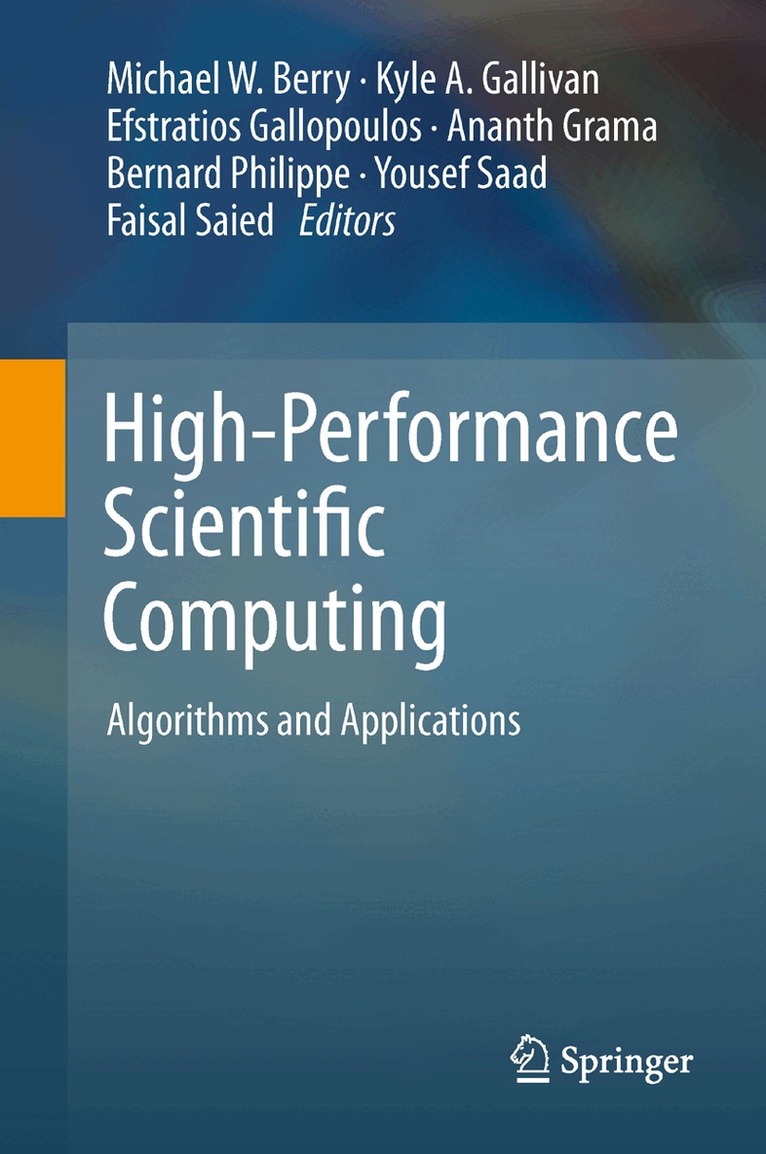
High-Performance Scientific Computing
Algorithms and Applications
Av Michael W. Berry, Kyle A. Gallivan m. fl.
Inbunden, 2012
1127 kr
Lägg i varukorg
This book presents the state of the art in parallel numerical algorithms, applications, architectures, and system software. The book examines various solutions for issues of concurrency, scale, energy efficiency, and programmability, which are discussed in the context of a diverse range of …
High-Performance Scientific Computing
Algorithms and Applications
Av Faisal Saied, Yousef Saad m. fl.
E-bok, 2012
1459 kr
Lägg i varukorg
This book presents the state of the art in parallel numerical algorithms, applications, architectures, and system software. The book examines various solutions for issues of concurrency, scale, energy efficiency, and programmability, which are discussed in the context of a diverse range of …
High-Performance Scientific Computing
Algorithms and Applications
Av Michael W. Berry, Kyle A. Gallivan m. fl.
Häftad, 2014
1094 kr
Lägg i varukorg
This book presents the state of the art in parallel numerical algorithms, applications, architectures, and system software. The book examines various solutions for issues of concurrency, scale, energy efficiency, and programmability, which are discussed in the context of a diverse range of …
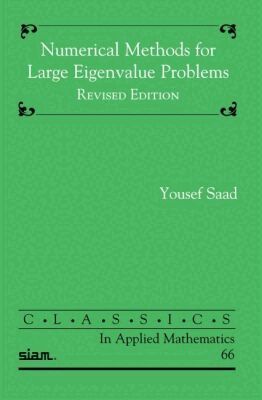
Numerical Methods for Large Eigenvalue Problems
Av Yousef Saad
Häftad, 2011
1001 kr
Lägg i varukorg
This revised edition discusses numerical methods for computing eigenvalues and eigenvectors of large sparse matrices. It provides an in-depth view of the numerical methods that are applicable for solving matrix eigenvalue problems that arise in various engineering and scientific applications. Each …
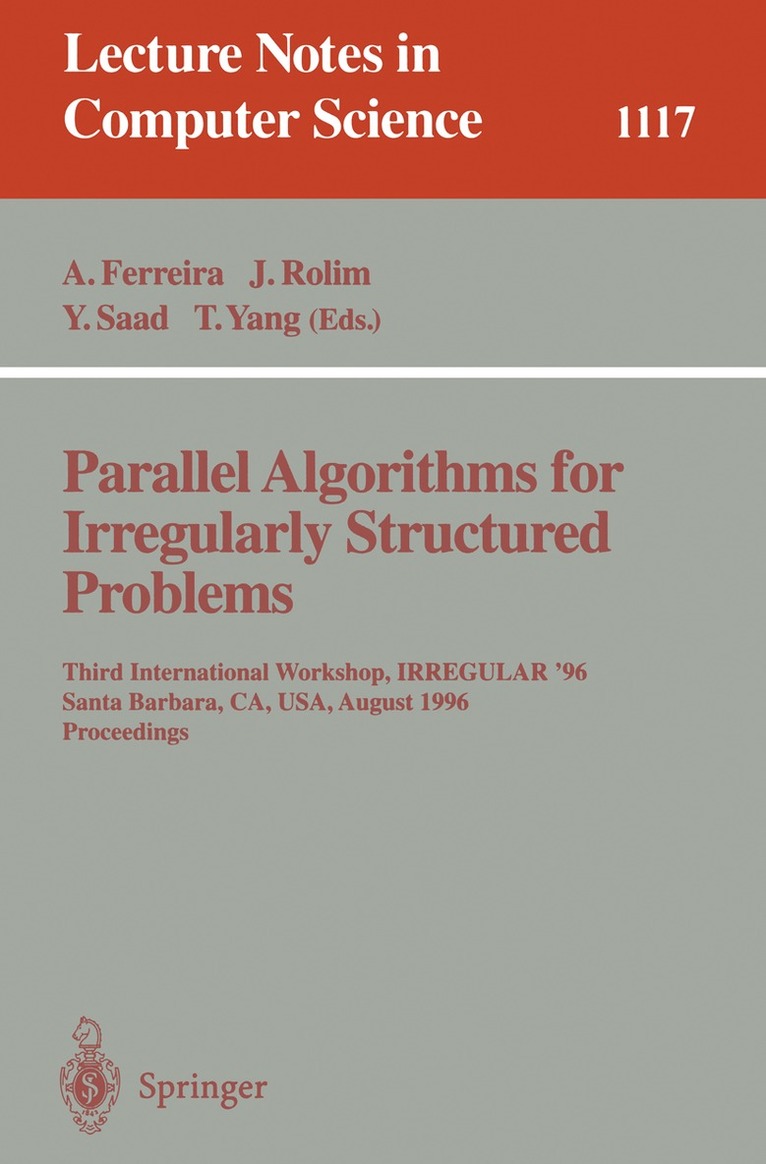
Parallel Algorithms for Irregularly Structured Problems
Third International Workshop, IRREGULAR '96, Santa Barbara, CA, USA, August 19 - 21, 1996. Proceedings
Av Alfonso Ferreira, Jose Rolim m. fl.
Häftad, 1996
567 kr
Lägg i varukorg
This book constitutes the refereed proceedings of the Third International Workshop on Parallel Algorithms for Irregularly Structured Problems, IRREGULAR '96, held in Santa Barbara, California, in August 1996.The volume presents 28 revised full papers selected from 51 submissions; also included are …