Yucel Saygin – författare
Visar alla böcker från författaren Yucel Saygin. Handla med fri frakt och snabb leverans.
6 produkter
6 produkter
E-bok
PDF, Engelska, 20061 368 kr
Läs direkt efter köp
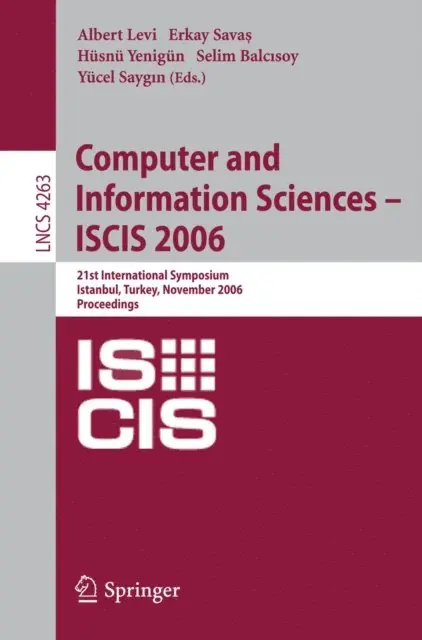
Thesearetheproceedingsofthe21stInternationalSymposiumonComputerand ? Information Sciences (ISCIS 2006) held in Istanbul, Turkey, November 1 – 3, 2006. ISCIS 2006 was organized by the Faculty of Engineering and Natural S- ences of Sabanc?University. These proceedings include updated versions of 106 papers selected by the program committee for presentation at the symposium. The increasing com- tition for presenting at the symposium, which relies on the success of previous ISCIS symposia,has led to many excellent papers and a higher standard overall. From a record-breaking 606 submissions, scheduling constraints dictated that only 106 papers could be accepted, resulting in a 17.5% acceptance rate. The program committee and external reviewers worked very hard and went through all submissions meticulously to select the best in a limited time frame. The selection process was especially hard when some of the good submissions could not be selected for publication due to space and time limitations. Another interesting fact about the submissions is that they were by authors from 41 countries covering all habitable continents (excluding Antarctica). This is a clear indication of the ever-increasing popularity of ISCIS symposia among researchersallaroundtheworldasamediumtoshareanddisseminatetheresults of their research activities.
Häftad, Engelska, 2008
561 kr
Skickas inom 10-15 vardagar
Vast amounts of data are collected by service providers and system administ- tors, and are available in public information systems. Data mining technologies provide an ideal framework to assist in analyzing such collections for computer security and surveillance-related endeavors. For instance, system administrators can apply data mining to summarize activity patterns in access logs so that potential malicious incidents can be further investigated. Beyond computer - curity, data mining technology supports intelligence gathering and summari- tion for homeland security. For years, and most recently fueled by events such as September 11, 2001, government agencies have focused on developing and applying data mining technologies to monitor terrorist behaviors in public and private data collections. Theapplicationof data mining to person-speci?cdata raisesseriousconcerns regarding data con?dentiality and citizens' privacy rights. These concerns have led to the adoption of various legislation and policy controls.In 2005, the - ropean Union passed a data-retention directive that requires all telephone and Internetservice providersto store data ontheir consumers for up to two yearsto assist in the prevention of terrorismand organized crime. Similar data-retention regulationproposalsareunderheateddebateintheUnitedStatesCongress. Yet, the debate often focuses on ethical or policy aspects of the problem, such that resolutions have polarized consequences; e. g. , an organization can either share data for data mining purposes or it can not. Fortunately, computer scientists, and data mining researchers in particular, have recognized that technology can beconstructedtosupportlesspolarizedsolutions. Computerscientistsaredev- oping technologies that enable data mining goals without sacri?cing the privacy and security of the individuals to whom the data correspond.
E-bok
PDF, Engelska, 2008708 kr
Läs direkt efter köp
E-bok
PDF, Engelska, 2008825 kr
Läs direkt efter köp
Privacy in statistical databases is a discipline whose purpose is to provide solutions to the tension between the increasing social, political and economical demand of accurate information, and the legal and ethical obligation to protect the privacy of the various parties involved. Those parties are the respondents (the individuals and enterprises to which the database records refer), the data owners (those organizations spending money in data collection) and the users (the ones querying the database, who would like their queries to stay con?d- tial). Beyond law and ethics, there are also practical reasons for data collecting agencies to invest in respondent privacy: if individual respondents feel their p- vacyguaranteed,they arelikelyto providemoreaccurateresponses. Data owner privacy is primarily motivated by practical considerations: if an enterprise c- lects data at its own expense, it may wish to minimize leakage of those data to other enterprises (even to those with whom joint data exploitation is planned). Finally, user privacy results in increased user satisfaction, even if it may curtail the ability of the database owner to pro?le users. Thereareatleasttwotraditionsinstatisticaldatabaseprivacy,bothofwhich started in the 1970s: one stems from o?cial statistics, where the discipline is also known as statistical disclosure control (SDC), and the other originatesfrom computer science and database technology. In o?cial statistics, the basic c- cern is respondent privacy.
Häftad, Engelska, 2011
561 kr
Skickas inom 10-15 vardagar
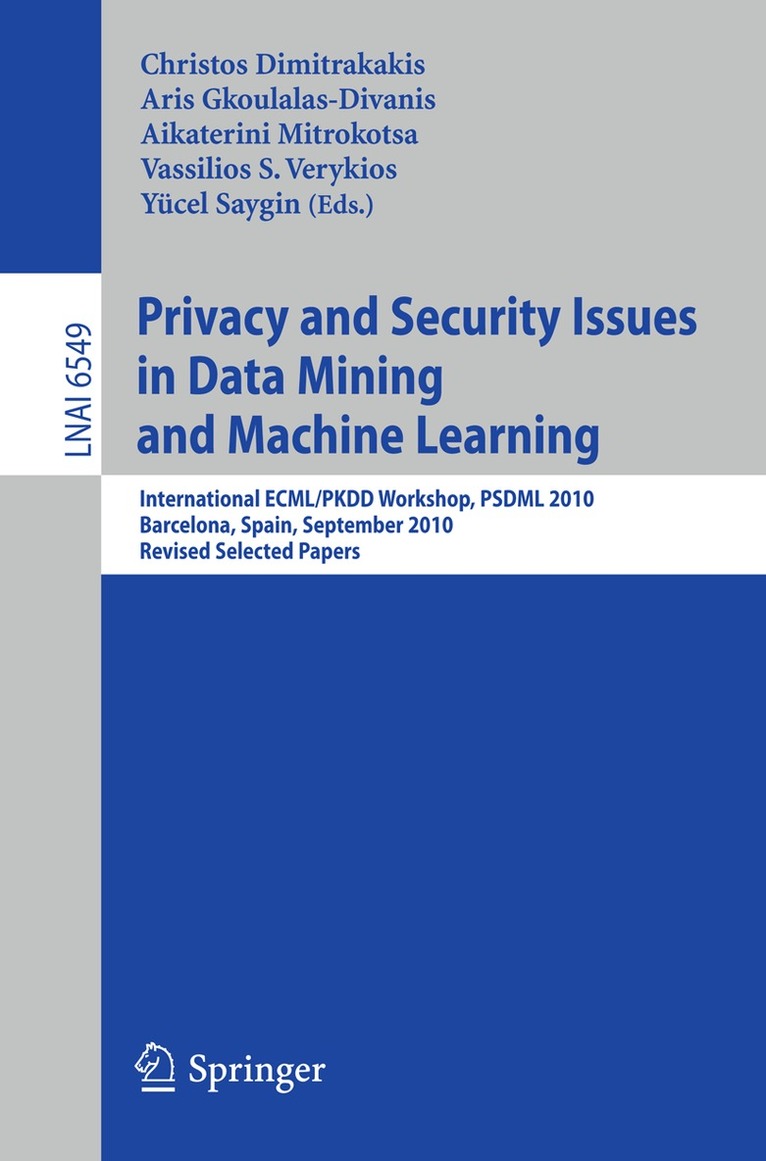
This book constitutes the refereed proceedings of the International ECML/PKDD Workshop on Privacy and Security Issues in Data Mining and Machine Learning, PSDML 2010, held in Barcelona, Spain, in September 2010.The 11 revised full papers presented were carefully reviewed and selected from 21 submissions. The papers range from data privacy to security applications, focusing on detecting malicious behavior incomputer systems.
E-bok
PDF, Engelska, 2011714 kr
Läs direkt efter köp
This book constitutes the refereed proceedings of the International ECML/PKDD Workshop on Privacy and Security Issues in Data Mining and Machine Learning, PSDML 2010, held in Barcelona, Spain, in September 2010.The 11 revised full papers presented were carefully reviewed and selected from 21 submissions. The papers range from data privacy to security applications, focusing on detecting malicious behavior incomputer systems.