Yujun Feng – författare
3 055 kr
Skickas inom 5-8 vardagar
2 733 kr
Läs direkt efter köp
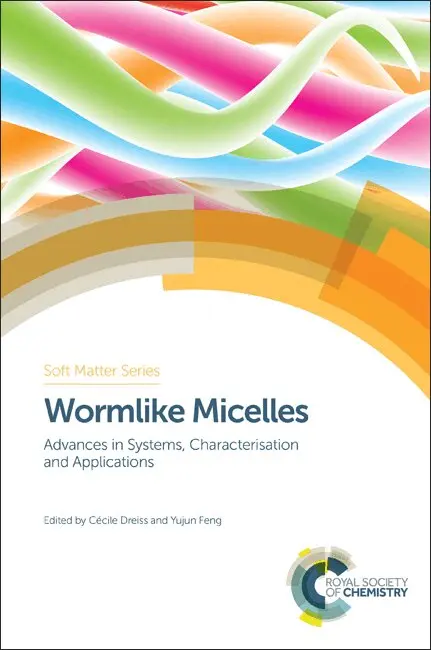
Wormlike micelles are elongated flexible self-assembled structures created from the aggregation of amphiphiles and their resulting dynamic networks have gained attention for a number of uses, particularly in the oil industry.
Written by experts, Wormlike Micelles describes the latest developments in the field providing an authoritative guide on the subject. The book starts with an introductory chapter giving an overview of the area and then looks at the three key topics of new wormlike micelle systems, characterization and applications. New systems covered in the first part include reverse wormlike micelles and stimuli-responsive wormlike micelles. The second part explores cutting-edge techniques that have led to advances in the understanding of their structure and dynamics, including direct imaging techniques and the combination of rheology with small-angle neutron scattering techniques. Finally, the book reviews their use in oil and gas well treatments as well as surfactant drag reducing solutions.
Aimed at postgraduate students and researchers, this text is essential reading for anyone interested in soft matter systems.
2 733 kr
Läs direkt efter köp
Wormlike micelles are elongated flexible self-assembled structures created from the aggregation of amphiphiles and their resulting dynamic networks have gained attention for a number of uses, particularly in the oil industry.
Written by experts, Wormlike Micelles describes the latest developments in the field providing an authoritative guide on the subject. The book starts with an introductory chapter giving an overview of the area and then looks at the three key topics of new wormlike micelle systems, characterization and applications. New systems covered in the first part include reverse wormlike micelles and stimuli-responsive wormlike micelles. The second part explores cutting-edge techniques that have led to advances in the understanding of their structure and dynamics, including direct imaging techniques and the combination of rheology with small-angle neutron scattering techniques. Finally, the book reviews their use in oil and gas well treatments as well as surfactant drag reducing solutions.
Aimed at postgraduate students and researchers, this text is essential reading for anyone interested in soft matter systems.
544 kr
Skickas inom 10-15 vardagar
687 kr
Läs direkt efter köp
This Brief provides an up-to-date overview of smart surfactants and describes a broad spectrum of triggers that induce the formation of wormlike micelles or reversibly tune the morphology of surfactant aggregates from wormlike micelles to another state, or vice versa. Combining the fields of chemistry, physics, polymer science, and nanotechnology, its primary focus is on the design, formulation, and processing of intelligent viscoelastic surfactant solutions, covering the scientific principles governing responsiveness to one or more particular triggers, down to the end-use-driven functions. The first chapter explains why and how surfactants self-assemble into viscoelastic wormlike micellar solutions reminiscent of polymer solutions, while the following chapters show how the response to a given trigger translates into macroscopic rheological changes, including temperature, light, pH, CO2, redox, hydrocarbon, etc. The last chapter demonstrates the applications of these viscoelastic assemblies in oil and gas production, drag reduction, biomaterials, cleaning processes, electrorheological and photorheological fluids. Comments and perspectives are provided at the end to conclude this Brief.
This Brief is aimed at chemists, physicists, chemical engineers and nano-scientists who are involved in self-assemblies and applications of surfactants, as well as graduates in physical chemistry.
Yujun Feng, Ph.D., is a professor at the State Key Laboratory of Polymer Materials Engineering, Polymer Research Institute of Sichuan University, Chengdu, Sichuan Province, P. R. China.Zonglin Chu, Ph.D., is a post-doctoral fellow working at the Physical Chemistry Institute, University of Zürich, Switzerland.Cécile A. Dreiss, Ph.D., is a senior lecturer at the Institute of Pharmaceutical Science, King’s College London,UK.