Yurij V. Prokhorov - Böcker
Visar alla böcker från författaren Yurij V. Prokhorov. Handla med fri frakt och snabb leverans.
2 produkter
2 produkter
1 064 kr
Skickas inom 10-15 vardagar
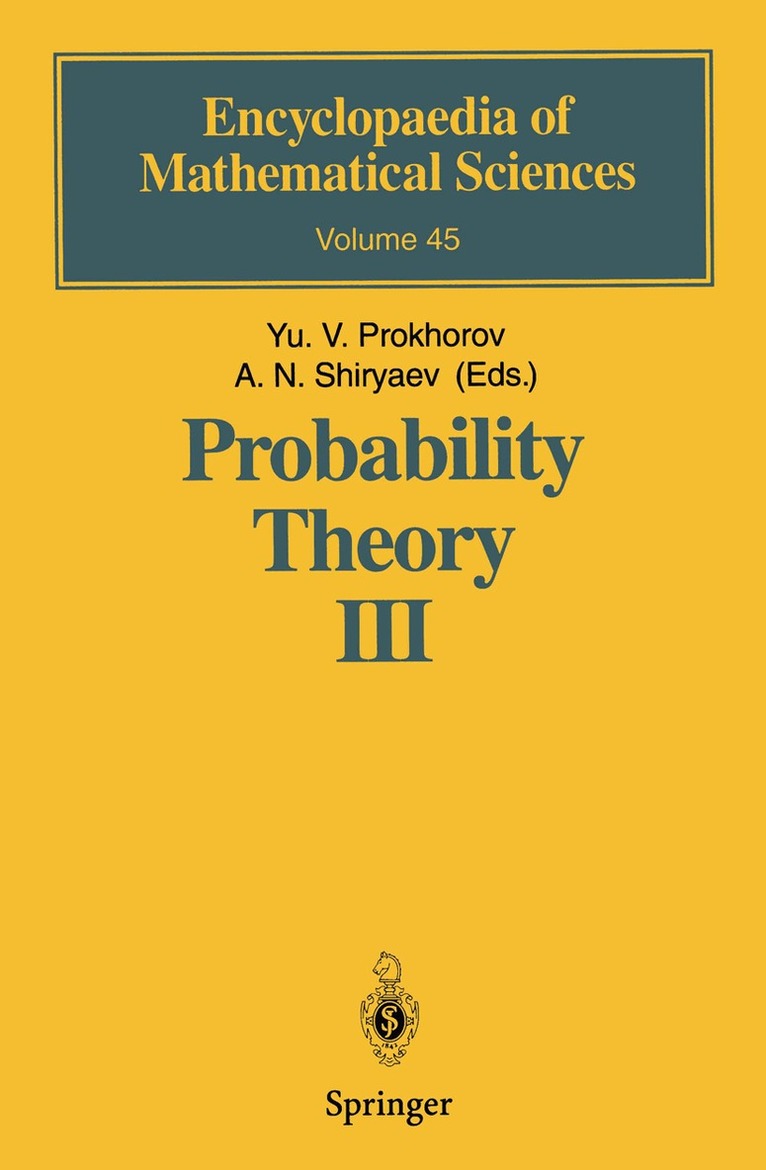
This volume of the Encyclopaedia is a survey of stochastic calculus which has become an increasingly important part of probability. The topics covered include Brownian motion, the Ito integral, stochastic differential equations and Malliavin calculus, the general theory of random processes and martingale theory. The five authors are well-known experts in the field. The first chapter of the book is an introduction which treats Brownian motion and describes the developments which lead to the definition of Ito's integral. The book addresses graduate students and researchers in probability theory and mathematical statistics and will also be used by physicists and engineers who need to apply stochastic methods.
Del 45 - Encyclopaedia of Mathematical Sciences
Probability Theory III
Stochastic Calculus
Häftad, Engelska, 2010
1 064 kr
Skickas inom 10-15 vardagar
Preface In the axioms of probability theory proposed by Kolmogorov the basic "probabilistic" object is the concept of a probability model or probability space. This is a triple (n, F, P), where n is the space of elementary events or outcomes, F is a a-algebra of subsets of n announced by the events and P is a probability measure or a probability on the measure space (n, F). This generally accepted system of axioms of probability theory proved to be so successful that, apart from its simplicity, it enabled one to embrace the classical branches of probability theory and, at the same time, it paved the way for the development of new chapters in it, in particular, the theory of random (or stochastic) processes. In the theory of random processes, various classes of processes have been studied in depth. Theories of processes with independent increments, Markov processes, stationary processes, among others, have been constructed. In the formation and development of the theory of random processes, a significant event was the realization that the construction of a "general theory of ran dom processes" requires the introduction of a flow of a-algebras (a filtration) F = (Ftk::o supplementing the triple (n, F, P), where F is interpreted as t the collection of events from F observable up to time t.