Zhi-Li Zhang – Författare
Visar alla böcker från författaren Zhi-Li Zhang. Handla med fri frakt och snabb leverans.
4 produkter
4 produkter
Del 739 - Springer International Series in Engineering and Computer Science
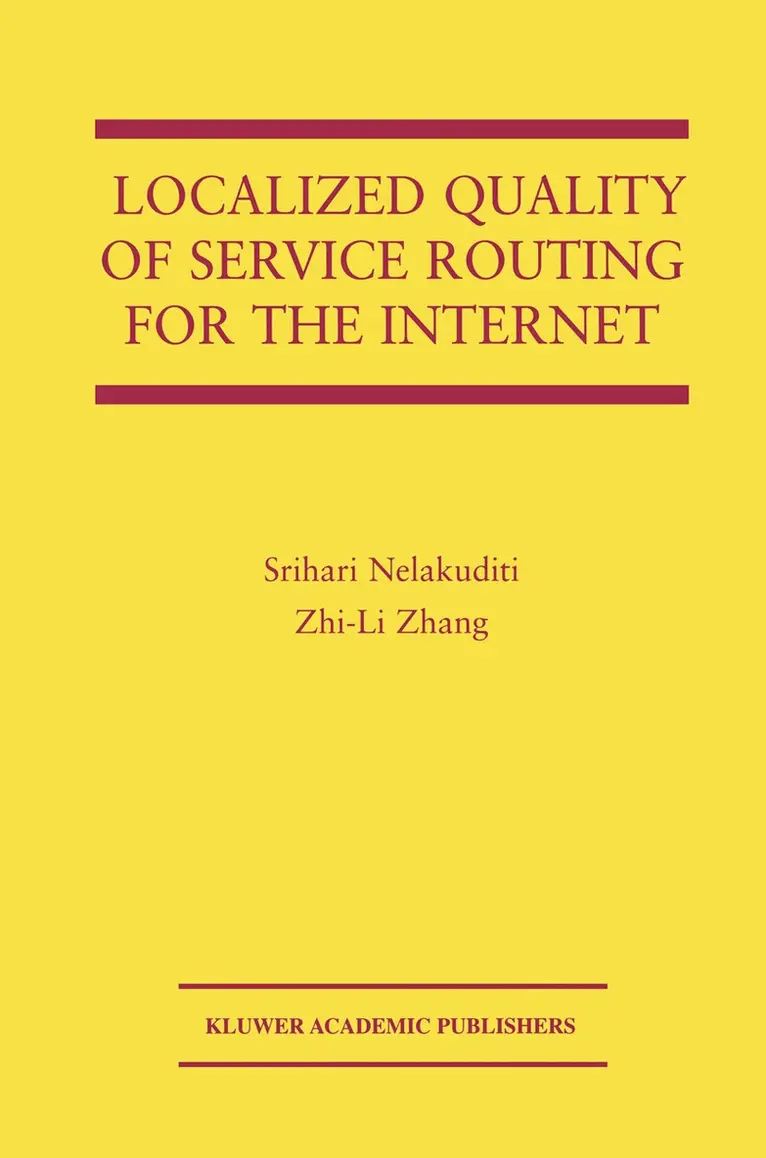
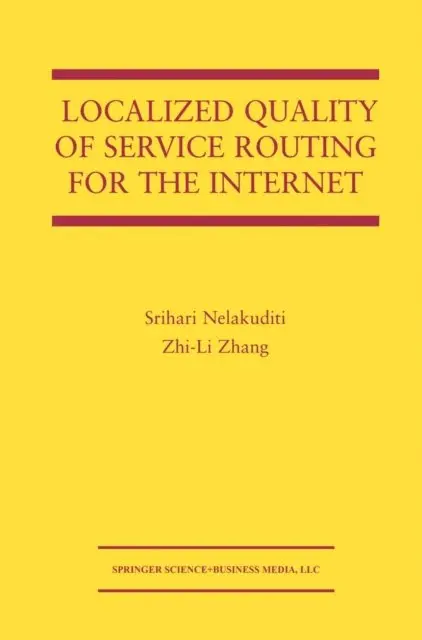
Localized Quality of Service Routing for the Internet
Inbunden, Engelska, 2003
550 kr
Skickas inom 10-15 vardagar
Under Quality of Service (QoS) routing, paths for flows are selected based upon the knowledge of resource availability at network nodes and the QoS requirements of flows. QoS routing schemes differ in the way they gather information about the network state and select paths based on this information. This text broadly categorizes these schemes in to best-path routing and proportional routing. The best-path routing schemes gather global network state information and always select the best path for an incoming flow based on this global view. On the other hand, proportional routing schemes proportion incoming flows among a set of candidate paths. We have shown that it is possible to compute near-optimal proportions using only locally collected information. Furthermore, a few good candidate paths can be selected using infrequently exchanged global information and thus with minimal communication overhead. This text describes these schemes in detail demonstrating that proportional routing schemes can achieve higher throughput with lower overhead than best-path routing schemes.It first addresses the issue of finding near-optimal proportions for a given set of candidate paths based on locally collected flow statistics. This book will also look into the selection of a few good candidate paths based on infrequently exchanged global information. The final phase of this book will describe extensions to proportional routing approach to provide hierarchical routing across multiple areas in a large network.
Del 739 - Springer International Series in Engineering and Computer Science
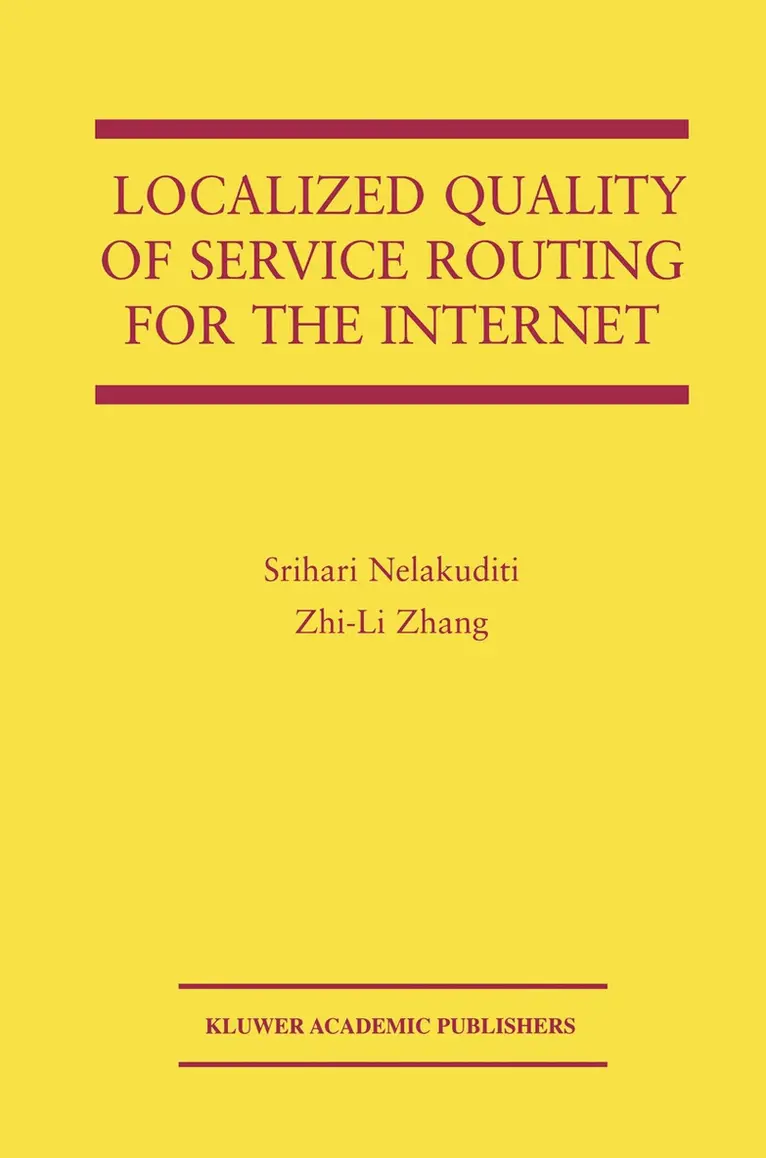
Localized Quality of Service Routing for the Internet
Häftad, Engelska, 2012
550 kr
Skickas inom 10-15 vardagar
The exponential growth of Internet brings to focus the need to control such large scale networks so that they appear as coherent, almost intelligent, organ isms. It is a challenge to regulate such a complex network of heterogeneous elements with dynamically changing traffic conditions. To make such a sys tem reliable and manageable, the decision making should be decentralized. It is desirable to find simple local rules and strategies that can produce coherent and purposeful global behavior. Furthermore, these control mechanisms must be adaptive to effectively respond to continually varying network conditions. Such adaptive, distributed, localized mechanisms would provide a scalable so lution for controlling large networks. The need for such schemes arises in a variety of settings. In this monograph, we focus on localized approach to quality of service routing. Routing in the current Internet focuses primarily on connectivity and typi cally supports only the "best-effort" datagram service. The routing protocols deployed such as OSPF use the shortest path only routing paradigm, where routing is optimized for a single metric such as hop count or administrative weight. While these protocols are well suited for traditional data applications such as ftp and telnet, they are not adequate for many emerging applications such as IP telephony, video on demand and teleconferencing, which require stringent delay and bandwidth guarantees. The "shortest paths" chosen for the "best effort" service may not have sufficient resources to provide the requisite service for these applications.
534 kr
Skickas inom 10-15 vardagar
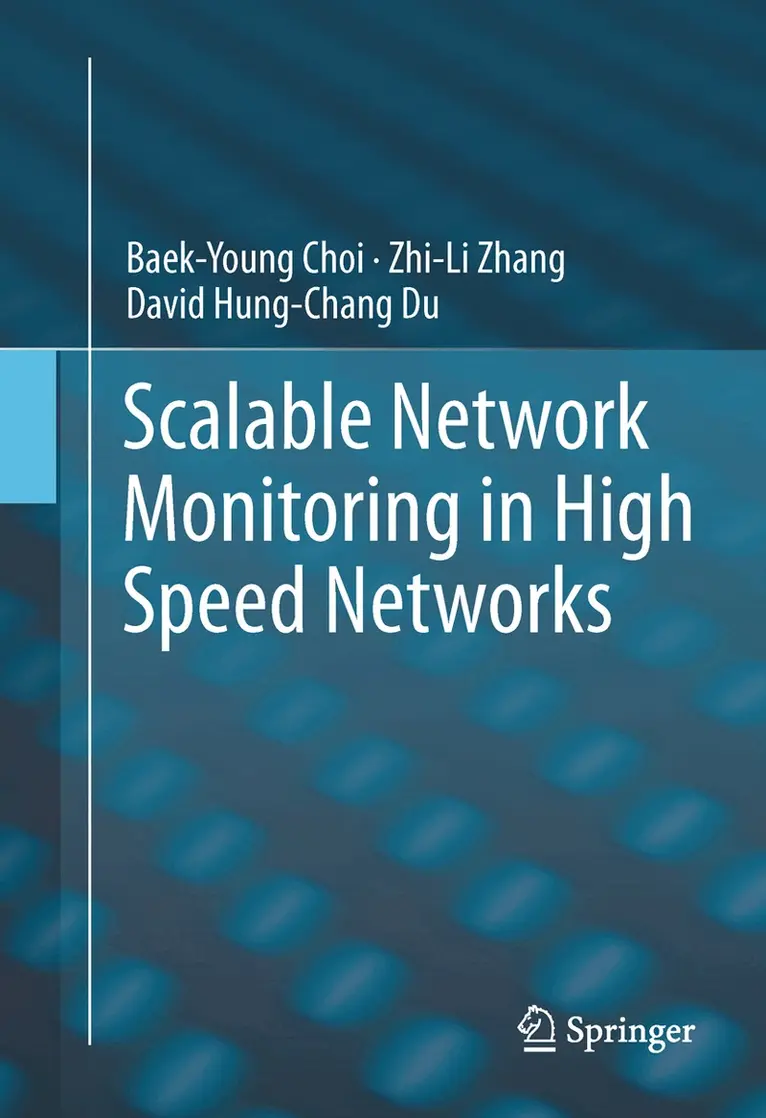
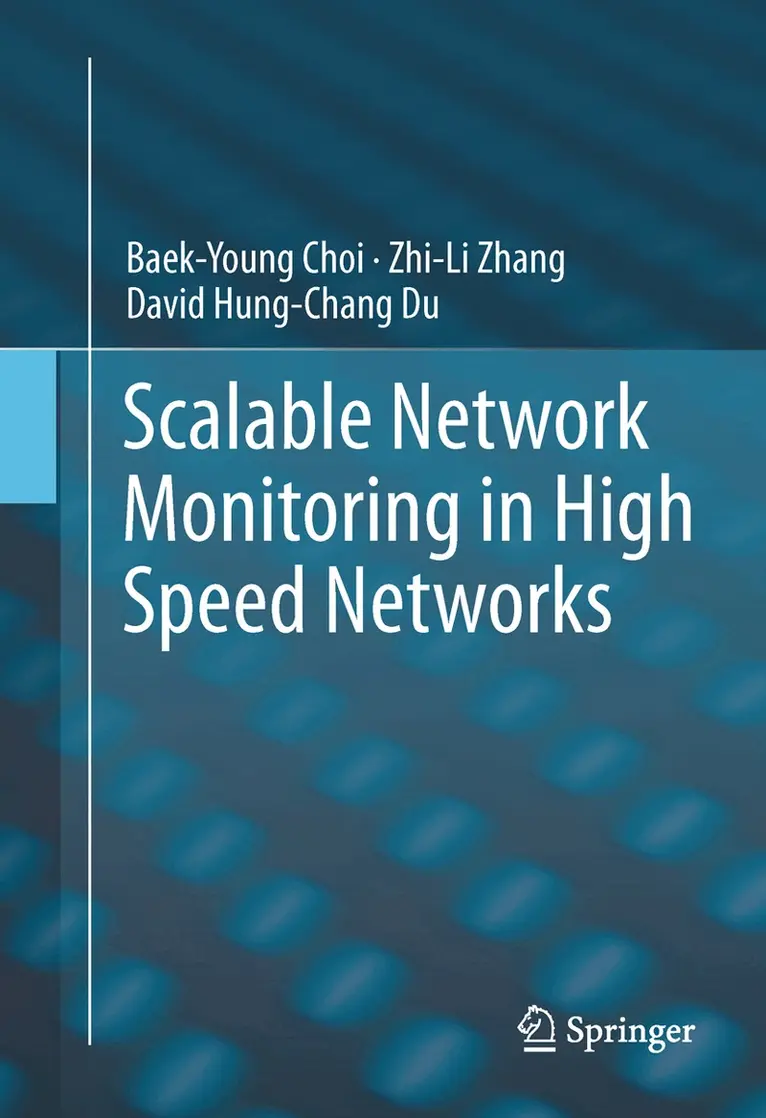
Network monitoring serves as the basis for a wide scope of network, engineering and management operations. Precise network monitoring involves inspecting every packet traversing in a network. However, this is not feasible with future high-speed networks, due to significant overheads of processing, storing, and transferring measured data. Network Monitoring in High Speed Networks presents accurate measurement schemes from both traffic and performance perspectives, and introduces adaptive sampling techniques for various granularities of traffic measurement. The techniques allow monitoring systems to control the accuracy of estimations, and adapt sampling probability dynamically according to traffic conditions. The issues surrounding network delays for practical performance monitoring are discussed in the second part of this book. Case studies based on real operational network traces are provided throughout this book. Network Monitoring in High Speed Networks is designed as a secondary text or reference book for advanced-level students and researchers concentrating on computer science and electrical engineering. Professionals working within the networking industry will also find this book useful.
534 kr
Skickas inom 10-15 vardagar
Network monitoring serves as the basis for a wide scope of network, engineering and management operations. Precise network monitoring involves inspecting every packet traversing in a network. However, this is not feasible with future high-speed networks, due to significant overheads of processing, storing, and transferring measured data. Network Monitoring in High Speed Networks presents accurate measurement schemes from both traffic and performance perspectives, and introduces adaptive sampling techniques for various granularities of traffic measurement. The techniques allow monitoring systems to control the accuracy of estimations, and adapt sampling probability dynamically according to traffic conditions. The issues surrounding network delays for practical performance monitoring are discussed in the second part of this book. Case studies based on real operational network traces are provided throughout this book. Network Monitoring in High Speed Networks is designed as a secondary text or reference book for advanced-level students and researchers concentrating on computer science and electrical engineering. Professionals working within the networking industry will also find this book useful.