Zhu Qian – författare
Visar alla böcker från författaren Zhu Qian. Handla med fri frakt och snabb leverans.
4 produkter
4 produkter
When Formalization Fails
The Credibility of Informality in China's Resettlement Communities
Häftad, Engelska, 2026
239 kr
Kommande
Globally, states use rural-to-urban resettlement to fuel development, yet this formal process consistently generates its own informalities. Using a comparative case study of China-contrasting its affluent coast with its poorer hinterland-this book reveals how informality not only persists after resettlement but performs essential functions, critically challenging the effectiveness of prevailing policies. Theoretically, the study leverages the innovative Credibility Thesis, applying its Formal, Actual, and Targeted (FAT) Institutional Framework and Credibility Scales and Intervention (CSI) Checklist to explain the emergence and evolution of post-resettlement informality. The findings offer powerful, empirically grounded recommendations for integrating informal realities into urban planning, with profound implications for understanding institutional credibility and the functional role of informality in development.
When Formalization Fails
The Credibility of Informality in China's Resettlement Communities
Inbunden, Engelska, 2026
771 kr
Kommande
Globally, states use rural-to-urban resettlement to fuel development, yet this formal process consistently generates its own informalities. Using a comparative case study of China-contrasting its affluent coast with its poorer hinterland-this book reveals how informality not only persists after resettlement but performs essential functions, critically challenging the effectiveness of prevailing policies. Theoretically, the study leverages the innovative Credibility Thesis, applying its Formal, Actual, and Targeted (FAT) Institutional Framework and Credibility Scales and Intervention (CSI) Checklist to explain the emergence and evolution of post-resettlement informality. The findings offer powerful, empirically grounded recommendations for integrating informal realities into urban planning, with profound implications for understanding institutional credibility and the functional role of informality in development.
2 312 kr
Kommande
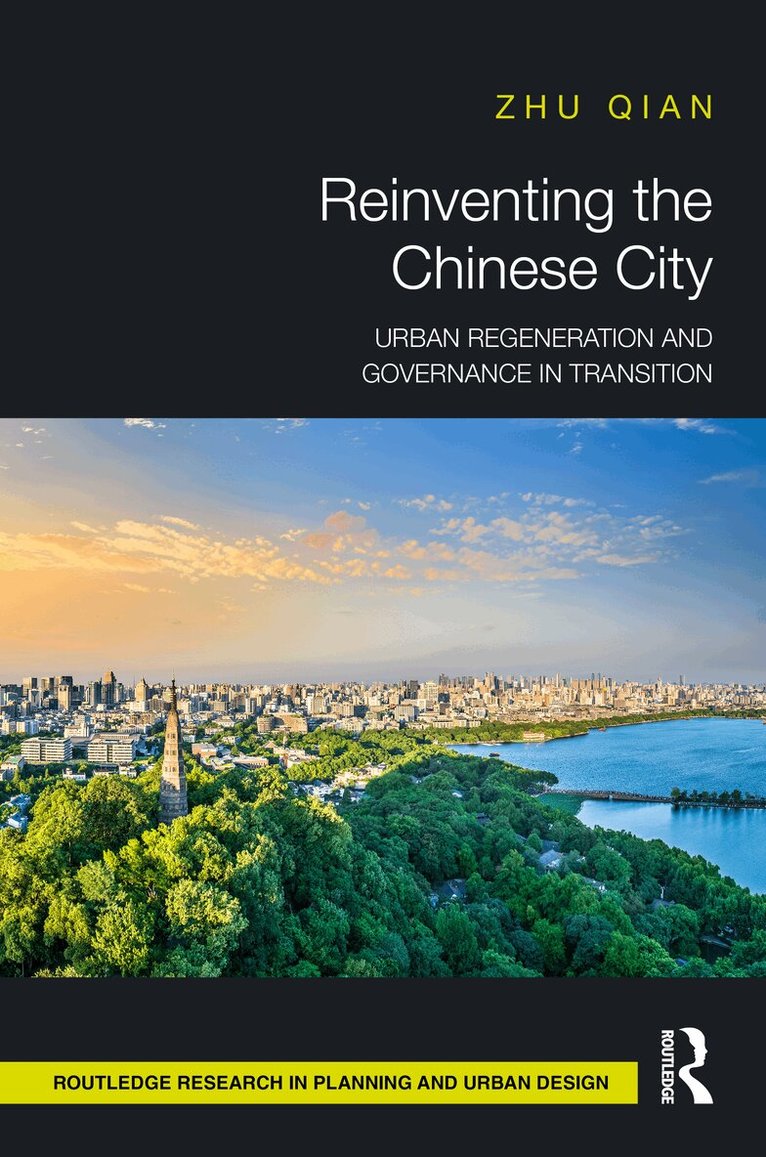
Reinventing the Chinese City: Urban Regeneration and Governance in Transition delves into the intricate relationships between space and society within the context of China’s rescaled urban regeneration. It seeks to uncover and critically examine pivotal aspects of these dynamics. Through a comprehensive, cross-sectoral, and multi-scalar approach, the book advances understanding of socioeconomic differentiations, multifaceted relations, institutional systems, administrative structures, and lived experiences tied to urban regeneration.This study offers a compelling exploration of the social and economic innovations driving urban regeneration in China’s evolving political and policy landscape. It examines the transformative changes reshaping society, culture, economy, and space, highlighting how these dynamics differ from earlier redevelopment strategies in terms of spatial patterns, economic impacts, and societal consequences. As social and economic conditions shift, the book delves into the complexities of socio-spatial relations, uncovering emerging challenges, conflicts, and priorities, while also shedding light on the growing influence of entrepreneurialism and the state’s expanding role in urban governance.This book is an essential resource for scholars in urban studies, geography, planning, and development studies, particularly those interested in China’s urbanisation, heritage, conservation, and environmental challenges. Graduate students and planning practitioners will also find it invaluable for understanding the complexities of urban development and governance in China.
1 618 kr
Skickas inom 5-8 vardagar
Addressing fundamental questions surrounding the critical changes affecting China’s urban landscape, social organization and community governance, Property Rights and Urban Transformation in China thoroughly reviews the reform of property rights in changing political and economic conditions.Zhu Qian presents a comprehensive study highlighting the key theories and practices in urban and social development processes and provides guidance on how to understand both the parallels and differences that these reveal. Utilizing a cross-sectoral and multi-scalar examination of property rights in a property-led urban environment, the book illustrates increasingly complex interactions between state and non-state actors and examines the characteristics and consequences of rural-urban land conversion. It further analyses the impacts of resettled villagers’ adaptation to urban society and the role of property rights in China’s recent high-profile urban-rural integrated development.This insightful book will ensure a thorough grasp of the pertinent issues for scholars, researchers and practitioners within the fields of urban planning, human geography and land economics. It will also provide a more general systemic understanding for graduate students interested in the recent challenges and strategies in a property rights regime with strong state intervention.