Zoï Kapoula – författare
1 469 kr
Skickas inom 5-8 vardagar
562 kr
Skickas inom 7-10 vardagar
1 533 kr
Skickas inom 7-10 vardagar
1 091 kr
Skickas inom 10-15 vardagar
1 417 kr
Skickas inom 10-15 vardagar
1 680 kr
Läs direkt efter köp
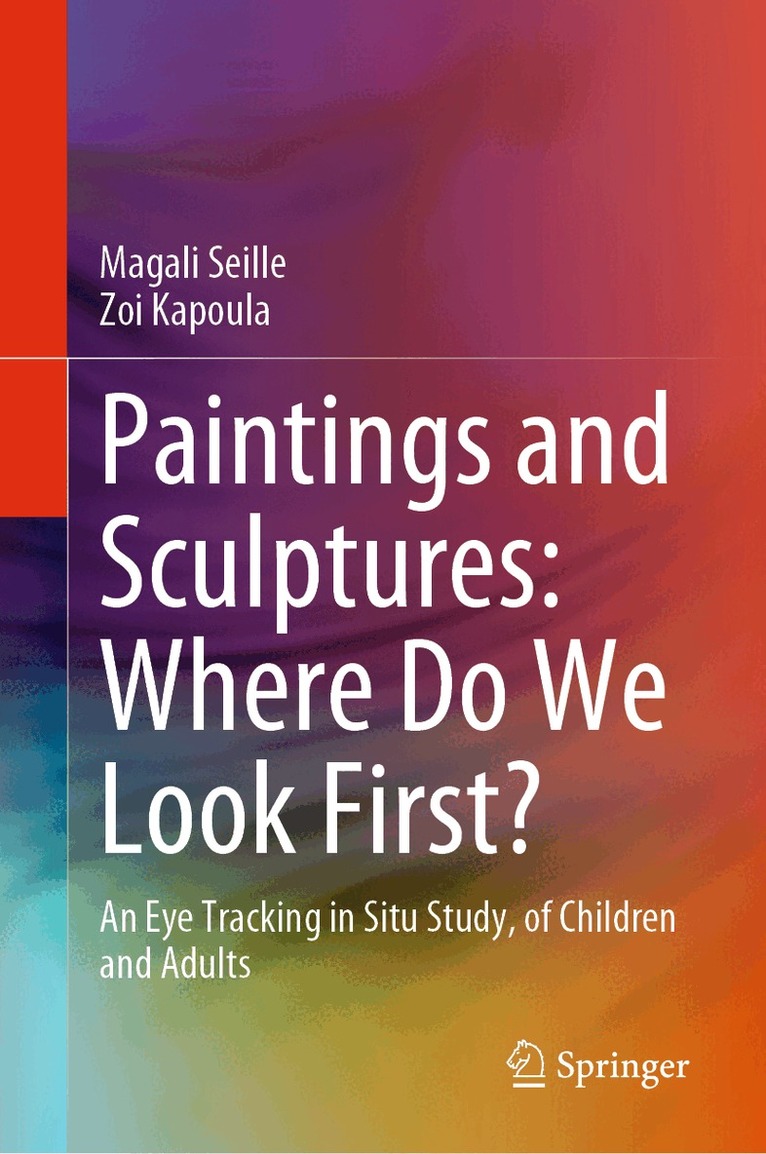
The book presents three studies in which eye tracking data were collected at the Musée des Beaux-Arts in Rouen in June and July 2013. Overall, the results of those three studies highlight the knowledge gained from the analysis of the very first saccade in a museum context, when people look at paintings and statues.
The first study analyzes how viewers orient their first saccade on paintings. This study shows that, in a museum, the first saccade is attracted toward the center of paintings. This attraction toward the paintings’ center is found in all the subjects’ groups that we have studied. Noteworthily, this effect is significantly less pronounced in individuals who never visit museums. It is among amateurs, who often visit museums, that the center attracts the most the first saccade. Among experts, painters or art history teachers, and to a lesser extent among amateurs, the pictorial composition largely determines the orientation of the first saccade. We indeed found that, as soon as the first saccade, experts orient their gaze toward the main subject. This phenomenon seems to be explained by the fact that experts immediately orient their gaze (here measured as the first saccade) toward the paintings’ location conveying the most meaning. It can either be the center, or a peripheral area, depending on whether the paintings’ most meaningful subject is located centrally or peripherally. The second study shows that the center does not attract the first saccade in 5-year-old children. This behavior appears later, in 8- to 10-year-old children. However, noticeably, the 8–10-year-old children orient significantly less frequently their first saccade toward the paintings’ center as adults do, and this is also true when one considers non-expert adult viewers.
The results of the third study focus on statues and reveal a very different oculomotor behavior: Indeed, rather than looking at the center, statues’ viewers exhibit a clear tendency to saccade first at the statues’ contours. This stands in contrast with the behavior that we observe with paintings. Our study concludes that statues trigger a specific oculomotor behavior. The latter appears to be mostly driven by the physical presence that stone bodies incarnate. The movement and the climax of this movement, that sculptors manage to convey, thus turn out to attract the gaze in a unique fashion.
The book concludes that the first saccade is a powerful indicator of the oculomotor behavior that greatly improves our comprehension of the unique relationship between a viewer and artworks.
631 kr
Skickas inom 5-8 vardagar
1 417 kr
Skickas inom 10-15 vardagar
1 200 kr
Skickas inom 10-15 vardagar
1 519 kr
Läs direkt efter köp
This edited monograph provides a compelling analysis of the interplay between neuroscience and aesthetics. The book broaches a wide spectrum of topics including, but not limited to, mathematics and creator algorithms, neurosciences of artistic creativity, paintings and dynamical systems as well as computational research for architecture. The international authorship is genuinely interdisciplinary and the target audience primarily comprises readers interested in transdisciplinary research between neuroscience and the broad field of aesthetics.
1 092 kr
Skickas inom 10-15 vardagar
1 367 kr
Läs direkt efter köp
1 200 kr
Skickas inom 10-15 vardagar