Zongping Shao – författare
1 662 kr
Läs direkt efter köp
Authoritative and comprehensive resource covering foundational knowledge of zinc–air batteries as well as their practical applications
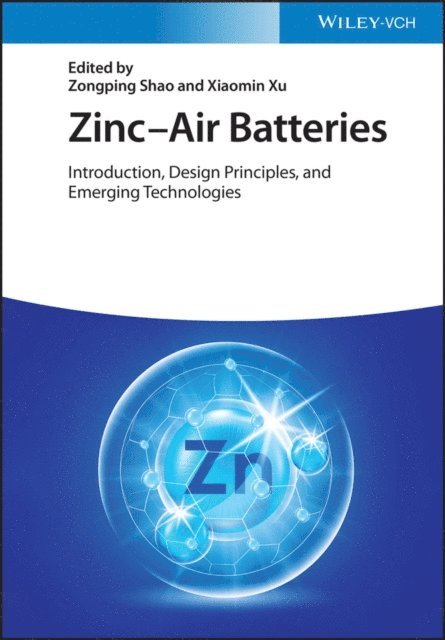
Zinc–Air Batteries provides a comprehensive understanding of the history and development of Zn–air batteries, with a systematic overview of components, design, and device innovation, along with recent advances in the field, especially with regards to the cathode catalyst design made by cutting-edge materials, engineering processes, and technologies.
In particular, design principles regarding the key components of Zn–air batteries, ranging from air cathode, to zinc anode, and to electrolyte, are emphasized. Furthermore, industrial developments of Zn–air batteries are discussed and emerging new designs of Zn–air batteries are also introduced. The authors argue that designing advanced Zn–air battery technologies is important to the realization of efficient energy storage and conversion—and, going further, eventually holds the key to a sustainable energy future and a carbon-neutral goal.
Edited and contributed to by leading professionals and researchers in the field, Zinc–Air Batteries also contains information regarding:
Design of oxygen reduction catalysts in primary zinc–air batteries, including precious metals, single-atoms, carbons, and transition metal oxides Design of bifunctional oxygen catalysts in rechargeable zinc–air batteries, covering specific oxygen redox reactions and catalyst candidates Design of three-dimensional air cathode in zinc–air batteries, covering loading of carbon-based and transition metal catalysts, plus design of the three-phase interface Design of electrolyte for zinc–air batteries, including liquid electrolytes (e.g., alkaline) and gel polymer electrolytes (e.g., PVA hydrogel)For students, researchers, and instructors working in battery technologies, materials science, and electrochemistry, and for industry and government representatives for decision making associated with energy and transportation, Zinc–Air Batteries summarizes the research results on Zn–air batteries and thereby helps researchers and developers to implement the technology in practice.
1 756 kr
Läs direkt efter köp
Authoritative and comprehensive resource covering foundational knowledge of zinc–air batteries as well as their practical applications
Zinc–Air Batteries provides a comprehensive understanding of the history and development of Zn–air batteries, with a systematic overview of components, design, and device innovation, along with recent advances in the field, especially with regards to the cathode catalyst design made by cutting-edge materials, engineering processes, and technologies.
In particular, design principles regarding the key components of Zn–air batteries, ranging from air cathode, to zinc anode, and to electrolyte, are emphasized. Furthermore, industrial developments of Zn–air batteries are discussed and emerging new designs of Zn–air batteries are also introduced. The authors argue that designing advanced Zn–air battery technologies is important to the realization of efficient energy storage and conversion—and, going further, eventually holds the key to a sustainable energy future and a carbon-neutral goal.
Edited and contributed to by leading professionals and researchers in the field, Zinc–Air Batteries also contains information regarding:
Design of oxygen reduction catalysts in primary zinc–air batteries, including precious metals, single-atoms, carbons, and transition metal oxides Design of bifunctional oxygen catalysts in rechargeable zinc–air batteries, covering specific oxygen redox reactions and catalyst candidates Design of three-dimensional air cathode in zinc–air batteries, covering loading of carbon-based and transition metal catalysts, plus design of the three-phase interface Design of electrolyte for zinc–air batteries, including liquid electrolytes (e.g., alkaline) and gel polymer electrolytes (e.g., PVA hydrogel)For students, researchers, and instructors working in battery technologies, materials science, and electrochemistry, and for industry and government representatives for decision making associated with energy and transportation, Zinc–Air Batteries summarizes the research results on Zn–air batteries and thereby helps researchers and developers to implement the technology in practice.
1 082 kr
Skickas inom 10-15 vardagar
1 387 kr
Läs direkt efter köp
This book discusses recent advances in intermediate-temperature solid oxide fuel cells (IT-SOFCs), focusing on material development and design, mechanism study, reaction kinetics and practical applications. It consists of five chapters presenting different types of reactions and materials employed in electrolytes, cathodes, anodes, interconnects and sealants for IT-SOFCs. It also includes two chapters highlighting new aspects of these solid oxide fuel cells and exploring their practical applications. This insightful and useful book appeals to a wide readership in various fields, including solid oxide fuel cells, electrochemistry, membranes and ceramics.
Zongping Shao is a Professor at the State Key Laboratory of Materials-Oriented Chemical Engineering and the College of Energy, Nanjing University of Technology, China.
Moses O. Tade is a Professor at the Department of Chemical Engineering, Curtin University, Australia.
1 082 kr
Skickas inom 10-15 vardagar
1 943 kr
Skickas inom 10-15 vardagar
2 524 kr
Läs direkt efter köp
This book focuses on the multidisciplinary teamwork for the design of key interfaces in fuel cell devices. It covers the fabrication, modelling, and operando-microanalysis sections in each chapter. Also, each chapter in the book consists of the introduction of basic theory, representative experimental results, and future prospects in each field. The book is an edited volume, intended to serve as an introductory textbook in multidisciplinary research work for the design and development of fuel cells. To fully enjoy the multidisciplinary research activities in fuel cell field, the beginners need to learn the basic knowledge and experimental data in each field. Compared with the published introductory textbooks in the field of science and engineering of fuel cells, this book has the following advantages. Firstly, it is an introductory textbook of multidisciplinary work for the design and development field of intermediate temperature (IT) solid oxide fuel cells (IT-SOFCs) and high-temperature polymer electrolyte fuel cells (HT-PEFCs) . And at the same time, this book is convenient for practical research implementation in R & D of those IT-SOFC and HT-PEFC devices. Secondly recent research topics with sufficient references are included in each chapter. Scientists and engineers in the fuel cell field will obtain useful knowledge in critical review chapters in the fabrication, modeling, and operando-microanalysis fields. Finally experimental results are closely combined with the cutting edge of scientific research work in the IT-SOFC and HT-PEFC materials and devices field. For all these reasons, this book is a useful start-up in multidisciplinary work for R & D of IT-SOFC and HT-PEFC devices.