
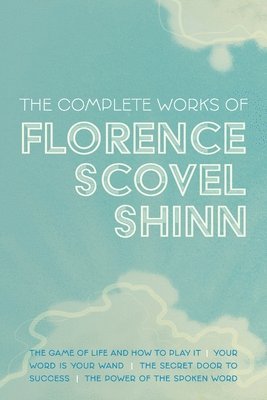
Häftad, Engelska, 2021
111 kr
Skickas inom 5-8 vardagar
This collection of four books by metaphysical writer and teacher Florence Scovel Shinn explores the power of thought and word to change your life.
111 kr
Skickas inom 5-8 vardagar
This collection of four books by metaphysical writer and teacher Florence Scovel Shinn explores the power of thought and word to change your life.

199 kr
Skickas inom 3-6 vardagar
289 kr
Skickas inom 3-6 vardagar

159 kr
Skickas inom 3-6 vardagar
307 kr
Skickas inom 3-6 vardagar
272 kr
Skickas inom 3-6 vardagar

319 kr
Skickas inom 3-6 vardagar

127 kr
Skickas inom 3-6 vardagar

310 kr
Skickas inom 3-6 vardagar

217 kr
Skickas inom 3-6 vardagar
291 kr
Skickas inom 3-6 vardagar
390 kr
Skickas inom 5-8 vardagar
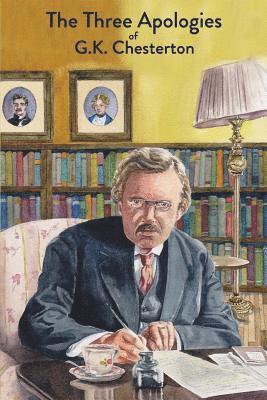
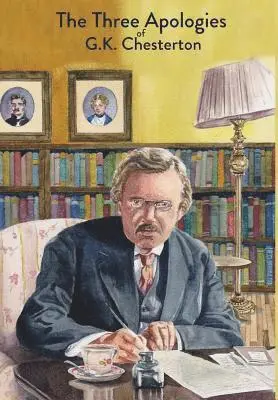
The three great apologies of G.K. Chesterton in one volume: Heretics, Orthodoxy & The Everlasting Man.
Gilbert Keith Chesterton has become synonymous with modern Christian apologetics. But his impact goes beyond just those interested in a defense of Christian thought. His writings have influenced such diverse authors as C.S. Lewis, Marshall McLuhan, and Jorge Luis Borges, and remains a subtle and unseen presence in contemporary Catholic thought. At his funeral, Ronald Knox said “All of this generation has grown up under Chesterton’s influence so completely that we do not even know when we are thinking Chesterton.” Before his conversion from atheism to knowing God, C.S. Lewis, the author of Mere Christianity & The Great Divorce, said “in reading Chesterton, as in reading MacDonald, I did not know what I was letting myself in for. A young man who wishes to remain a sound atheist cannot be too careful of his reading. There are traps everywhere —"
Chesterton wrote in a time when materialism and new forms of political theory were soon to cause havoc in the western world. His was a voice calling for restraint - pointing back to the fundamentals of Christian doctrine, the purpose and value of which was being lost in the noise and commotion of the post industrial age. Describing the rush towards less familiar and attractive ideologies, Chesterton wrote: “In the matter of reforming things, as distinct from deforming them, there is one plain and simple principle; a principle which will probably be called a paradox. There exists in such a case a certain institution or law; let us say, for the sake of simplicity, a fence or gate erected across a road. The more modern type of reformer goes gaily up to it and says, ‘I don’t see the use of this; let us clear it away.’ To which the more intelligent type of reformer will do well to answer: ‘If you don’t see the use of it, I certainly won’t let you clear it away. Go away and think. Then, when you can come back and tell me that you do see the use of it, I may allow you to destroy it.’”
Chesterton was a man who continually showed us the use of orthodoxy in Christianity - most of all in his three great apologies: Heretics, Orthodoxy & The Everlasting Man.
In Heretics, he first points to the flaws in the beliefs of the moderns. In Orthodoxy, he defends the values handed down through millennium of Christian dogma. In The Everlasting Man, he tells the grand story of Christianity itself and the often ignored miracle of its appearance in the life of man.
Chesterton was a great debater, often trading blows with modern thinkers such as George Bernard Shaw, H.G. Wells, Bertrand Russell and Clarence Darrow. He became known as the “prince of paradox,” He was also a prolific writer, producing biographies on St. Augustine and St. Francis, and touched on many of the varieties of religion in his writings. He wrote fiction as well, authoring the famous Father Brown books and the Man Who Was Thursday.
Chesterton was certainly not the imitation of Christ in his personal life. A large man fond of food and drink, he was almost childlike in wonder of the magic of the world, while expressing the wit of an ancient. He gave no secret doctrine or systematic theology, but his “goodness” and basic “common sense” led many to the Church. One commenter stated: first you read C.S. Lewis, then Chesterton, then you become Catholic. Despite his less than temperate life, he is now under investigation by the Church for Beatification: such was his impact.
253 kr
Skickas inom 3-6 vardagar
169 kr
Skickas inom 5-8 vardagar

326 kr
Skickas inom 3-6 vardagar

301 kr
Skickas inom 3-6 vardagar
This edition is a fully illustrated reprint of the 1904 publication by Aleister Crowley and Samuel Liddell MacGregor Mathers. This edition of The Lesser Key of Solomon the King contains all of the over 150 seals, sigils, and charts of the original lesser book of Solomon. Beware of other editions that do not contain the Lesser Key of Solomon seals; they were painstakingly researched by Mathers and Crowley, and Solomon’s lesser key is enhanced by their inclusion. This edition also contains Crowley’s original comments located in over 35 annotations to help the reader understand the lesser keys of Solomon the king.
In this work, Crowley and Mathers assemble descriptions and directions for the invocation of over 72 demons or spirits. Included are: illustrations of Solomon’s Magic Circle & Triangle, Enochian translations of the Goetia book, step by step guides for invocation, as well as definitions and explanations for the ancient terms seen throughout the Lesser Key of Solomon book.
The Lesser Key of Solomon, or the Clavicula Salomonis Regis, or Lemegeton, is a compilation of materials and writings from ancient sources making up a text book of magic or “grimoire.” Portions of this book can be traced back to the mid-16th to 17th centuries, when occult researchers such as Cornelius Agrippa and Johannes Trithemisus assembled what they discovered during their investigations into their own great works.
As a modern grimoire, the Lesser Key of Solomon has seen several editions with various authors and editors taking liberty to edit and translate the ancient writings and source material. In 1898, Arthur Edward Waite published his The Book of Black Magic and of Pacts, which contained large portions of the Lemegeton. He was followed by Mathers and Crowley in 1904 who published The Goetia: The Lesser Key of Solomon. Many others have assembled their own version of this ancient material since, and it is important to realize that it is the contents rather than the book itself that make up the Lesser Key. Traditionally, the source material is divided into five books: Ars Goetia, Ars Theurgia Goetia, Ars Paulina, Ars Almadel, and Ars Notoria. Mathers and Crowley indicate their edition is a translation only of the first book: Goetia.
In the preface to this edition, it is explained that a “Secret Chief” of the Rosicrucian Order directed the completion of the book. The original editor was a G. H. Fra. D.D.C.F. who translated ancient texts from French, Hebrew, and Latin, but was unable to complete his labors because of the martial assaults of the Four Great Princes. Crowley was then asked to step in and finish what the previous author had begun. Traditionally, S. L. MacGregor Mathers is credited as the translator of this edition, and Crowley is given the title of editor. Although impossible to verify, it is often claimed that Mathers did not want to publish this work, but Crowley did so anyway without his permission.
411 kr
Skickas inom 3-6 vardagar
167 kr
Skickas inom 3-6 vardagar

296 kr
Skickas inom 5-8 vardagar
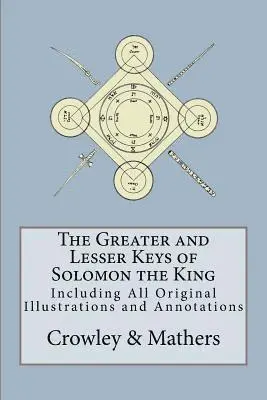
This hardback volume contains both The Key of Solomon the King (The Greater Key) and The Lesser Key of Solomon, including all of the original illustrations, diagrams and annotations to aid the reader in their understanding of the Solomon Key.
The Key of Solomon the King was originally researched and translated by S.L. MacGregor Mathers from ancient manuscripts in the British museums. Included by Mathers is the Order of the Pentacles of Solomon, the Ancient Fragment of the Key of Solomon, The Qabalistic Invocation of Solomon, and 15 plates full of figures, seals and charts, as well as the original text giving detailed instruction for spells and invocations.
The work is traditionally divided into two books detailing the Key of King Solomon. Book One explains the operation of conjurations, curses, spells and other magical works. Book Two instructs the practitioner on the proper attire, purification rituals and other means of obtaining the goals of the Goetia. Between these two books is the list of plates that contain numerous illustrations and secret seals of Solomon, including the Mystical Seal of Solomon, the Pentacles of Solomon, and the Mystical Alphabet, which impart the mechanisms and requirements for the invocation of spirits and demons.
The Lesser Key of Solomon, or the Clavicula Salomonis Regis, or Lemegeton, is a compilation of materials and writings from ancient sources making up a text book of magic or “grimoire.” Portions of this book can be traced back to the mid-16th to 17th centuries, when occult researchers such as Cornelius Agrippa and Johannes Trithemisus assembled what they discovered during their investigations into their own great works.
As a modern grimoire, the Lesser Key of Solomon has seen several editions with various authors and editors taking liberty to edit and translate the ancient writings and source material. In 1898, Arthur Edward Waite published his The Book of Black Magic and of Pacts, which contained large portions of the Lemegeton. He was followed by Mathers and Crowley in 1904 who published The Goetia: The Lesser Key of Solomon. Many others have assembled their own version of this ancient material since, and it is important to realize that it is the contents rather than the book itself that make up the Lesser Key. Traditionally, the source material is divided into five books: Ars Goetia, Ars Theurgia Goetia, Ars Paulina, Ars Almadel, and Ars Notoria. Mathers and Crowley indicate their edition is a translation of the first.
In the preface to this edition, it is explained that a “Secret Chief” of the Rosicrucian Order directed the completion of the book. The original editor was a G. H. Fra. D.D.C.F. who translated ancient texts from French, Hebrew, and Latin, but was unable to complete his labors because of the martial assaults of the Four Great Princes. Crowley was then asked to step in and finish what the previous author had begun. Traditionally, S. L. MacGregor Mathers is credited as the translator of this edition, and Crowley is given the title of editor.
Scholars believe these books of Solomon and their many iterations derive from the ancient practices of Jewish Kabbalah and Arab Alchemy. After time, it is thought Greek and Roman influences were added until, finally, the work was used and molded by high Renaissance magicians. This book, as well as other King Solomon books, such as the Magical Treatise of King Solomon and the Testament of Solomon, were brought back to modern times through the labors of occult practitioners such as S. L. MacGregor Mathers, Aleister Crowley and others around the turn of the last century.
179 kr
Skickas inom 3-6 vardagar

165 kr
Skickas inom 3-6 vardagar

270 kr
Skickas inom 3-6 vardagar

271 kr
Skickas inom 5-8 vardagar
257 kr
Skickas inom 3-6 vardagar
316 kr
Skickas inom 3-6 vardagar
387 kr
Skickas inom 3-6 vardagar
316 kr
Skickas inom 3-6 vardagar
387 kr
Skickas inom 3-6 vardagar

122 kr
Skickas inom 3-6 vardagar

326 kr
Skickas inom 3-6 vardagar