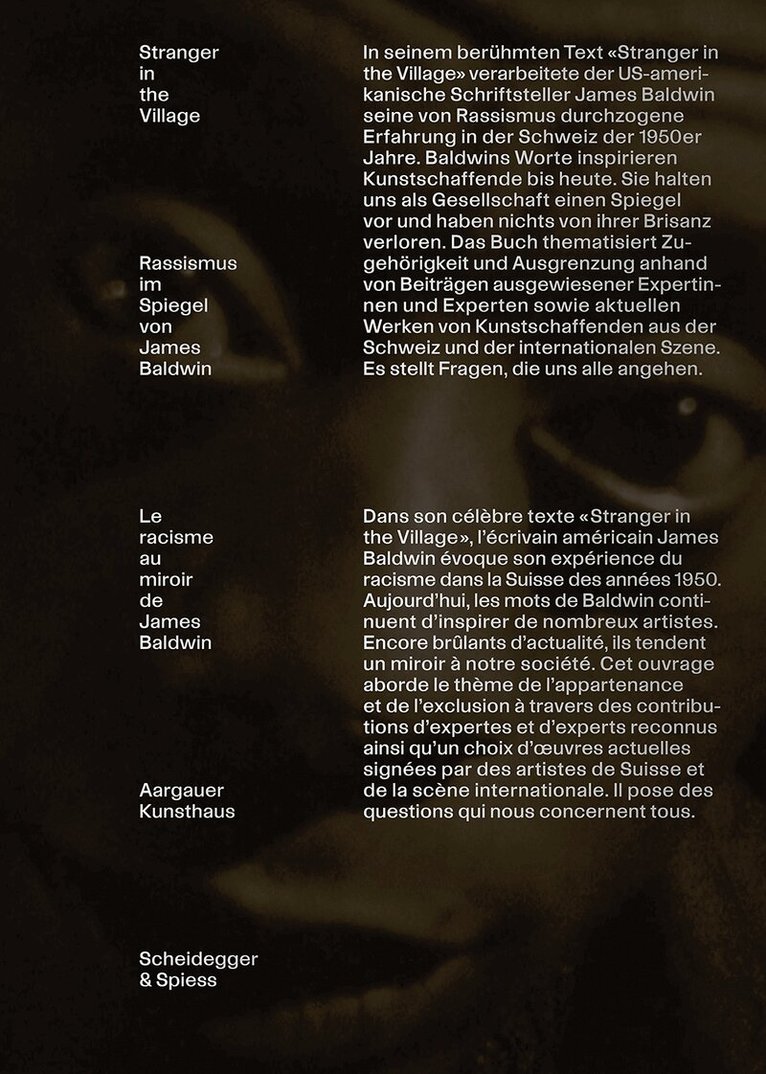
James Baldwin’s perennial essay as a starting point for artistic exploration of racism.James Baldwin (1924–1987) penned his famous essay Stranger in the Village in the early 1950s during a stay in the Swiss Alpine village of Loèches-les-Bains. It is the starting point for an artistic examination of the subject of racism in Switzerland, and in the art and culture industries in particular, that is documented in this multilingual French/German book.Works by international contemporary artists — including Igshaan Adams, Kader Attia, Omar Ba, James Bantone, Marlene Dumas, Melanie Grauer, Jonathan Horowitz, Sasha Huber, Pierre Koralnik, Glenn Ligon, Martine Syms, and others—react to Baldwin’s literary-political treatise. Essays contributed by distinguished authors supplement the artistic debate and highlight the consequences of the prevailing structural racism.The book is an invitation to break taboos. It holds a mirror up to us, raising questions that concern us all, and reveals the topicality of everyday racism to every one of us through the artworks it features.Text in French, English and German.
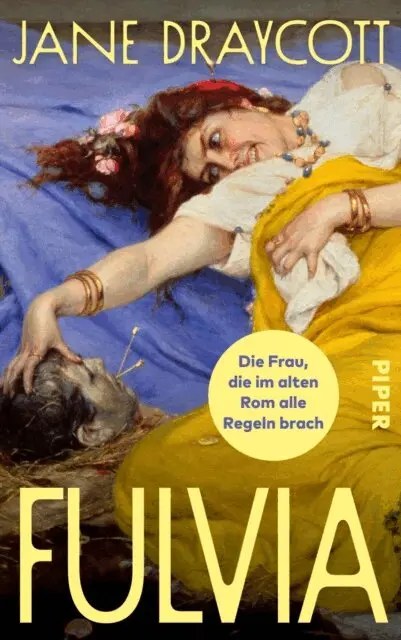
»Grausam, habgierig, unweiblich« – Ihre männlichen Gegner hassten Fulvia. Doch wer war sie wirklich, die mächtigste Frau Roms?Um 83 v. Chr. geboren, lebte Fulvia zur Zeit von Cäsar und Kleopatra – und gehörte zu den ganz wenigen Frauen des römischen Reiches, die enorm viel Macht und Einfluss hatten. Bekannt ist sie zwar aus antiken Quellen, doch fast immer als Zerrbild durch die Feder ihrer männlichen Feinde: habgierig, grausam, eigensinnig, unweiblich. Ein Ruf, der sich über Jahrhunderte festgesetzt hat, bis hin zu der Legende, sie habe nach Ciceros Tod seine Zunge mit Haarnadeln durchstochen.Die britische Historikerin Jane Draycott spürt der Fulvia hinter den Diffamierungen nach. Sie liest die Texte von Fulvias Gegnern kritisch, ordnet sie politisch ein und lässt dabei das alte Rom auferstehen. Sie erzählt von Fulvias Aufstieg an die Spitze der Macht, von ihren strategischen Bündnissen und ihrem außergewöhnlichen Charisma.So entsteht das faszinierende Porträt einer Frau, die nicht gefallen wollte, sondern ihr Leben und ihren Aufstieg selbst gestaltete: vielleicht hart, sicher klug – und politisch gefährlich genug, um bis heute missverstanden zu werden.