• Fri frakt över 249 kr
  • •
  • Snabba leveranser
  • •
  • Billiga böcker
Kundservice

Du är på sajten för privatpersoner.

Företag, bibliotek eller offentlig verksamhet?

Du handlar på classic.bokus.com, där alla dina funktioner finns intakta.
Till classic.bokus.com
Bokus logotyp. Gå till startsidan.
  • Erbjudanden
  • Nyheter
  • Student
  • Topplistor
  • Barn & ungdom
  • Bokus Play
  • E-böcker
  • Pocketböcker
  • Spel & pussel

10% rabatt på allt med kod NYSTART10 →

Sidfot

Mina sidor

    Hjälp

    • Kundservice
    • Vanliga frågor och svar
    • Frakt och leverans
    • Retur vid ångerrätt
    • Reklamera vara
    • Betalning
    • Köpvillkor
    • Allmänna villkor
    • Information om webbplatsens tillgänglighet

    Om Bokus

    • Om oss
    • Pressrum
    • För studenter
    • För företag
    • För bibliotek och offentlig verksamhet
    • För leverantörer
    • Hållbarhet

    Populärt

    • Aktuella erbjudanden
    • Presentkort
    • Studentlitteratur
    • Nya böcker
    • Topplistor
    • Signerade böcker
    • Engelska böcker

    Inspiration

    • Boktips
    • BookTok
    • Populära bokserier
    • Barnbokskaraktärer
    • Populära författare
    Logotyp för Bokus
    Följ oss på Facebook (extern länk)Följ oss på Instagram (extern länk)Följ oss på YouTube (extern länk)Följ oss på TikTok (extern länk)
    bokus @ CookiesAnpassa cookiesIntegritetspolicyKöpvillkor
    Till Citymail hemsida (extern länk)Till Budbee hemsida (extern länk)Till Postnord hemsida (extern länk)Till Schenker hemsida (extern länk)Till Early Bird hemsida (extern länk)Till Walleys hemsida (extern länk)
    1. Naturvetenskap och teknik
    2. Teknik och industri
    3. Maskinteknik och material

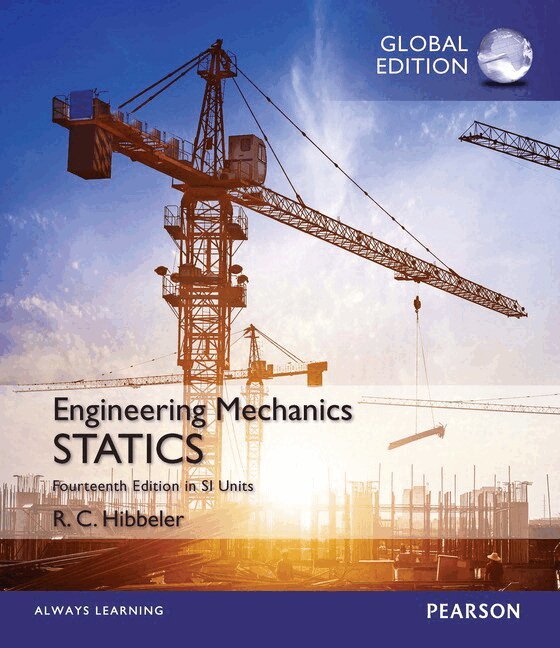
    Engineering Mechanics

    Statics & Dynamics -- Mastering Engineering with Pearson eText

    AvRussell Hibbeler

    Pearson Education

    2018

    2 824 kr

    Kommande

    Fler format och utgåvor

    Övrigt

    Kommande

    Beskrivning

    NOTE: Before purchasing, check with your instructor to ensure you select the correct ISBN. Several versions of Pearson's MyLab & Mastering products exist for each title, and registrations are not transferable. To register for and use Pearson's MyLab & Mastering products, you may also need a Course ID, which your instructor will provide.


    Used books, rentals, and purchases made outside of Pearson

    If purchasing or renting from companies other than Pearson, the access codes for Pearson's MyLab & Mastering products may not be included, may be incorrect, or may be previously redeemed. Check with the seller before completing your purchase.


    For Statics, Dynamics, and Combined Statics & Dynamics Courses.


    A proven approach to conceptual understanding and problem-solving skills

    Engineering Mechanics: Statics & Dynamics excels in providing a clear and thorough presentation of the theory and application of engineering mechanics. Engineering Mechanics empowers students to succeed by drawing upon Prof. Hibbeler’s everyday classroom experience and his knowledge of how students learn. The text is shaped by the comments and suggestions of hundreds of reviewers in the teaching profession, as well as many of the author’s students.


    The 14th Edition features Preliminary Problems to help students develop conceptual understanding and build problem-solving skills. The text also provides a large variety of problems with varying levels of difficulty that cover a broad range of engineering disciplines and stress practical, realistic situations encountered in professional practice.


    Mastering™ is the teaching and learning platform that empowers you to reach every student. By combining trusted author content with digital tools developed to engage students and emulate the office-hour experience, Mastering personalizes learning and often improves results for each student. Tutorial exercises and author-created tutorial videos walk students through how to solve a problem, consistent with the author’s voice and approach from the book.


    0135881277/9780135881279 Engineering Mechanics: Statics & Dynamics, 14/e Plus Modified Mastering Engineering Revision with Pearson eText -- Access Card Package, 14/e

    Package consists of:

    • 0133915425/9780133915426  Engineering Mechanics: Statics & Dynamics, 14/e
    • 0135699185/9780135699188 Modified Mastering Engineering Revision with Pearson eText -- Standalone Access Card -- for Engineering Mechanics: Statics & Dynamics, 14/e


    Produktinformation

    • Märke:Pearson Education
    • Utgivningsdatum:2018-06-04
    • Höjd:216 x 279 x 2 mm
    • Vikt:14 g
    • Språk:Engelska
    • Antal sidor:9 998
    • Upplaga:14
    • Förlag:Pearson Education
    • EAN:9780133941296

    Utforska kategorier

    • Maskinteknik och material inom Naturvetenskap och teknik

    Innehållsförteckning

    • 1 General Principles 3 Chapter Objectives 31.1 Mechanics 31.2 Fundamental Concepts 41.3 Units of Measurement 71.4 T he International System of Units 91.5 Numerical Calculations 101.6 General Procedure for Analysis 122 Force Vectors 17Chapter Objectives 172.1 Scalars and Vectors 172.2 Vector Operations 182.3 Vector Addition of Forces 202.4 Addition of a System of Coplanar Forces 322.5 C artesian Vectors 432.6 Addition of Cartesian Vectors 462.7 Position Vectors 562.8 Force Vector Directed Along a Line 592.9 Dot Product 693 Equilibrium of a Particle 85Chapter Objectives 853.1 Condition for the Equilibrium of a Particle 853.2 The Free-Body Diagram 863.3 Coplanar Force Systems 893.4 Three-Dimensional Force Systems 1034 Force System Resultants 117Chapter Objectives 1174.1 Moment of a Force—Scalar Formulation 1174.2 Cross Product 1214.3 Moment of a Force—Vector Formulation 1244.4 Principle of Moments 1284.5 Moment of a Force about a Specified Axis 1394.6 Moment of a Couple 1484.7 Simplification of a Force and Couple System 1604.8 Further Simplification of a Force and Couple System 1704.9 Reduction of a Simple Distributed Loading 1835 Equilibrium of a Rigid Body 199Chapter Objectives 1995.1 Conditions for Rigid-Body Equilibrium 1995.2 Free-Body Diagrams 2015.3 Equations of Equilibrium 2145.4 Two- and Three-Force Members 2245.5 Free-Body Diagrams 2375.6 Equations of Equilibrium 2425.7 Constraints and Statical Determinacy 2436 Structural Analysis 263Chapter Objectives 2636.1 Simple Trusses 2636.2 The Method of Joints 2666.3 Zero-Force Members 2726.4 The Method of Sections 2806.5 Space Trusses 2906.6 Frames and Machines 2947 Internal Forces 331Chapter Objectives 3317.1 Internal Loadings Developed in Structural Members 3317.2 Shear and Moment Equations and Diagrams 3477.3 Relations between Distributed Load, Shear, and Moment 3567.4 Cables 3678 Friction 389Chapter Objectives 3898.1 Characteristics of Dry Friction 3898.2 Problems Involving Dry Friction 3948.3 Wedges 4168.4 Frictional Forces on Screws 4188.5 Frictional Forces on Flat Belts 4258.6 Frictional Forces on Collar Bearings, Pivot Bearings, and Disks 4338.7 Frictional Forces on Journal Bearings 4368.8 Rolling Resistance 4389 Center of Gravity and Centroid 451Chapter Objectives 4519.1 Center of Gravity, Center of Mass, and the Centroid of a Body 4519.2 Composite Bodies 4749.3 Theorems of Pappus and Guldinus 4889.4 Resultant of a General Distributed Loading 4979.5 Fluid Pressure 49810 Moments of Inertia 515 Chapter Objectives 51510.1 Definition of Moments of Inertia for Areas 51510.2 Parallel-Axis Theorem for an Area 51610.3 Radius of Gyration of an Area 51710.4 Moments of Inertia for Composite Areas 52610.5 Product of Inertia for an Area 53410.6 Moments of Inertia for an Area about Inclined Axes 53810.7 Mohr’s Circle for Moments of Inertia 54110.8 Mass Moment of Inertia 54911 Virtual Work 567Chapter Objectives 56711.1 Definition of Work 56711.2 Principle of Virtual Work 56911.3 Principle of Virtual Work for a System of Connected Rigid Bodies 57111.4 Conservative Forces 58311.5 Potential Energy 58411.6 Potential-Energy Criterion for Equilibrium 58611.7 Stability of Equilibrium Configuration 587 AppendixContents12 Kinematics of a Particle 12.1 Introduction 12.2 Rectilinear Kinematics: Continuous Motion 12.3 Rectilinear Kinematics: Erratic Motion 12.4 General Curvilinear Motion 12.5 Curvilinear Motion: Rectangular Components 12.6 Motion of a Projectile 12.7 Curvilinear Motion: Normal and Tangential Components 12.8 Curvilinear Motion: Cylindrical Components 12.9 Absolute Dependent Motion Analysis of Two Particles 12.10 Relative-Motion of Two Particles Using Translating Axes 13 Kinetics of a Particle: Force andAcceleration 13.1 Newton’s Second Law of Motion 13.2 The Equation of Motion 13.3 Equation of Motion for a Systemof Particles 13.4 Equations of Motion: Rectangular Coordinates 13.5 Equations of Motion: Normaland Tangential Coordinates 13.6 Equations of Motion: Cylindrical Coordinates *13.7 Central-Force Motion and Space Mechanics 14 Kinetics of a Particle: Work andEnergy 14.1 The Work of a Force 14.2 Principle of Work and Energy 14.3 Principle of Work and Energy for a System of Particles 14.4 Power and Efficiency 14.5 Conservative Forces and Potential Energy 14.6 Conservation of Energy 15 Kinetics of a Particle: Impulseand Momentum 15.1 Principle of Linear Impulse and Momentum 15.2 Principle of Linear Impulse and Momentum for a System of Particles15.3 Conservation of Linear Momentum for a System of Particles 15.4 Impact 15.5 Angular Momentum 15.6 Relation Between Moment of a Force and Angular Momentum 15.7 Principle of Angular Impulse and Momentum 15.8 Steady Flow of a Fluid Stream *15.9 Propulsion with Variable Mass 16 Planar Kinematics of a RigidBody 16.1 Planar Rigid-Body Motion 16.2 Translation 16.3 Rotation about a Fixed Axis 16.4 Absolute Motion Analysis 16.5 Relative-Motion Analysis: Velocity 16.6 Instantaneous Center of Zero Velocity 16.7 Relative-Motion Analysis: Acceleration 16.8 Relative-Motion Analysis using Rotating Axes 17 Planar Kinetics of a Rigid Body:Force and Acceleration 17.1 Mass Moment of Inertia 17.2 Planar Kinetic Equations of Motion 17.3 Equations of Motion: Translation 17.4 Equations of Motion: Rotation about a Fixed Axis 17.5 Equations of Motion: General Plane Motion 18 Planar Kinetics of a Rigid Body:Work and Energy 18.1 Kinetic Energy 18.2 The Work of a Force 18.3 The Work of a Couple Moment 18.4 Principle of Work and Energy 18.5 Conservation of Energy 19 Planar Kinetics of a Rigid Body:Impulse and Momentum 19.1 Linear and Angular Momentum 19.2 Principle of Impulse and Momentum 19.3 Conservation of Momentum *19.4 Eccentric Impact 20 Three-Dimensional Kinematics ofa Rigid Body 20.1 Rotation About a Fixed Point *20.2 The Time Derivative of a Vector Measured from Either a Fixedor Translating-Rotating System 20.3 General Motion *20.4 Relative-Motion Analysis Using Translating and Rotating Axes 21 Three-Dimensional Kinetics of aRigid Body *21.1 Moments and Products of Inertia 21.2 Angular Momentum 21.3 Kinetic Energy *21.4 Equations of Motion *21.5 Gyroscopic Motion 21.6 Torque-Free Motion 22 Vibrations *22.1 Undamped Free Vibration *22.2 Energy Methods *22.3 Undamped Forced Vibration *22.4 Viscous Damped Free Vibration *22.5 Viscous Damped Forced Vibration *22.6 Electrical Circuit Analogs A Mathematical Expressions B Vector Analysis C The Chain Rule Fundamental Problems PartialSolutions and Answers