• Fri frakt över 249 kr
  • •
  • Snabba leveranser
  • •
  • Billiga böcker
Kundservice

Du är på sajten för privatpersoner.

Företag, bibliotek eller offentlig verksamhet?

Du handlar på classic.bokus.com, där alla dina funktioner finns intakta.
Till classic.bokus.com
Bokus logotyp. Gå till startsidan.
  • Erbjudanden
  • Nyheter
  • Student
  • Topplistor
  • Barn & ungdom
  • Bokus Play
  • E-böcker
  • Pocketböcker
  • Spel & pussel

10% rabatt på allt med kod: NYSTART10 →

Sidfot

Mina sidor

    Hjälp

    • Kundservice
    • Vanliga frågor och svar
    • Frakt och leverans
    • Retur vid ångerrätt
    • Reklamera vara
    • Betalning
    • Köpvillkor
    • Allmänna villkor
    • Information om webbplatsens tillgänglighet

    Om Bokus

    • Om oss
    • Pressrum
    • För studenter
    • För företag
    • För bibliotek och offentlig verksamhet
    • För leverantörer
    • Hållbarhet

    Populärt

    • Aktuella erbjudanden
    • Presentkort
    • Studentlitteratur
    • Nya böcker
    • Topplistor
    • Signerade böcker
    • Engelska böcker

    Inspiration

    • Boktips
    • BookTok
    • Populära bokserier
    • Barnbokskaraktärer
    • Populära författare
    Logotyp för Bokus
    Följ oss på Facebook (extern länk)Följ oss på Instagram (extern länk)Följ oss på YouTube (extern länk)Följ oss på TikTok (extern länk)
    bokus @ CookiesAnpassa cookiesIntegritetspolicyKöpvillkor
    Till Citymail hemsida (extern länk)Till Budbee hemsida (extern länk)Till Postnord hemsida (extern länk)Till Schenker hemsida (extern länk)Till Early Bird hemsida (extern länk)Till Walleys hemsida (extern länk)
    1. Naturvetenskap och teknik
    2. Matematik och naturvetenskap
    3. Matematik

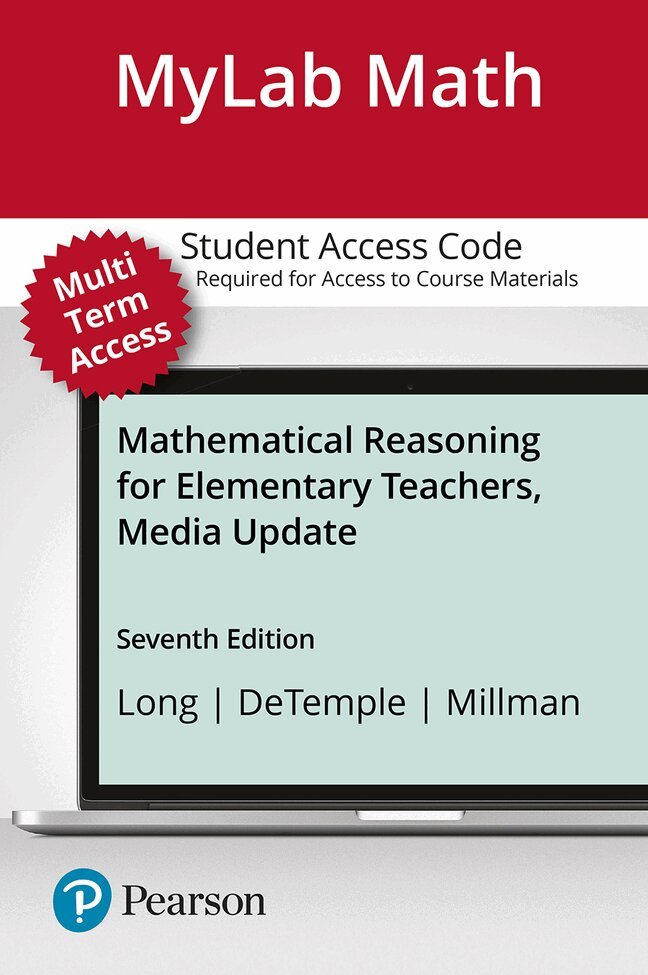
    MyLab Math with Pearson eText Access Code (24 Months) for Mathematical Reasoning for Elementary Teachers, Media Update

    AvCalvin Long,Duane DeTemple

    Pearson Education

    2018

    2 571 kr

    Tillfälligt slut

    Beskrivning

    MyLab Math Standalone Access Card to accompany Long/DeTemple/Millman, Mathematical Reasoning for Elementary Teachers - Media Update, 7e

    This item is an access card for MyLabTM Math. This physical access card includes an access code for your MyLab Math course. In order to access the online course you will also need a Course ID, provided by your instructor.

    This title-specific access card provides access to the Long/DeTemple/Millman, Mathematical Reasoning for Elementary Teachers - Media Update, 7e accompanying MyLab course ONLY.

    013476675X / 9780134766751 MYLAB MATH WITH PEARSON ETEXT -- ACCESS CARD -- FOR MATHEMATICAL REASONING FOR ELEMENTARY TEACHERS - MEDIA UPDATE, 7/e

    MyLab Math is the world’s leading online tutorial, and assessment program designed to help you learn and succeed in your mathematics course. MyLab Math online courses are created to accompany one of Pearson’s best-selling math textbooks. Every MyLab Math course includes a complete, interactive eText. Learn more about MyLab Math.

    ALERT:

    Before you purchase, check with your instructor or review your course syllabus to ensure that you select the correct ISBN.

    Used or rental books

    If you rent or purchase a used book with an access code, the access code may have been redeemed previously and you may have to purchase a new access code.

    Access codes

    Access codes that are purchased from sellers other than Pearson carry a higher risk of being either the wrong ISBN or a previously redeemed code. Check with the seller prior to purchase.

    Produktinformation

    • Märke:Pearson Education
    • Utgivningsdatum:2018-01-08
    • Höjd:216 x 279 x 2 mm
    • Vikt:14 g
    • Språk:Engelska
    • Upplaga:7
    • Förlag:Pearson Education
    • EAN:9780134766751

    Utforska kategorier

    • Matematik inom Naturvetenskap och teknik

    Mer om författaren

    About our authors Calvin Long received his B.S. in Mathematics from the University of Idaho. Following M.S. and Ph.D. degrees in Mathematics from the University of Oregon, he worked briefly as an analyst for the National Security Agency and then joined the faculty at Washington State University. His teaching ran the gamut from elementary algebra through graduate courses and included frequently teaching the content courses for prospective elementary school teachers.His other professional activities include serving on numerous committees of the National Council of Teachers of Mathematics and the Mathematical Association of America, and holding various leadership positions in those organizations. Professor Long has also been heavily engaged in directing and instructing in-service workshops and institutes for teachers at all levels, has given more than 100 presentations at national and regional meetings of NCTM and its affiliated groups, and has presented invited lectures on mathematics education abroad.Professor Long has co-authored 2 books and is the sole author of a text on number theory. In addition, he has authored over 90 articles on mathematics and mathematics education, and served as a frequent reviewer for mathematics journals including The Arithmetic Teacher and The Mathematics Teacher. In 1986 he received the Faculty Excellence Award in Teaching from Washington State University, and in 1991 he received a Certificate for Meritorious Service to the Mathematical Association of America.Aside from his professional activities, Cal enjoys listening to, singing and directing classical music, reading, fly fishing, camping and backpacking.Duane DeTemple received his B.S. with majors in Applied Science and Mathematics from Portland State College. Following his Ph.D. in Mathematics from Stanford University, he was a faculty member at Washington State University, where he is now a Professor Emeritus of Mathematics. He has been extensively involved with teacher preparation and professional development at both the elementary and secondary levels. Professor DeTemple has been a frequent consultant to projects sponsored by the Washington State Office of the Superintendent of Public Instruction, the Higher Education Coordinating Board and other boards and agencies.Dr. DeTemple has co-authored 4 other books and over 100 articles on mathematics or mathematics materials for the classroom. He is a member of the Washington State University President’s Teaching Academy, and in 2007 was the recipient of the WSU Sahlin Faculty Excellence Award for Instruction and the Distinguished Teaching Award of the Pacific Northwest Section of the Mathematical Association of America.In addition to teaching and research mathematics, Duane enjoys reading, listening to and playing music, hiking, biking, canoeing, traveling and playing tennis.Richard Millman received a B.S. from the Massachusetts Institute of Technology and a Ph.D. from Cornell University in Mathematics. He is a professor of mathematics and was director of the Center for Education Integrating Science, Mathematics and Computing (CEISMC) at the Georgia Institute of Technology, which supports STEM outreach in K-12. He was formerly the Outreach Professor of Mathematics at the University of Kentucky, where he was involved in both preservice and in-service teacher training for mathematics teachers.Dr. Millman has co-authored 4 books in mathematics, co-edited 3 others, and received 10 peer-reviewed grants. He has published over 50 articles about mathematics or mathematics education and has taught a wide variety of mathematics and mathematics education courses throughout the undergraduate and graduate curriculum, including those for preservice teachers. He received, with a former student, an Excel Prize for Expository Writing for an article in The Mathematics Teacher and was a Member-at-Large of the Council of the American Mathematical Society. He was principal investigator and project director for ALGEBRA CUBED, a grant from the National Science Foundation to improve algebra education in rural Kentucky. He was the principal investigator of a Race to the Top grant from the Georgia Department of Education and another NSF grant, SLIDER, in which students use a curriculum based on engineering design in the context of building robots to learn 8th-grade physical science and math.Rich enjoys traveling, writing about mathematics, losing golf balls, listening to music, and going to plays and movies. He also loves and is enormously proud of his grandchildren, with whom he enjoys discussing the conceptual basis of mathematics, among other topics.

    Innehållsförteckning

    • Thinking Critically 1.1 An Introduction to Problem Solving1.2 Polya’s Problem-Solving Principles and the Standards for Mathematical Practice of the Common Core State Standards for Mathematics1.3 More Problem-Solving Strategies1.4 Algebra as a Problem-Solving Strategy1.5 Additional Problem-Solving Strategies1.6 Reasoning MathematicallySets and Whole Numbers 2.1 Sets and Operations on Sets2.2 Sets, Counting, and the Whole Numbers2.3 Addition and Subtraction of Whole Numbers2.4 Multiplication and Division of Whole NumbersNumeration and Computation 3.1 Numeration Systems Past and Present3.2 Algorithms for Addition and Subtraction of Whole Numbers3.3 Algorithms for Multiplication and Division of Whole Numbers3.4 Mental Arithmetic and Estimation3.5 Nondecimal Positional SystemsNumber Theory 4.1 Divisibility of Natural Numbers4.2 Tests for Divisibility4.3 Greatest Common Divisors and Least Common MultiplesIntegers 5.1 Representation of Integers5.2 Addition and Subtraction of Integers5.3 Multiplication and Division of IntegersFractions and Rational Numbers 6.1 The Basic Concepts of Fractions and Rational Numbers6.2 Addition and Subtraction of Fractions6.3 Multiplication and Division of Fractions6.4 The Rational Number SystemDecimals, Real Numbers, and Proportional Reasoning 7.1 Decimals and Real Numbers7.2 Computations with Decimals7.3 Proportional Reasoning7.4 PercentAlgebraic Reasoning, Graphing, and Connections with Geometry 8.1 Variables, Algebraic Expressions, and Functions8.2 Graphing Points, Lines, and Elementary Functions8.3 Connections between Algebra and GeometryGeometric Figures 9.1 Figures in the Plane9.2 Curves and Polygons in the Plane9.3 Figures in SpaceMeasurement: Length, Area, and Volume 10.1 The Measurement Process10.2 Area and Perimeter10.3 The Pythagorean Theorem10.4 Volume10.5 Surface AreaTransformations, Symmetries, and Tilings 11.1 Rigid Motions and Similarity Transformations11.2 Patterns and Symmetries11.3 Tilings and Escher-like DesignsCongruence, Constructions, and Similarity 12.1 Congruent Triangles12.2 Constructing Geometric Figures12.3 Similar TrianglesStatistics: The Interpretation of Data 13.1 Organizing and Representing Data13.2 Measuring the Center and Variation of Data13.3 Statistical InferenceProbability 14.1 The Basics of Probability14.2 Applications of Counting Principles to Probability14.3 Permutations and Combinations14.4 Odds, Expected Values, Geometric Probability, and Simulations