• Fri frakt över 249 kr
  • •
  • Snabba leveranser
  • •
  • Billiga böcker
Kundservice

Du är på sajten för privatpersoner.

Företag, bibliotek eller offentlig verksamhet?

Du handlar på classic.bokus.com, där alla dina funktioner finns intakta.
Till classic.bokus.com
Bokus logotyp. Gå till startsidan.
  • Erbjudanden
  • Nyheter
  • Student
  • Topplistor
  • Barn & ungdom
  • Bokus Play
  • E-böcker
  • Pocketböcker
  • Spel & pussel

10% rabatt på allt med kod: NYSTART10 →

Sidfot

Mina sidor

    Hjälp

    • Kundservice
    • Vanliga frågor och svar
    • Frakt och leverans
    • Retur vid ångerrätt
    • Reklamera vara
    • Betalning
    • Köpvillkor
    • Allmänna villkor
    • Information om webbplatsens tillgänglighet

    Om Bokus

    • Om oss
    • Pressrum
    • För studenter
    • För företag
    • För bibliotek och offentlig verksamhet
    • För leverantörer
    • Hållbarhet

    Populärt

    • Aktuella erbjudanden
    • Presentkort
    • Studentlitteratur
    • Nya böcker
    • Topplistor
    • Signerade böcker
    • Engelska böcker

    Inspiration

    • Boktips
    • BookTok
    • Populära bokserier
    • Barnbokskaraktärer
    • Populära författare
    Logotyp för Bokus
    Följ oss på Facebook (extern länk)Följ oss på Instagram (extern länk)Följ oss på YouTube (extern länk)Följ oss på TikTok (extern länk)
    bokus @ CookiesAnpassa cookiesIntegritetspolicyKöpvillkor
    Till Citymail hemsida (extern länk)Till Budbee hemsida (extern länk)Till Postnord hemsida (extern länk)Till Schenker hemsida (extern länk)Till Early Bird hemsida (extern länk)Till Walleys hemsida (extern länk)
    1. Naturvetenskap och teknik
    2. Matematik och naturvetenskap
    3. Matematik

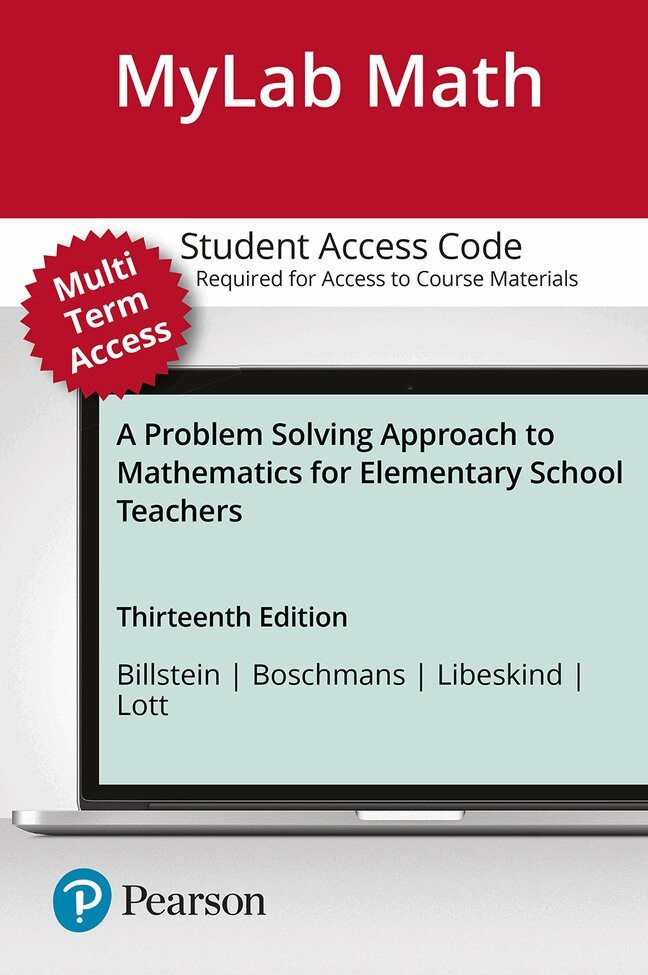
    MyLab Math with Pearson eText Access Code (24 Months) for Problem Solving Approach to Mathematics for Elementary School Teachers, A

    AvRick Billstein,Shlomo Libeskind

    Pearson Education

    2019

    2 571 kr

    Beställningsvara. Skickas inom 7-10 vardagar. Fri frakt över 249 kr.

    Beskrivning

    MyLab Math Standalone Access Card to accompany Billstein et al., A Problem Solving Approach to Mathematics for Elementary School Teachers, 13/e

    This item is an access card for MyLabTM Math. This physical access card includes an access code for your MyLab Math course. In order to access the online course you will also need a Course ID, provided by your instructor.

    This title-specific access card provides access to the Billstein et al., A Problem Solving Approach to Mathematics for Elementary School Teachers, 13/e accompanying MyLab course ONLY.

    0135190053 / 9780135190050 MYLAB MATH WITH PEARSON ETEXT -- STANDALONE ACCESS CARD -- FOR A PROBLEM SOLVING APPROACH TO MATHEMATICS FOR ELEMENTARY SCHOOL TEACHERS, 13/e

    MyLab Math is the world’s leading online tutorial, and assessment program designed to help you learn and succeed in your mathematics course. MyLab Math online courses are created to accompany one of Pearson’s best-selling math textbooks. Every MyLab Math course includes a complete, interactive eText. Learn more about MyLab Math.

    ALERT:

    Before you purchase, check with your instructor or review your course syllabus to ensure that you select the correct ISBN.

    Used or rental books

    If you rent or purchase a used book with an access code, the access code may have been redeemed previously and you may have to purchase a new access code.

    Access codes

    Access codes that are purchased from sellers other than Pearson carry a higher risk of being either the wrong ISBN or a previously redeemed code. Check with the seller prior to purchase.

    Produktinformation

    • Märke:Pearson Education
    • Utgivningsdatum:2019-01-02
    • Språk:Engelska
    • Antal sidor:9 998
    • Upplaga:13
    • Förlag:Pearson Education
    • EAN:9780135190050

    Utforska kategorier

    • Matematik inom Naturvetenskap och teknik

    Mer om författaren

    About our authors Rick Billstein is a Professor of Mathematics at the University of Montana. He has worked in mathematics teacher education at this university for over 40 years and his current research is in the areas of curriculum development and mathematics teacher education. He teaches courses for future teachers in the Mathematics Department. He served as the site director for the Show-Me Project, an NSF-funded project supporting the dissemination and implementation of standards-based middle grades mathematics curricula. He worked on the NSF grant Tinker Plots to develop new data analysis software and he serves on the Advisory Boards for several other national projects. From 1992-1997, he directed the NSF-funded Six Through Eight Mathematics (STEM) middle school mathematics curriculum project and is now directing the Middle Grades MATH Thematics Phase II Project. Dr. Billstein has published articles in over 20 different journals and has co-authored over 40 books, including 10 editions of A Problem Solving Approach to Mathematics for Elementary Teachers. He typically does about 25 regional and national presentations per year and has worked in mathematics education at the international level. He presently serves on the Editorial Board of NCTM’s Mathematics Teaching in the Middle School. Dr. Billstein was recently awarded the George M. Dennison Presidential Faculty Award for Distinguished Accomplishment at the University of Montana.Dr. Barbara Boschmans teaches in the Department of Mathematics and Statistics at Northern Arizona University. She received her BsEd (1995), MAT (1997), and EdD (2003) in Mathematics Education from Northern Arizona University. She has taught at Arizona State University (AZ), Plymouth State University (NH), and Northern Arizona University (AZ). Dr. Boschmans has taught a variety of mathematics and mathematics education courses. She has been a frequent speaker at local, state, national, and international conferences. She has been a board member of the New Hampshire Teachers of Mathematics and the Arizona Association of Teachers of Mathematics. Dr. Boschmans is interested in bringing a joy and appreciation of mathematics to preservice and inservice elementary teachers, and changing non-STEM students’ fixed mindset to a growth mindset.Shlomo Libeskind is a professor in the mathematics department at the University of Oregon in Eugene, Oregon, and has been responsible there for the mathematics teaching major since 1986. In addition to teaching and advising pre-service and in-service teachers, Dr. Libeskind has extensive writing experience (books, articles, and workshop materials) as well as in directing mathematics education projects. In teaching and in writing, Dr. Libeskind uses a heuristic approach to problem solving and proof; in this approach the reasonableness of each step in a solution or proof is emphasized along with a discussion on why one direction might be more promising than another. As part of his focus on the improvement of the teaching of mathematics, Dr. Libeskind is also involved at many levels locally, nationally and worldwide in the evaluation of mathematics teacher preparation programs. In his home state he is actively involved in schools and councils, as well as in reviewing materials for the state standards for college admission. Most recently (spring 2008) he visited teacher colleges in Israel as a Fulbright Fellow. During this visit he conducted observations and critiques of the preparation of mathematics teachers at several colleges in Northern Israel. Dr. Libeskind received his Bachelor’s and Master’s Degrees in Mathematics at the Technion (Israel Institute of Technology) and his PhD in Mathematics at the University of Wisconsin, Madison.Johnny W. Lott began his teaching career in the public schools of DeKalb County, Georgia, outside Atlanta. There he taught mathematics in grades 8-12. He also taught one year at the Westminster Schools, grades 9-12, and one year in the Pelican, Alaska, school, grades 6-12. Johnny is the co-author of several books and has written numerous articles and other essays in the "Arithmetic Teacher", "Teaching Children Mathematics", "The Mathematics Teacher", "School Science and Mathematics", "Student Math Notes", and "Mathematics Education Dialogues". He was the Project Manager for the "Figure This!" publications and website developed by the National Council of Teachers of Mathematics (NCTM) and was project co-director of the State Systemic Initiative for Montana Mathematics and Science (SIMMS) Project. He has served on many NCTM committees, has been a member of its Board of Directors, and was its president from April 2002-April 2004. Dr. Lott is Professor Emeritus from the Department of Mathematical Sciences at The University of Montana, having been a full professor. He is currently the Director of the Center for Excellence in Teaching and Learning, Professor of Mathematics, and Professor of Education at the University of Mississippi. Additionally, he is on the Steering Committee of the Park City Mathematics Institute, works with the International Seminar, the Designing and Delivering Professional Development Seminar, and is editor for its high school publications. His doctorate is in mathematics education from Georgia State University.

    Innehållsförteckning

    • An Introduction to Problem Solving 1-1 Mathematics and Problem Solving1-2 Explorations with PatternsChapter 1 ReviewIntroduction to Logic and Sets 2-1 Reasoning and Logic: An Introduction2-2 Describing Sets2-3 Other Set OperationsChapter 2 ReviewNumeration Systems and Whole Number Operations 3-1 Numeration Systems3-2 Addition of Whole Numbers3-3 Subtraction of Whole Numbers3-4 Multiplication of Whole Numbers3-5 Division of Whole NumbersChapter 3 ReviewNumber Theory 4-1 Divisibility4-2 Prime and Composite Numbers4-3 Greatest Common Divisor and Least Common MultipleModule A: Clock and Modular Arithmetic–onlineChapter 4 ReviewIntegers 5-1 Addition and Subtraction of Integers5-2 Multiplication and Division of IntegersChapter 5 ReviewRational Numbers and Proportional Reasoning 6-1 The Set of Rational Numbers6-2 Addition, Subtraction, and Estimation with Rational Numbers6-3 Multiplication, Division, and Estimation with Rational Numbers6-4 Proportional ReasoningChapter 6 ReviewDecimals, Percents, and Real Numbers 7-1 Terminating Decimals7-2 Operations on Decimals7-3 Repeating Decimals7-4 Percents7-5 Real NumbersChapter 7 ReviewAlgebraic Thinking 8-1 Variables8-2 Equals Relation and Equations8-3 Functions8-4 Equations in a Cartesian Coordinate SystemModule B: Using Real Numbers in Equations–onlineChapter 8 ReviewProbability 9-1 Determining Probabilities9-2 Multistage Experiments and Modeling Games9-3 Simulations and Applications in Probability9-4 Permutations and Combinations in ProbabilityChapter 9 ReviewData Analysis/Statistics: An Introduction 10-1 Designing Experiments/Collecting Data10-2 Displaying Data: Part I10-3 Displaying Data: Part II10-4 Measures of Central Tendency and VariationChapter 10 ReviewIntroductory Geometry 11-1 Basic Notions11-2 Curves, Polygons, and Symmetry11-3 More About Angles11-4 Geometry in Three DimensionsModule C: Networks–onlineChapter 11 ReviewCongruence and Similarity with Constructions 12-1 Congruence Through Constructions12-2 Additional Congruence Theorems12-3 Additional Constructions12-4 Similar Triangles and Other Similar FiguresModule D: Trigonometry Ratios via Similarity–onlineChapter 12 ReviewArea, Pythagorean Theorem, and Volume 13-1 Linear Measure13-2 Areas of Polygons and Circles13-3 The Pythagorean Theorem, Distance Formula, and Equation of a Circle13-4 Surface Areas13-5 Volume, Mass, and TemperatureChapter 13 Review 890Technology ModulesModule E: Spreadsheets–onlineModule F: Graphing Calculators–onlineModule H: GeoGebra–onlineTransformations 14-1 Translations, Rotations, and Tessellations14-2 Reflections and Glide Reflections14-3 Dilations 935Chapter 14 ReviewCredits Answers to Problems Additional Instructor Answers (Annotated Instructor’s Edition only)