• Fri frakt över 249 kr
  • •
  • Snabba leveranser
  • •
  • Billiga böcker
Kundservice

Du är på sajten för privatpersoner.

Företag, bibliotek eller offentlig verksamhet?

Du handlar på classic.bokus.com, där alla dina funktioner finns intakta.
Till classic.bokus.com
Bokus logotyp. Gå till startsidan.
  • Erbjudanden
  • Nyheter
  • Student
  • Topplistor
  • Barn & ungdom
  • Bokus Play
  • E-böcker
  • Pocketböcker
  • Spel & pussel

10% studentrabatt med kod TERM26

Sidfot

Mina sidor

    Hjälp

    • Kundservice
    • Vanliga frågor och svar
    • Frakt och leverans
    • Retur vid ångerrätt
    • Reklamera vara
    • Betalning
    • Köpvillkor
    • Allmänna villkor
    • Information om webbplatsens tillgänglighet

    Om Bokus

    • Om oss
    • Pressrum
    • För studenter
    • För företag
    • För bibliotek och offentlig verksamhet
    • För leverantörer
    • Hållbarhet

    Populärt

    • Aktuella erbjudanden
    • Presentkort
    • Studentlitteratur
    • Nya böcker
    • Topplistor
    • Signerade böcker
    • Engelska böcker

    Inspiration

    • Boktips
    • BookTok
    • Populära bokserier
    • Barnbokskaraktärer
    • Populära författare

    Mina sidor

      Hjälp

      • Kundservice
      • Vanliga frågor och svar
      • Frakt och leverans
      • Retur vid ångerrätt
      • Reklamera vara
      • Betalning
      • Köpvillkor
      • Allmänna villkor
      • Information om webbplatsens tillgänglighet

      Om Bokus

      • Om oss
      • Pressrum
      • För studenter
      • För företag
      • För bibliotek och offentlig verksamhet
      • För leverantörer
      • Hållbarhet

      Populärt

      • Aktuella erbjudanden
      • Presentkort
      • Studentlitteratur
      • Nya böcker
      • Topplistor
      • Signerade böcker
      • Engelska böcker

      Inspiration

      • Boktips
      • BookTok
      • Populära bokserier
      • Barnbokskaraktärer
      • Populära författare
      Logotyp för Bokus
      Följ oss på Facebook (extern länk)Följ oss på Instagram (extern länk)Följ oss på YouTube (extern länk)Följ oss på TikTok (extern länk)
      bokus @ CookiesAnpassa cookiesIntegritetspolicyKöpvillkor
      Till Citymail hemsida (extern länk)Till Budbee hemsida (extern länk)Till Postnord hemsida (extern länk)Till Schenker hemsida (extern länk)Till Early Bird hemsida (extern länk)Till Walleys hemsida (extern länk)
      1. Naturvetenskap och teknik
      2. Geovetenskap
      3. Miljövetenskap och miljöpolitik

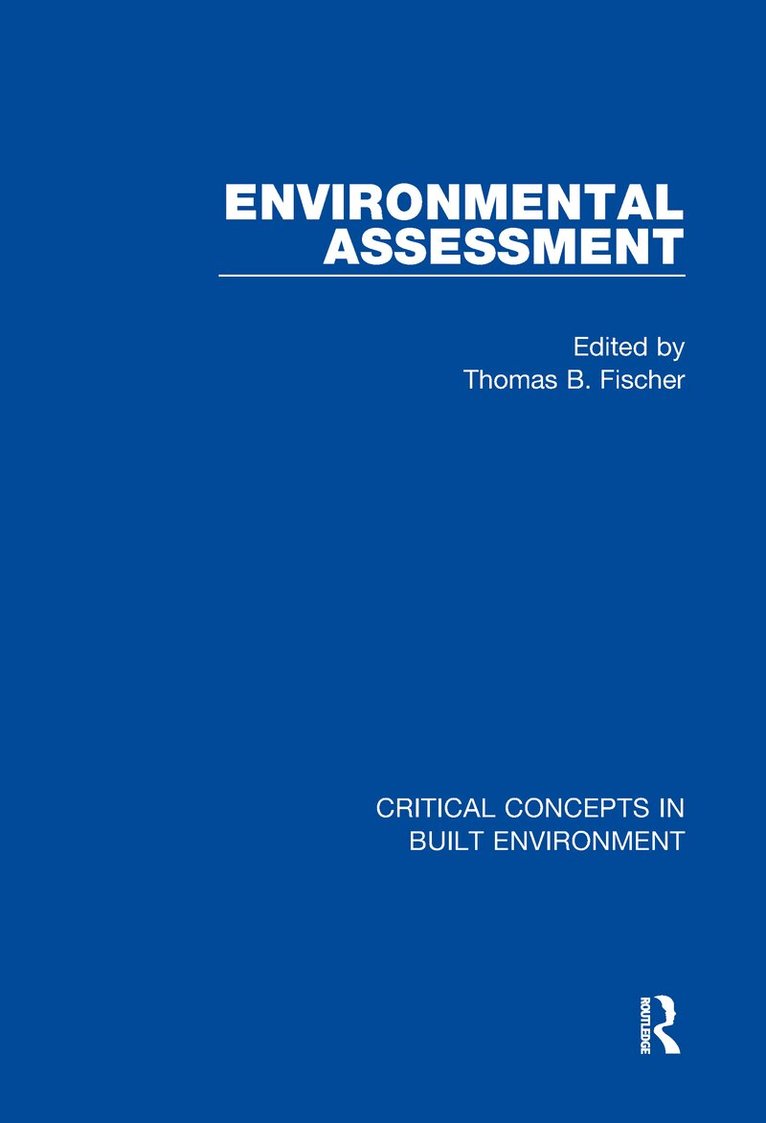
      Environmental Assessment

      AvThomas B. Fischer

      Taylor & Francis Ltd

      2015

      Del i serien Critical Concepts in Built Environment

      22 924 kr

      Beställningsvara. Skickas inom 5-8 vardagar. Fri frakt över 249 kr.

      Beskrivning

      This new four-volume collection from Routledge brings together the most important canonical and cutting-edge works in Environmental Assessment. International in scope, the materials gathered cover the background of Environmental Assessment and the different possible approaches. The collection showcases the important historical material alongside current methods and theory.

      Produktinformation

      • Märke:Taylor & Francis Ltd
      • Utgivningsdatum:2015-08-17
      • Höjd:156 x 234 x undefined mm
      • Vikt:3 080 g
      • Språk:Engelska
      • Serie:Critical Concepts in Built Environment
      • Antal sidor:1 592
      • Förlag:Taylor & Francis Ltd
      • EAN:9781138777767

      Utforska kategorier

      • Miljövetenskap och miljöpolitik inom Naturvetenskap och teknik
      • Miljöekonomi inom Ekonomi och Ledarskap

      Mer om författaren

      Thomas B Fischer is a Professor at the University of Liverpool, UK, and is currently one of the most widely published authors on SEA and EIA with over 65 papers in refereed academic journals, nine books and numerous book chapters. He is Editor of the Journal of Environmental Assessment Policy and Management and an editorial board member of the journals EIA review and Impact Assessment and Project Appraisal. He is a Fellow of the Institute of Environmental Management and Assessment (FIEMA).

      Innehållsförteckning

      • Volume I: Background and Context of Environmental Assessment1. Caldwell, L.J., 1988. Environmental impact analysis (EIA): origins, evolution, and future directions. Review of Policy Research, 8 (1): 75–83.2. Lee, N. and Walsh, F. 1992. Strategic environmental assessment: an overview, Project Appraisal, 7(3): 126–136. 3. Ortolano, L. and Shepherd, A. 1995. Environmental impact assessment: challenges and opportunities. Impact Assessment, 13 (1): 3–30.4. Brown, A. L. and Thérivel, R. 2000. Principles to guide the development of strategic environmental assessment methodology, Impact Assessment and Project Appraisal, 18(3): 183-189.5. Verheem, R.A.A. and Tonk, J.A.M.N. 2000. Strategic environmental assessment: One concept, multiple forms, Impact Assessment and Project Appraisal, 18(3): 177-183.6. Fischer, T.B. 2001. The practice of environmental assessment for transport and land use policies, plans and programmes, Impact Assessment & Project Appraisal, 19(1): 41-51.7. Rajvanshi, A. 2001. Strategic environmental assessment of the India eco-development project: experiences, prospects and lessons learnt, Journal of Environmental Assessment Policy and Management, 3(3): 373-393.8. Vanclay, F. 2004. The triple bottom line and impact assessment: How do TBL, EIA, SIA, SEA and EMS relate to each other, Journal of Environmental Assessment Policy and Management, 6(3): 265-288.9. Alshuwaikhat, H. M. 2005. Strategic environmental assessment can help solve environmental impact assessment failures in developing countries, Environmental Impact Assessment Review, 25(4): 307-317.10. Vidyarratne, H. 2006. EIA theories and practice: balancing conservation and development in Sri Lanka, Journal of Environmental Assessment Policy and Management, 8(2): 205-222.11. Jay, S.; Jones, C; Slinn, P. and Wood, C. 2007. Environmental impact assessment, retrospect and prospect, Environmental Impact Assessment Review, 27(4): 287-300.12. Hilding-Rydevik, T. and Bjarnadóttir, H. 2007. Context awareness and sensitivity in SEA implementation, Environmental Impact Assessment Review, 27(7): 666-684.13. Runhaar, H. and Driessen, P.P.J. 2007. What makes strategic environmental assessment successful environmental assessment? The role of context in the contribution of SEA to decision-making, Impact Assessment and Project Appraisal, 25(1): 2-14.14. Koivurova, T. 2008. Transboundary environmental assessment in the Arctic, Impact Assessment and Project Appraisal, 26: 265-275.15. Lam, K.-C.; Chen, J. D. and Wu, J. 2009. Strategic environmental assessment in China: Opportunities, issues and challenges, Journal of Environmental Assessment Policy and Management, 11(4): 369-385.16. Sadler, B. 2011.Taking stock of SEA; in: Sadler B., Aschemann, R.; Dusik, J.; Fischer,T. B.; Partidário, M. and Verheem R. (eds). Handbook of Strategic Environmental Assessment, Earthscan, London: 1-18.17. Fischer, T.B. and Onyango, V. 2012. SEA related research projects and journal articles: an overview of the past 20 years, Impact Assessment and Project Appraisal, 30(4): 253-263.18. Morgan, R. K. 2012. Environmental impact assessment: the state of the art, Impact Assessment and Project Appraisal, 30(1): 5-14.Volume II: Environmental Assessment Theory19. Bartlett, R.V. and Kurian, P.A. 1999. The theory of environmental impact assessment: implicit models of policy-making, Policy and Politics, 27 (4): 415–433.20. Noble, B. 2000. Strategic environmental assessment: What is it? What makes it strategic? Journal of Environmental Assessment Policy and Management, 2(2): 203–22421. Clark, R. 2000. Making EIA count in decision making, in: Partidario, M. Perspectives on Strategic Environmental Assessment, Lewis Publishers: 15-28.22. Kørnøv, L. and Thissen, W.A.H. 2000. Rationality in decision- and policy-making: Implications for strategic environmental assessment, Impact Assessment and Project Appraisal, 18(3): 191–200.23. Nielsson, M. N. and Dalkmann, H. 2001. Decision making and strategic environmental assessment, Journal of Environmental Assessment Policy and Management, 3(3): 305–328.24. Dovers, S. 2002. Too deep and SEA? Strategic environmental assessment in the era of sustainability; in: Marsden, S. and Dovers, S. (eds.) SEA in Australasia, Sydney Place Federation Press: 24-46.25. Fischer, T.B. 2003. Strategic environmental assessment in post-modern times, Environmental Impact Assessment Review, 23(2): 155–170.26. Wilkins, H. 2003. The need for subjectivity in EIA: Discourse as a tool for sustainable development, Environmental Impact Assessment Review, 23(4): 401-414.27. Cashmore, M. 2004. The role of science in environmental impact assessment: Process and procedure versus purpose in the development of theory, Environmental Impact Assessment Review, 24(3): 403-426.28. Pope, J.; Annandale, D. and Morrison-Saunders, A. 2004. Conceptualising sustainability assessment, Environmental Impact Assessment Review, 24 (6): 595–616.29. Morrison-Saunders, A. und Fischer, T.B. 2006. What is wrong with EIA and SEA anyway? - A Sceptic's Perspective on Sustainability Assessment, Journal of Environmental Assessment Policy and Management, 8(1): 19-39.30. Kidd, S. and Fischer, T.B. 2007. Towards sustainability: Is integrated appraisal a step in the right direction?, Environment and Planning C, 25(2): 233—249.31. Sinclair, A.J., Diduck, A. and Fitzpatrick, P. 2008. Conceptualizing learning for sustainability through environmental assessment: Critical reflections on 15 years of research, Environmental Impact Assessment Review, 28: 415–428.32. Retief, F. 2010. The evolution of environmental assessment debates: critical perspectives from South Africa, Journal of Environmental Assessment Policy and Management, 12 (4): 375–397.33. Weston, J. 2010. EIA theories – all Chinese whispers and no critical theory, Journal of Environmental Assessment Policy and Management, 12 (4): 357–374.34. Kørnøv, L.; Lyhne, I.; Larsen, S. V. and Hansen, A. M. 2011. Change agents in the field of strategic environmental assessment – what does it involve and what potential does it have for research and practice?, Journal of Environmental Assessment Policy and Management, 13(2): 203–228.35. Richardson, T. and Cashmore, M. 2012. Power, knowledge and environmental assessment: the World Bank’s pursuit of ‘good governance’, Journal of Political Power, 4(1): 105-125.36. Tajima, R. and Fischer, T. B. 2013. Should different impact assessment instruments be integrated? Evidence from English spatial planning, Environmental Impact Assessment Review, 41: 29-37.Volume III: Methodological aspects of Environmental Assessment37. Weston, J. 2000. EIA, Decision-making Theory and Screening and Scoping in UK Practice, Journal of Environmental Planning and Management, 43:2, 185-203.38. Enserink, B. 2000. A quick scan for infrastructure planning: screening alternatives through interactive stakeholder analysis, Impact Assessment and Project Appraisal, 18 (1): 15–22.39. Tukker, A. 2000. Life cycle assessment as a tool in environmental impact assessment, Environmental Impact Assessment Review, 20(4): 435-456.40. Marshall, R. 2001. Application of mitigation and its resolution within environmental impact assessment: An industrial perspective, Impact Assessment and Project Appraisal, 19(3): 195–204.41. Rossouw, N. 2003. A Review of Methods and Generic Criteria for Determining Impact Significance, African Journal of Environmental Assessment and Management, 6: 44-61.42. Petts, J. 2003. Barriers to deliberative participation in EIA: learning from waste policies, plans and projects, Journal of Environmental Assessment Policy and Management, 5 (3): 269–293.43. Stein, W.; Gerlach, J. and Tomlinson, P. 2004. SEA in transport planning in Germany; in: : Schmidt M, João E and Albrecht E (eds), Implementing Strategic Environmental Assessment, Springer-Verlag: 585-597.44. Treweek, J.; Thérivel, R .; Thompson, S. and Slater, M. 2005. Principles for the use of strategic environmental assessment as a tool for promoting the conservation and sustainable use of biodiversity, Journal of Environmental Assessment Policy and Management, 7 (2): 173-199.45. Partidário M. R. and Arts, J. 2005. Exploring the concept of strategic environmental assessment follow-up, Impact Assessment and Project Appraisal, 23(3): 246-257.46. Hacking, T. and Guthrie, P. 2006. Sustainable development objectives in impact assessment: Why are they needed and where do they come from? Journal of Environmental Assessment Policy and Management, 8(3): 341-371.47. Duinker, P.N. and Greig, L.A. 2007. Scenario analysis in environmental impact assessment: improving explorations of the future, Environmental Impact Assessment Review, 27(3): 206-219.48.Gunn, J. H. and Noble, B. F. 2009. Integrating cumulative effects in regional strategic environmental assessment frameworks: Lessons from practice, Journal of Environmental Assessment Policy and Management, 11(3): 267-290.49. Pinho, P.; McCallum, S.; and Santos Cruz, S. 2010. A critical appraisal of EIA screening practice in EU Member States, Impact Assessment and Project Appraisal, 28 (2): 91–107.50. Nadeem, O. and Fischer, T.B. 2011. 'An Evaluation Framework for Effective Public Participation in EIA in Pakistan', Environmental Impact Assessment Review, 31(1): 36-47.51. González Del Campo, A. 2012. GIS in environmental assessment – a review of current issues and future needs, Journal of Environmental Assessment Policy and Management, 14(1): 1250007.52. Noble, B. F.; Gunn, J. and Martin, J.2012. Survey of current methods and guidance for strategic environmental assessment, Impact Assessment and Project Appraisal, 30(3): 139-147.53. Fischer, T. B. 2012. Identifying shortcomings of SEA practice, Town and Country Planning 81 (6): 281-286.Volume IV: Environmental Assessment effectiveness54. Ten Heuvelhof, E. and Nauta, C. 1997. The effects of environmental impact assessment in the Netherlands, Project Appraisal, 12(1), 25–30.55. Marsden, S. 1998. Importance of Context in measuring the effectiveness of strategic environmental assessment, Impact Assessment and Project Appraisal, 16(4): 255-266.56. Emmelin, L. 1998. Evaluating environmental impact assessment systems—Part 1: theoretical and methodological considerations. Scandinavian Housing and Planning Research, 15: 129–148.57. Emmelin, L. 1998. Evaluating environmental impact assessment systems—Part 2: Professional Culture as an aid in understanding implementation. Scandinavian Housing and Planning Research, 15: 187-209.58. Wood, C. 1999. Comparative evaluation of environmental impact assessment systems, in: Petts, J. Handbook of EIA: Volume 2: Impact and Limitations, Wiley, 10-34.59. Glasson, J. 1999. The First 10 Years of UK EIA System: Strengths, Weaknesses, Opportunities and Threats, Planning Theory and Practice, 14(3): 363–375.60. Fischer, T.B. 2002. SEA performance criteria – the same requirements for every assessment? Journal of Environmental Assessment Policy and Management, 4(1): 83-99.61. Cashmore, M.; Gwilliam, R.; Morgan, R.; Cobb, D. and Bond, A. 2004. The interminable issue of effectiveness: substantive purposes, outcomes and research challenges in the advancement of environmental impact assessment theory, Impact Assessment and Project Appraisal, 22 (4): 295–310.62. Ortolano, L. and May, C. L. 2004. Appraising effects of mitigation measures: the Grand Coulee Dam’s Impacts on Fisheries; in: Arts, J. and Morrison-Saunders, A. (eds.). Follow-up in Environmental Assessment, Earthscan, London: 97-117.63. Fischer, T.B. and Gazzola, P. 2006. SEA good practice elements and performance criteria — equally valid in all countries? — the case of Italy, Environment Impact Assessment Review, 26(4): 396–409.64. Retief, F. 2007. Effectiveness of strategic environmental assessment in South Africa, Journal of Environmental Assessment Policy and Management,9(1):38-101.65. Runhaar, H.A.C. and Driessen, P.P.J. 2007. What makes strategic environmental assessment successful environmental assessment?, Impact Assessment and Project Appraisal, 25(1): 2–14.66. Spaling, H. and Vroom, B. 2007. Environmental assessment after the 2004 tsunami: a case study, lessons and prospects, Impact Assessment and Project Appraisal, 25: 43-52.67. Bina, O. 2008. Context and systems: thinking more broadly about effectiveness in strategic environmental assessment in China, Environmental Management, 42: 717-733.68. Elling, B., 2009. Rationality and effectiveness: does EIA/SEA treat them as synonyms?, Impact Assessment and Project Appraisal, 27 (2): 121–131.69. Jha-Thakur, U.; Gazzola, P.; Peel, D.; Fischer, T.B. and Kidd, S. 2009. Effectiveness of strategic environmental assessment — the significance of learning, Impact Assessment and Project Appraisal, 27(2): 133–144.70. Stoeglehner, G.; Brown, A.L. and Kørnøv, L.B. 2009. SEA and planning: "ownership" of strategic environmental assessment by the planners is the key to its effectiveness, Impact Assessment and Project Appraisal, 27(2): 111–120.71. Arts, J.; Runhaar, H.; Fischer, T.B.; Jha-Thakur, U.; van Laerhoven, F.; Driessen, P. and Onyango, V. 2012. The Effectiveness of EIA as an Instrument for Environmental Governance – A Comparison of the Netherlands and the UK, Journal of Environmental Assessment Policy and Management, 14(4): 1250025.72. Tajima, R.; Gore, T. and Fischer, T. B. 2014. Policy integration between Environmental Assessment and Disaster Management, Journal of Environmental Assessment Policy and Management, 16(3): 450028
      Hoppa över listan

      Du kanske också är intresserad av

      Marc Rosen - Energy Storage, Övrigt

      Energy Storage

      Marc Rosen

      22 924 kr

      Matt DeLisi, Michael Vaughn - Biosocial Criminology, Övrigt

      Biosocial Criminology

      Matt DeLisi, Michael Vaughn

      22 924 kr

      Will Sweetman - Hinduism, Övrigt

      Hinduism

      Will Sweetman

      22 924 kr

      Carole Cusack, Helen Farley - Religion, the Occult, and the Paranormal, Övrigt

      Religion, the Occult, and the Paranormal

      Carole Cusack, Helen Farley

      22 924 kr

      Ragnar Lofstedt, Frederic Bouder - Risk, Övrigt

      Risk

      Ragnar Lofstedt, Frederic Bouder

      22 924 kr

      Richard Bellamy, Madeleine Kennedy-Macfoy - Citizenship, Övrigt

      Citizenship

      Richard Bellamy, Madeleine Kennedy-Macfoy

      22 924 kr

      Eva Sternfeld - Environment, Climate Change, and Governance in China, Övrigt

      Environment, Climate Change, and Governance in China

      Eva Sternfeld

      22 924 kr

      William Chambliss, Chris Moloney - State Crime, Övrigt

      State Crime

      William Chambliss, Chris Moloney

      22 924 kr

      Jonardon Ganeri - Ganeri: Indian Philosophy, 4-vol. set, Övrigt

      Ganeri: Indian Philosophy, 4-vol. set

      Jonardon Ganeri

      22 924 kr

      Christopher H. Sterling - Rise of American Radio 6 vols, Övrigt

      Rise of American Radio 6 vols

      Christopher H. Sterling

      22 924 kr