• Fri frakt över 249 kr
  • •
  • Snabba leveranser
  • •
  • Billiga böcker
Kundservice

Du är på sajten för privatpersoner.

Företag, bibliotek eller offentlig verksamhet?

Du handlar på classic.bokus.com, där alla dina funktioner finns intakta.
Till classic.bokus.com
Bokus logotyp. Gå till startsidan.
  • Erbjudanden
  • Nyheter
  • Student
  • Topplistor
  • Barn & ungdom
  • Bokus Play
  • E-böcker
  • Pocketböcker
  • Spel & pussel

10% rabatt på allt med kod: NYSTART10 →

Sidfot

Mina sidor

    Hjälp

    • Kundservice
    • Vanliga frågor och svar
    • Frakt och leverans
    • Retur vid ångerrätt
    • Reklamera vara
    • Betalning
    • Köpvillkor
    • Allmänna villkor
    • Information om webbplatsens tillgänglighet

    Om Bokus

    • Om oss
    • Pressrum
    • För studenter
    • För företag
    • För bibliotek och offentlig verksamhet
    • För leverantörer
    • Hållbarhet

    Populärt

    • Aktuella erbjudanden
    • Presentkort
    • Studentlitteratur
    • Nya böcker
    • Topplistor
    • Signerade böcker
    • Engelska böcker

    Inspiration

    • Boktips
    • BookTok
    • Populära bokserier
    • Barnbokskaraktärer
    • Populära författare
    Logotyp för Bokus
    Följ oss på Facebook (extern länk)Följ oss på Instagram (extern länk)Följ oss på YouTube (extern länk)Följ oss på TikTok (extern länk)
    bokus @ CookiesAnpassa cookiesIntegritetspolicyKöpvillkor
    Till Citymail hemsida (extern länk)Till Budbee hemsida (extern länk)Till Postnord hemsida (extern länk)Till Schenker hemsida (extern länk)Till Early Bird hemsida (extern länk)Till Walleys hemsida (extern länk)
    1. Naturvetenskap och teknik
    2. Geovetenskap
    3. Geovetenskap

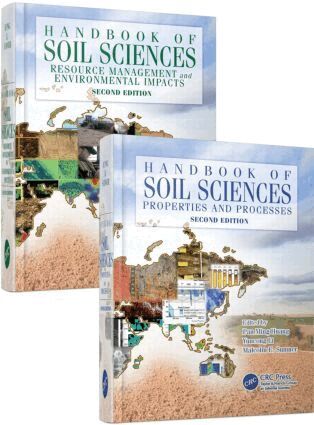
    Handbook of Soil Sciences (Two Volume Set)

    AvPan Ming Huang,Yuncong Li

    Taylor & Francis Inc

    2011

    3 744 kr

    Tillfälligt slut

    Beskrivning

    An evolving, living organic/inorganic covering, soil is in dynamic equilibrium with the atmosphere above, the biosphere within, and the geology below. It acts as an anchor for roots, a purveyor of water and nutrients, a residence for a vast community of microorganisms and animals, a sanitizer of the environment, and a source of raw materials for construction and manufacturing. To develop lasting solutions to the challenges of balanced use and stewardship of the Earth, we require a fundamental understanding of soil—from its elastic, porous three-phase system to its components, processes, and reactions.Now in two volumes, Handbook of Soil Sciences, Second Edition is a comprehensive and cohesive reference on the discipline of soil science. It contains definitive descriptions of each major area in the discipline, including fundamental principles, appropriate methods to measure each property, variations in properties in different soils throughout the world, and guidelines for the interpretation of the data for various applications in agriculture, engineering, and environmental sciences.Completely revised and updated, the handbook assembles core knowledge from all fields encompassed within the soil sciences. The first volume presents fundamental principles and recent advances in the traditional areas of soil science: soil physics, soil chemistry, soil mineralogy, soil biology and biochemistry, and pedology. The second volume covers interfacial interactions between the physical, chemical, and biological regimes within the soil; the factors that control the availability of plant nutrients and microelements; interdisciplinary aspects of soil science, including salinity, sodicity, and soil erosion; and soil databases for assessing worldwide soil resources.Critical elements addressed in each section include: Descriptions of concepts and theoriesDefinitions, approaches, methodologies, and proceduresData in tabular and figure format Extensive referencesCompiled by leading scientists, this handbook provides a resource rich in data and gives professional soil scientists, agronomists, engineers, ecologists, biologists, naturalists, and students their first point of entry into a particular aspect of the soil sciences.

    Produktinformation

    • Märke:Taylor & Francis Inc
    • Utgivningsdatum:2011-11-17
    • Höjd:210 x 280 x undefined mm
    • Vikt:5 520 g
    • Språk:Engelska
    • Antal sidor:2 280
    • Upplaga:2
    • Förlag:Taylor & Francis Inc
    • EAN:9781439803035

    Utforska kategorier

    • Geovetenskap inom Naturvetenskap och teknik
    • Tillämpad fysik inom Naturvetenskap och teknik
    • Agronomi inom Naturvetenskap och teknik

    Mer om författaren

    Dr. Pan Ming Huang was the professor of soil science emeritus at the University of Saskatchewan, Saskatoon, Saskatchewan, Canada, and served for 44 years in that institution. His research work has significantly advanced the frontiers of knowledge on the formation chemistry, nature, and surface reactivity of mineral colloids, organic matter, and organomineral complexes in soils and sediments and their role in the dynamics, transformations, and fate of nutrients, toxic metals, and xenobiotics in terrestrial and aquatic environments. His research findings, embodied in well over 300 refereed scientific publications, are fundamental to the development of sound strategies for managing land and water resources in the Earth’s critical zone. Dr. Yuncong Li is the University of Florida Research Foundation (UFRF) professor of soil science in the Department of Soil and Water Science at the Tropical Research and Education Center, Institute of Food and Agricultural Sciences (IFAS), University of Florida in Homestead. He is also an affiliated professor at the University of Florida’s Center for Tropical Agriculture, Hydrologic Sciences Academic Cluster, School of Natural Resources and Environment, and Water Institute. His research and extension program focuses on water and soil quality monitoring, assessment and remediation, management practices to improve nutrient use efficiency, and nutrient cycling in soils/sediments. He has authored or coauthored over 150 research papers, 70 extension articles, and 15 book chapters. He recently edited a book, Water Quality Concepts, Sampling, and Analyses (CRC Press, 2010). He serves as an associate editor for Critical Reviews in Environmental Science and Technology and Communications in Soil Science and Plant Analysis. Dr. Malcolm E. Sumner is the Regents’ Professor of Environmental Soil Science Emeritus in the Department of Crop and Soil Sciences at the University of Georgia, Athens. His published works cover a wide range of topics, including subsoil acidity, the agricultural uses of gypsum, diagnosis of yield-limiting factors, beneficial use of anthropogenic wastes, and transport of nutrients in soils. A widely respected author, Dr. Sumner’s works include Soil Acidity (Springer-Verlag, 1991), Soil Crusting: Chemical and Physical Processes (Lewis Publishers, 1992), Suelos de la Agroindustria Cafetalera de Guatemala (University of Georgia, 1994), Distribution, Properties and Management of Australian Sodic Soils (CSIRO Publications, 1995), Sodic Soils: Distribution, Properties, Management, and Environmental Consequences (Oxford University Press, 1998), and the Handbook of Soil Sciences (CRC Press, 1999). He has authored or coauthored over 350 scientific papers, including 220 refereed journal articles, and has contributed chapters to over 30 books.

    Recensioner i media

    These two books are the greatly revised, rewritten and expanded versions of the Handbook first published in 2000. In the intervening period, soil science has undergone great changes through the application of modern methods of chemical and physical analysis, new approaches to biology and the application of ever more powerful computers to the processing and display of natural resource data. There has also been a significant shift in the approach to soils as part of an environmental continuum with the atmosphere and water, and the implications of change to all these compartments and the interactions between them, and the rise of interdisciplinary science. These books reflect that progress. The Editors have drawn together a distinguished and wide-ranging panel of Associate Editors and contributors to assist them in the presentation of the information. —European Journal of Soil Science, April 2012, 63, 312–313This unique, valuable handbook continues to be the state-of-the-art resource in soil science. This edition is dedicated to Huang, who began developing the second edition but died before its completion. Summing Up: Highly recommended. Upper-division undergraduates and graduate students in soil science disciplines, researchers/faculty, and professionals, including biologists, engineers, geomorphologists, and agronomists with a soil science background.—S. G. Shetron, emeritus, Michigan Technological University, CHOICE, 2012

    Innehållsförteckning

    • Volume I: Properties and Processes: Soil Physics. Soil Chemistry. Soil Mineralogy. Soil Biology and Biochemistry: Soil Biology in Its Second Golden Age. Pedology. Index.Volume II: Resource Management and Environmental Impacts: Soil Physical, Chemical, and Biological Interfacial Interactions. Soil Fertility and Plant Nutrition. Interdisciplinary Aspects of Soil Science. Soil Databases. Index.