• Fri frakt över 249 kr
  • •
  • Snabba leveranser
  • •
  • Billiga böcker
Kundservice

Du är på sajten för privatpersoner.

Företag, bibliotek eller offentlig verksamhet?

Du handlar på classic.bokus.com, där alla dina funktioner finns intakta.
Till classic.bokus.com
Bokus logotyp. Gå till startsidan.
  • Erbjudanden
  • Nyheter
  • Student
  • Topplistor
  • Barn & ungdom
  • Bokus Play
  • E-böcker
  • Pocketböcker
  • Spel & pussel

10% rabatt på allt med kod: NYSTART10 →

Sidfot

Mina sidor

    Hjälp

    • Kundservice
    • Vanliga frågor och svar
    • Frakt och leverans
    • Retur vid ångerrätt
    • Reklamera vara
    • Betalning
    • Köpvillkor
    • Allmänna villkor
    • Information om webbplatsens tillgänglighet

    Om Bokus

    • Om oss
    • Pressrum
    • För studenter
    • För företag
    • För bibliotek och offentlig verksamhet
    • För leverantörer
    • Hållbarhet

    Populärt

    • Aktuella erbjudanden
    • Presentkort
    • Studentlitteratur
    • Nya böcker
    • Topplistor
    • Signerade böcker
    • Engelska böcker

    Inspiration

    • Boktips
    • BookTok
    • Populära bokserier
    • Barnbokskaraktärer
    • Populära författare
    Logotyp för Bokus
    Följ oss på Facebook (extern länk)Följ oss på Instagram (extern länk)Följ oss på YouTube (extern länk)Följ oss på TikTok (extern länk)
    bokus @ CookiesAnpassa cookiesIntegritetspolicyKöpvillkor
    Till Citymail hemsida (extern länk)Till Budbee hemsida (extern länk)Till Postnord hemsida (extern länk)Till Schenker hemsida (extern länk)Till Early Bird hemsida (extern länk)Till Walleys hemsida (extern länk)
    1. Språk och ordböcker
    2. Språkundervisning och språkinlärning

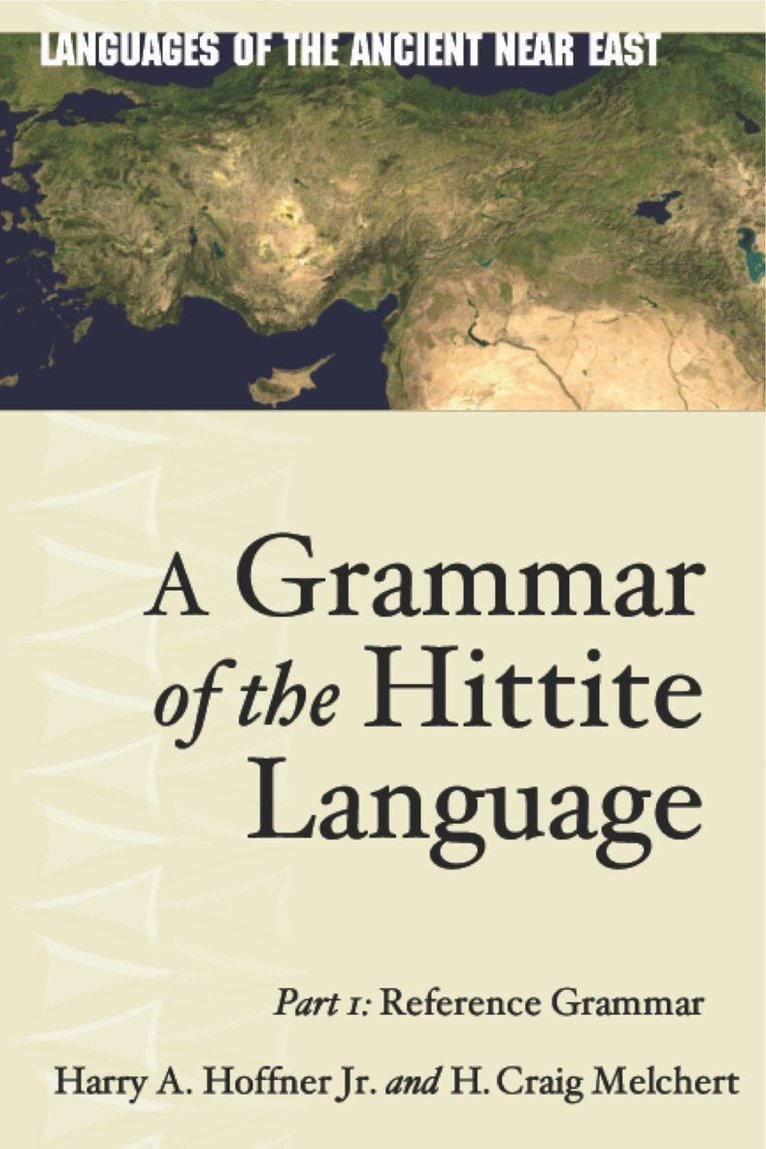
    Grammar of the Hittite Language

    Part 1: Reference Grammar

    AvHarry A. Hoffner Jr.,H. Craig Melchert

    Pennsylvania State University Press

    2008

    Del i serien Languages of the Ancient Near East

    999 kr

    Beställningsvara. Skickas inom 5-8 vardagar. Fri frakt över 249 kr.

    Fler format och utgåvor

    Inbunden

    967 kr

    Häftad

    343 kr

    Beskrivning

    Hoffner and Melchert’s long-awaited work is sure to become both the standard reference grammar and the main teaching tool for the Hittite language. The first volume includes a thorough description of Hittite grammar, grounded in an abundance of textual examples. Moreover, the authors take into account a vast array of studies on all aspects of the Hittite language. In the five decades since the publication of the second edition of Johannes Friedrich’s Hethitisches Elementarbuch (1960), our knowledge of Hittite grammar has become more detailed and nuanced, especially because of the number of new texts available and the growing body of secondary literature. This first volume in the LANE series fills a serious gap and offers a comprehensive reference for decades to come.The second volume is a tutorial that consists of a series of graded lessons with illustrative sentences for the student to translate. The tutorial is keyed to the reference grammar and provides extensive notes.The printed grammar volume is accompanied by a CD-ROM that contains the entire text of the grammar and tutorial in searchable, cross-referenced, and hyperlinked form.

    Produktinformation

    • Märke:Pennsylvania State University Press
    • Utgivningsdatum:2008-06-30
    • Höjd:178 x 254 x 42 mm
    • Vikt:975 g
    • Språk:Engelska
    • Serie:Languages of the Ancient Near East
    • Antal sidor:500
    • Förlag:Pennsylvania State University Press
    • EAN:9781575061191

    Utforska kategorier

    • Språkundervisning och språkinlärning inom Språk och ordböcker

    Recensioner i media

    “[T]he authors deserve the deepest gratitude of Hittitologists and of scholars of neighbouring fields for this excellent grammar book.”—Zsolt Simon Journal of Near Eastern Studies

    Innehållsförteckning

    • PrefaceAbbreviations and Conventional MarkingsGeneral AbbreviationsBibliographical AbbreviationsIntroductionThe Hittites and Their LanguageDeciphermentThe Text CorpusModern Resources for StudyCuneiform EditionsCommentariesSign LexiconGrammarsDictionariesText Catalogues and Name CollectionsChapter 1. Orthography and PhonologyThe Cuneiform Writing System of the HittitesOrthographyWriting ConventionsTranscriptional ConventionsHomophonyPolyphonyMultivalenceNew ValuesLogogram PronunciationPhonologyIndividual Phonemes (Vowels and Consonants)VowelsConsonantsPhonotacticsOnomatopoeiaAccentChapter 2Noun and Adjective FormationUnderived StemsDerived StemsReduplicated Nouns and AdjectivesCompounded Nouns and AdjectivesChapter 3Noun and Adjective InflectionInflectional EndingsThe Basic SchemeCommon-Gender NominativeCommon-Gender AccusativeNeuter Nominative-AccusativeErgativeGenitiveDative-LocativeVocativeAllativeAblativeInstrumentalStem VariationChapter 4Noun and Adjective Declensiona-Stem NounsCommon-Gender a-Stem NounsNeuter a-Stem Nounsa-Stem Adjectivesi- and u-Stem Nounsi-Stem Nounsi-MutationCommon-Gender i-Stem NounsNeuter i-Stem Nounsai-Stem Nounsi-Stem Adjectivesu-Stem NounsCommon-Gender u-Stem NounsNeuter u-Stem Nounsau-Stem Nounsu-Stem Adjectivese-Stem NounConsonantal-Stem Nouns and Adjectives-Stem Nounl-Stem Nounsal-Stem Nounse/il-Stem Nounsul-Stem Nounsn-Stem NounsNeuter n-Stem NounsCommon-Gender n-Stem Nounsr-Stem Nouns and Adjectivess-Stem Nounst-Stem Nouns and AdjectivesSimple t-Stem Nounsnt-Stem Nouns and Adjectivesr/n-Stem NounsNon-Derived r/n-Stem NounsDerived Nouns with Suffix -atarDerived Nouns with Suffix -eššarDerived Nouns with Suffix -awarDerived Nouns with Suffix -marVerbal SubstantivesIrregular Consonant-Stem NounsChapter 5Personal PronounsDistinctive Features of Pronominal Stems and EndingsAccented (Independent) Personal PronounsEnclitic Personal PronounsChapter 6Possessive PronounsChapter 7Deixis: The Demonstrativeska- and apa-aši, uni, inianni-Adverbs Built to DemonstrativesChapter 8. Relative and Indefinite PronounsThe Interrogative and Relative Pronoun kui-The Indefinite Pronoun kuiški and the Distributive kuiššaOther Stems with Partial Pronominal InflectionChapter 9NumbersForm and Declension of the Cardinals‘One’‘Two’ to ‘Ten’The Syntax of the CardinalsAgreement in CaseNumber Agreement with Non-CollectivesCounting Non-Decimal SetsWord Order in CountingFractionsOrdinal NumbersOrdinals in -t-MultiplicativesDistributivesDerivative Adjectives and VerbsNumbers in CompoundsCompound NumbersChapter 10. Verb FormationReduplicated RootsVerbal Suffixes and InfixesOverviewThe Individual SuffixesChapter 11Verb InflectionTypes of Verbal InflectionIrregularities in the mi-ConjugationIrregularities in the ḫi-ConjugationMedio-Passive EndingsVerbal Substantive, Participle, Infinitive, and SupineChapter 12Conjugation of mi-VerbsConsonantal StemsRoot StemsAffixed StemsVocalic StemsAblautingNon-AblautingSuppletive VerbVerbs with Mixed StemsChapter 13Conjugation of ḫi-VerbsConsonantal StemsVocalic Stemsa-StemsStems Originally in -Cw-ai-StemsStems with Mixed Inflection in -a- and -i-Verbs with the Imperfective Suffix -anna/i-Mixture of mi- and ḫi-FormsChapter14Medio-Passive ConjugationConsonantal StemsVocalic StemsChronology of the Medio-Passive EndingsMedio-Passive Stem FormationChapter 15Grammatical AgreementTypes of AgreementLack of AgreementIn GenderIn NumberChapter 16Noun CasesGeneralitiesNominativeVocative and ‘Naming Construction’Other Forms of Direct AddressAccusativeErgativeGenitiveWord Order in a Genitival PhraseDative-LocativeIndirect ObjectIndicating PossessionDative of DisadvantageGoalPurpose or ResultLocationTemporal UsesUnits of Measure and DimensionsAdditive-IncrementalAllativeAblativeInstrumentalCases with Particular VerbsChapter 17AdjectivesComparison of AdjectivesComparative DegreeSuperlative DegreeChapter 18PronounsIndependent Personal PronounsEnclitic Personal Pronouns(Third-Person) Subject CliticsIntransitive Verbs with Subject CliticsIntransitive Verbs without Subject CliticsOther Clauses without Referential SubjectsSpecial CasesDemonstrative Pronounska-, apa-, and aši: Word OrderDeclinable kaš kaš as a Distributive ExpressionCorrelated ka-Forms Having Different CasesOther Deictic ElementsThe Indefinite Pronoun kuiškitamai-Chapter 19AdverbsLocal AdverbsTemporal AdverbsAdverbs of MannerDenominative AdverbsThe Adverbial Suffix -iliAdverbial CircumlocutionsChapter 20Local Adverbs, Preverbs, and PostpositionsFree-standing AdverbsPreverbsPostpositionsChapter 21Verb VoiceActive VoiceMiddle VoicePassive VoiceChapter 22Verb TensePresentPreteriteThe Analytic Perfect ConstructionFunctionFormUniqueness within the Old Anatolian Indo-European GroupExamples‘Stative’ Constructions with ḫar (k)- and eš-Chapter 23Verb MoodIndicativeImperativeOptative, Potential, and IrrealisOptativePotential and IrrealisChapter 24Verb AspectImperfectivesAdverbial MarkersSuffix MarkersNuances of Imperfective AspectChoice of SuffixSuffix Redundancykaša (tta) and kašmaThe ‘Serial’ Use of pai- ‘to go’ and uwa- ‘to come’Chapter 25Non-Finite Verb FormsVerbal SubstantiveInfinitiveSupineParticipleChapter 26. NegationnattaWord Order with nattaNegative Rhetorical Questions (with Negatives of Assertion)nawi ‘not yet’Imperatival and Categorical Negative lele⸗man and numanCategorical Negative leWord Order with lene/ikkuDouble NegativesCarry-Over of Negative ForceSummaryChapter 27QuestionsIntonation MarkingYes-No QuestionsDirect Questions with Interrogative Pronouns, Adjectives,and AdverbsQuestions Posing AlternativesIndirect QuestionsChapter 28ParticlesThe Particle -wa (r-)The Particle -z (a)FormReflexive FunctionLexical Use of -z (a)Use in Nominal Sentences and with the Verb ‘To Be’The Local Particles -an, -apa, -ašta, -kan, and -šanThe Particle -kanThe ‘Local’ ValueAccompanying the ‘Dative of Disadvantage’The Terminative ValueWith Verbs of HostilityAspect Independent of Verb’s Lexical MeaningAbsence of Expected -kanSummaryThe Particle -šanCo-occurring with the Adverb šerPhysical or Conceptual Movement toward an ObjectThe Particle -anThe Particle -apaThe Particle -aštaThe Particle -patAnaphoricParticularizingRestrictiveContrastiveChapter 29ConjunctionsClause-Initial Clause-Linking ConjunctionsDistributionnušutaEnclitic Clause-Linking Conjunctions-a/-ma-a/-yaAsyndetonFormFunctionDisjunctionnaššu naš (šu)ma-(a) ku -(a) kuChapter 30ClausesWord OrderMajor ConstituentsDeletion ProcessesSentential CliticsNominal and ‘To Be’ SentencesDependent ClausesTemporal ClausesCausal ClausesConcessive ClausesConditional ClausesSimple ConditionsContrary-to-Fact ConditionsRelative ClausesIndirect Statements and QuestionsMultiple Dependent ClausesChapter 31. Sumerian and AkkadianSumerogramsNouns, Adjectives, and ParticiplesPronounsVerbsAkkadian GrammarOrthographySuperscriptingPhonetic ComplementsPhonologyMorphologyNouns and AdjectivesPronominal SuffixesNumbersVerbsConjunctionsCalquesPrepositionsReferences