• Fri frakt över 249 kr
  • •
  • Snabba leveranser
  • •
  • Billiga böcker
Kundservice

Du är på sajten för privatpersoner.

Företag, bibliotek eller offentlig verksamhet?

Du handlar på classic.bokus.com, där alla dina funktioner finns intakta.
Till classic.bokus.com
Bokus logotyp. Gå till startsidan.
  • Erbjudanden
  • Nyheter
  • Student
  • Topplistor
  • Barn & ungdom
  • Bokus Play
  • E-böcker
  • Pocketböcker
  • Spel & pussel

10% rabatt på allt med kod: NYSTART10 →

Sidfot

Mina sidor

    Hjälp

    • Kundservice
    • Vanliga frågor och svar
    • Frakt och leverans
    • Retur vid ångerrätt
    • Reklamera vara
    • Betalning
    • Köpvillkor
    • Allmänna villkor
    • Information om webbplatsens tillgänglighet

    Om Bokus

    • Om oss
    • Pressrum
    • För studenter
    • För företag
    • För bibliotek och offentlig verksamhet
    • För leverantörer
    • Hållbarhet

    Populärt

    • Aktuella erbjudanden
    • Presentkort
    • Studentlitteratur
    • Nya böcker
    • Topplistor
    • Signerade böcker
    • Engelska böcker

    Inspiration

    • Boktips
    • BookTok
    • Populära bokserier
    • Barnbokskaraktärer
    • Populära författare
    Logotyp för Bokus
    Följ oss på Facebook (extern länk)Följ oss på Instagram (extern länk)Följ oss på YouTube (extern länk)Följ oss på TikTok (extern länk)
    bokus @ CookiesAnpassa cookiesIntegritetspolicyKöpvillkor
    Till Citymail hemsida (extern länk)Till Budbee hemsida (extern länk)Till Postnord hemsida (extern länk)Till Schenker hemsida (extern länk)Till Early Bird hemsida (extern länk)Till Walleys hemsida (extern länk)
    1. Naturvetenskap och teknik
    2. Geovetenskap
    3. Miljövetenskap och miljöpolitik

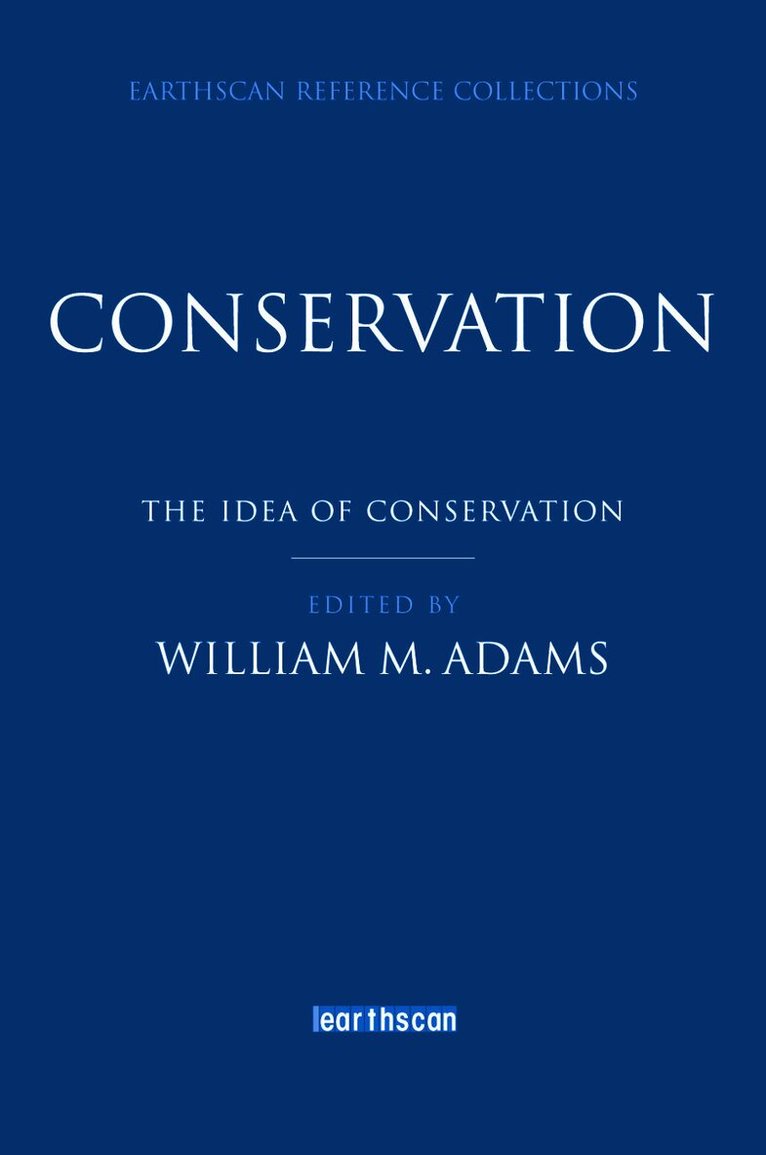
    Conservation

    AvWilliam M. Adams

    Taylor & Francis Ltd

    2008

    Del i serien Earthscan Reference Collections

    19 224 kr

    Beställningsvara. Skickas inom 5-8 vardagar. Fri frakt över 249 kr.

    Fler format och utgåvor

    Inbunden

    Kommande

    Inbunden

    4 075 kr

    Inbunden

    4 075 kr

    Inbunden

    4 075 kr

    Beskrivning

    The thought-provoking articles in Conservation can assist in catalyzing the transition to a new green economy by shaping the mind-sets of leaders, students, teachers and the public alike.' Achim Steiner, UN Under-Secretary General and Executive Director, UN Environment Programme (UNEP)'An extremely useful compilation of articles on the complex issues underlying nature conservation.' Ashish Kothari, Co-chair, IUCN Intercommission Strategic Direction on Governance, Equity, and Livelihoods in Relation to Protected Areas (TILCEPA)'In this intelligently chosen, broadly ranging set of readings on conservation, Professor Adams assembles a set of vital readings for professionals, teachers, students, and the interested public.' Kent Redford, Director, Wildlife Conservation Society InstituteThis 4-volume set, edited by a leading expert on nature conservation, brings together in one collection a series of papers fundamental to understanding the social, political, cultural and scientific dimensions of conservation. Each volume is introduced by a new review essay, which both sets the scope for the collection and advances analytical understanding of conservation issues.Volume I covers the historical development of conservation ideas and reviews the diverse contemporary philosophical, ethical, cultural and practical arguments for conservation.Volume II addresses the core issue of conservation: the maintenance of living diversity in the face of human demands on the biosphere. The intention here is not to offer a sourcebook of conservation science, but to include the key texts that have changed the way conservation is understood and practised.Volume III explores the overlaps and conflicts between conservation and development, andwin-win solutions to conflicts between the two, including ideas of sustainable development.Volume IV presents work on conservation as an essentially political process, drawing chiefly on social science and, in particular, political ecology and environmental history.

    Produktinformation

    • Märke:Taylor & Francis Ltd
    • Utgivningsdatum:2008-11-28
    • Höjd:156 x 234 x undefined mm
    • Vikt:3 150 g
    • Språk:Engelska
    • Serie:Earthscan Reference Collections
    • Antal sidor:1 690
    • Förlag:Taylor & Francis Ltd
    • EAN:9781844074143

    Utforska kategorier

    • Miljövetenskap och miljöpolitik inom Naturvetenskap och teknik

    Mer om författaren

    William M. (Bill) Adams is the Moran Professor of Conservation and Development at the University of Cambridge, UK, and a Senior Editor of Oryx: The International Journal of Conservation. He has written and edited numerous books on conservation, including Future Nature: A Vision for Conservation (now in its second edition), Decolonizing Nature: Strategies for Conservation in a Post-colonial Era (edited with Martin Mulligan) and Against Extinction: The Story of Conservation. His book Green Development: Environment and Sustainability in the Third World was first published in 1990 with its third edition published in 2008.

    Innehållsförteckning

    • Volume I: The Idea of ConservationEditorial Introduction to Volume IPart I: Western Ideas of Nature1. Creating a Second Nature2. The Origins of Environmentalism3. Walking4. The Hetch Hetchy Valley5. A Fable for Tomorrow and the Obligation to EndurePart II: Indigenous Ideas of Nature and Conservation6. Animals7. Traditional Knowledge Systems in PracticePart III: The Misuse of Nature8. Destructiveness of Man and Human and Brute Action Compared9. Principles of Conservation10. The Former Abundance of Wildlife11. The Round RiverPart IV: Philosophies of Conservation12. Ideas of Nature13. The Cultural Approach to Conservation Biology14. The Conservation Ethic15. Definitions, Values and PhilosophiesPart V: Wilderness and Countryside16. Thinking Like a Mountain17. The Trouble with Wilderness; or Getting Back to the Wrong Nature18. The Making of an IdealPart VI: Protecting Nature19. Perspectives20. The Carbon ConnectionIndexVolume II: The Conservation of DiversityEditorial Introduction to Volume IIPart I: Biodiversity and Biodiversity Loss1. The Vulnerable Earth: Toward a Planetary History2. Biodiversity Threatened3. Human domination of Earth's ecosystemsPart II: Understanding Change in Nature4. Anecdotes and the Shifting Baseline Syndrome of Fisheries5. What is Natural? The Need for a Long-term Perspective in Biodiversity Conservation6. False Forest History, Complicit Social Analysis: Rethinking Some West African Environmental NarrativesPart III: Ecology and Conservation7. The Use and Abuse of Vegetational Concepts and Terms8. Resilience and Stability of Ecological Systems9. Pyromancy: Reading Stories in the FlamesPart IV: Conservation Planning10. Biodiversity Hotspots for Conservation Priorities11. The Global 200: A Representation Approach to Conserving the Earth's Most Biologically Valuable Ecoregions12. Mapping the Conservation Landscape13. Systematic Conservation PlanningPart V: Managing Species and Spaces14. Command and Control and the Pathology of Natural Resource Management15. Directions in Conservation Biology16. The Island Dilemma: Lessons of Modern Biogeographic Studies for the Design of Natural Reserves17. A Regional Landscape Approach to Maintain Diversity18. Effectiveness of Parks in Protecting Tropical BiodiversityPart VI: Conservation Management and Restoration19. Biological Invasions: Winning the Science Battles but Losing the Conservation War?20. Restoration Ecology: Repairing the Earth's Ecosystems in the New MillenniumIndexVolume III: Conservation and DevelopmentEditorial Introduction to Volume IIIPart I: Conservation and Sustainable Development1. The Land Ethic2. Towards Sustainable Development3. Conservation of Biodiversity in a World of Use4. Biodiversity Conservation and the Eradication of PovertyPart II: Sustainability and Wild Harvests5. Fishing Down Marine Food Webs6. Having Your Wildlife and Eating It Too: An Analysis of Hunting Sustainability Across Tropical Ecosystems7. Requiem for the Grand BanksPart III: Institutions and Environmental Management8. The Struggle to Govern the Commons9. Human Ecology and Resource Sustainability: The Importance of Institutional Diversity10. People, Livelihoods and Collective Action in Biodiversity ManagementPart IV: Economics and Conservation11. The Value of Nature and the Nature of Value12. Who Should Pay for Tropical Conservation, and How Could the Costs Be Met?13. Direct Payments to Conserve BiodiversityPart V: Community and Conservation14. If Community Conservation is the Answer, What is the Question?15. Enchantment and Disenchantment: The Role of Community in Natural Resource Conservation16. The Background to Community-based Conservation17. Planning for People and Parks: Design Dilemmas18. The Future of Integrated Conservation and Development Projects: Building on What Works19. Sustainable Use and Incentive-driven Conservation: Realigning Human and Conservation InterestsIndexVolume IV: The Politics of ConservationEditorial Introduction to Volume IVPart I: The State, Conservation and Protected Areas1. Nature and Space 2. Nature-State-Territory: Towards a Critical Theorization of Conservation Enclosures3. The Environmental Challenge to the Nation-State: Superparks and National Parks Policy in Zimbabwe4. Coercing Conservation? The Politics of State Resource ControlPart II: Science, Knowledge and the Politics of Conservation5. Deliberative Democracy and Participatory Biodiversity6. Environmentality: Community, Intimate Government, and the Making of Environmental Subjects in Kumaon, India7. Non-governmental Organizations and Governmentality: 'Consuming' Biodiversity and Indigenous People in the Philippines8. Green Dots, Pink Hearts: Displacing Politics from the Malaysian Rainforest9. The Shifting Middle Ground: Amazonian Indians and Eco-politics10.The 'Wild', the Market and the Native: Indigenous People Face New Forms of Global Colonization11. Radical American Environmentalism and Wilderness Preservation: A Third World CritiquePart III: The Social Impacts of Protected Areas12. Salvaging Nature: Indigenous Peoples and Protected Areas13. Farewell Song14. Displacement and Relocation from Protected Areas: Towards a Biological and Historical Synthesis15. The Winding Road: Incorporating Social Justice and Human Rights into Protected Areas Policies16. Political Incentives for Biodiversity ConservationPart IV: Conservation Futures17. Love it Or Lose it: The Coming Biophilia Revolution18. Nature Matrix: Reconnecting People and Nature19. Society With Nature20. Optimism and Hope in a Hotter TimeIndex