• Fri frakt över 249 kr
  • •
  • Snabba leveranser
  • •
  • Billiga böcker
Kundservice

Du är på sajten för privatpersoner.

Företag, bibliotek eller offentlig verksamhet?

Du handlar på classic.bokus.com, där alla dina funktioner finns intakta.
Till classic.bokus.com
Bokus logotyp. Gå till startsidan.
  • Erbjudanden
  • Nyheter
  • Student
  • Topplistor
  • Barn & ungdom
  • Bokus Play
  • E-böcker
  • Pocketböcker
  • Spel & pussel

10% studentrabatt med kod TERM26

Sidfot

Mina sidor

    Hjälp

    • Kundservice
    • Vanliga frågor och svar
    • Frakt och leverans
    • Retur vid ångerrätt
    • Reklamera vara
    • Betalning
    • Köpvillkor
    • Allmänna villkor
    • Information om webbplatsens tillgänglighet

    Om Bokus

    • Om oss
    • Pressrum
    • För studenter
    • För företag
    • För bibliotek och offentlig verksamhet
    • För leverantörer
    • Hållbarhet

    Populärt

    • Aktuella erbjudanden
    • Presentkort
    • Studentlitteratur
    • Nya böcker
    • Topplistor
    • Signerade böcker
    • Engelska böcker

    Inspiration

    • Boktips
    • BookTok
    • Populära bokserier
    • Barnbokskaraktärer
    • Populära författare
    Logotyp för Bokus
    Följ oss på Facebook (extern länk)Följ oss på Instagram (extern länk)Följ oss på YouTube (extern länk)Följ oss på TikTok (extern länk)
    bokus @ CookiesAnpassa cookiesIntegritetspolicyKöpvillkor
    Till Citymail hemsida (extern länk)Till Budbee hemsida (extern länk)Till Postnord hemsida (extern länk)Till Schenker hemsida (extern länk)Till Early Bird hemsida (extern länk)Till Walleys hemsida (extern länk)
    1. Naturvetenskap och teknik
    2. Matematik och naturvetenskap
    3. Astronomi

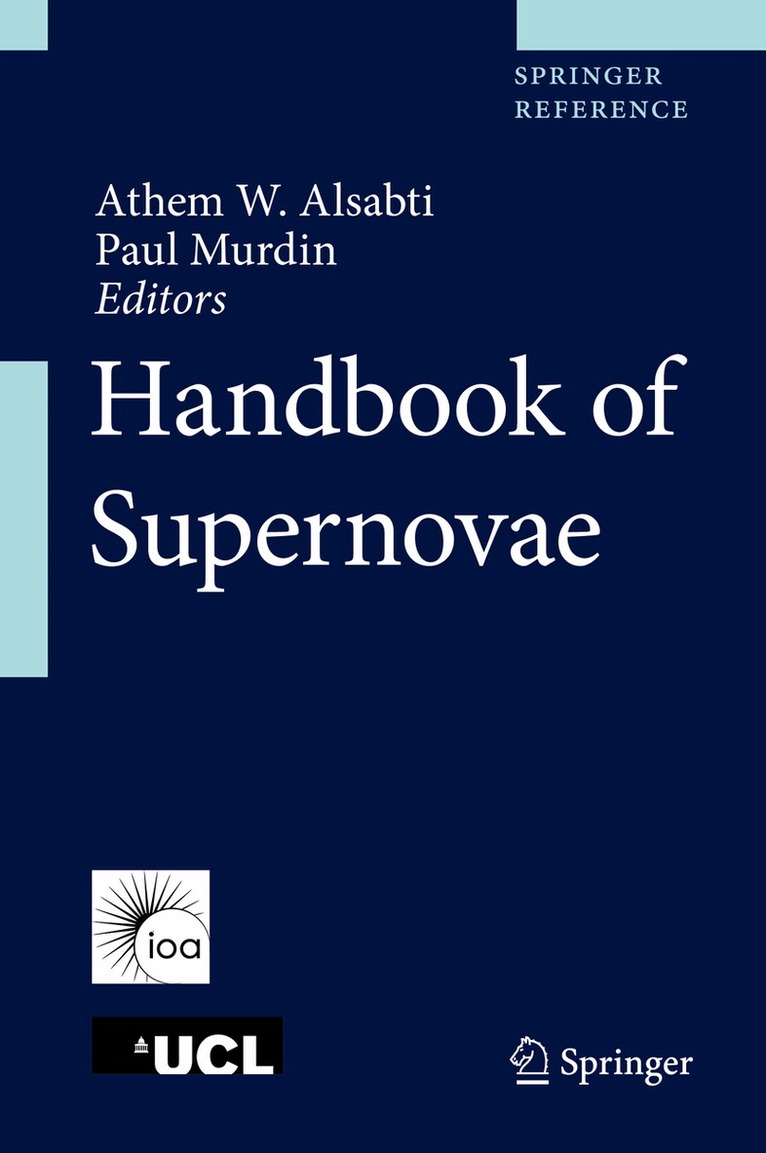
    Handbook of Supernovae

    AvAthem W. Alsabti,Paul Murdin

    Springer International Publishing AG

    2017

    15 359 kr

    Beställningsvara. Skickas inom 10-15 vardagar. Fri frakt över 249 kr.

    Beskrivning

    This reference work gathers all of the latest research in the supernova field areas to create a definitive source book on supernovae, their remnants and related topics. It includes each distinct subdiscipline, including stellar types, progenitors, stellar evolution, nucleosynthesis of elements, supernova types, neutron stars and pulsars, black holes, swept up interstellar matter, cosmic rays, neutrinos from supernovae, supernova observations in different wavelengths, interstellar molecules and dust. While there is a great deal of primary and specialist literature on supernovae, with a great many scientific groups around the world focusing on the phenomenon and related subdisciplines, nothing else presents an overall survey. This handbook closes that gap at last. As a comprehensive and balanced collection that presents the current state of knowledge in the broad field of supernovae, this is to be used as a basis for further work and study by graduate students, astronomers and astrophysicists working in close/related disciplines, and established groups.  Editorial BoardEDITORS-IN-CHIEFAthem W. Alsabti University College London Observatory, University College London, London, UKSections: Supernovae and Supernova Remnants                          Supernovae and the Environment of the Solar SystemPaul Murdin Institute of Astronomy, University of Cambridge, Cambridge, UKSection: Supernovae and Supernova RemnantsSECTION EDITORSDavid Arnett Steward Observatory,University of Arizona, Tucson, AZ, USASection: Nucleosynthesis in SupernovaePhil Charles University of Southampton, School of Physics and Astronomy, Southampton, UKSection: Stellar Remnants - Neutron Stars and Black HolesRobert A. Fesen Department of Physics and Astronomy, Dartmouth College, Hanover, NH, USASection: Evolution of Supernovae and the Interstellar MediumDavid A. Green Cavendish Laboratory, University of Cambridge, Cambridge, UKSection: Historical SupernovaeMario Hamuy Astronomy Department, University of Chile, Santiago, Chile;  Millennium Institute of Astrophysics, Santiago, ChileSection: Cosmology from SupernovaePeter Hoeflich Department of Physics, Florida State University, Tallahassee, FL, USASection: Explosion Mechanisms of SupernovaeKen’ichi Nomoto Kavli Institute for the Physics and Mathematics of the Universe (WPI), The University of Tokyo, Kashiwa, Chiba, JapanSection: Supernovae and Stellar EvolutionStephen Smart  Astrophysics Research Centre, Queen's University, Belfast; Northern Ireland, UKSection: Light Curves and Spectra of SupernovaeMark Sullivan School of Physics and Astronomy, University of Southampton, Highfield, Southampton, UK Section: Types of SupernovaeFriedrich-Karl Thielemann Department of Physics, University of Basel, Basel, SwitzerlandSections: Neutrinos, Gravitational Waves and Cosmic Rays                         Nucleosynthesis in SupernovaeChengmin M. Zhang National Astronomical Observatories, Chinese Academy of Sciences, Beijing, China;  Key Laboratory of Radio Astronomy, CAS, Beijing, China;  School of Physical Science, University of Chinese Academy of Sciences, Beijing, China Section: Stellar Remnants - Neutron Stars and Black Holes

    Produktinformation

    • Märke:Springer International Publishing AG
    • Utgivningsdatum:2017-12-08
    • Höjd:155 x 235 x undefined mm
    • Språk:Engelska
    • Antal sidor:2 727
    • Förlag:Springer International Publishing AG
    • EAN:9783319218458

    Utforska kategorier

    • Astronomi inom Naturvetenskap och teknik
    • Fysikalisk kemi inom Naturvetenskap och teknik

    Mer om författaren

    Born in Iraq in 1945, Dr. Alsabti moved to the UK on a scholarship to the University of Manchester. He obtained his BSc in Mathematical Physics in 1967, his MSc in 1968 (Astrophysics, Supernovae) and his PhD in 1970 (“Investigating very faint nebulosities associated with non-thermal galactic radio sources”). He now works at University College London, in the Department of Physics and Astronomy. Dr. Alsabti's research interests are in the origin and evolution of supernovae and interstellar matter. Dr. Alsabti was also a Professor of Physics at Baghdad University and founded the Baghdad Planetarium and Iraqi National Observatory. He has been an active member of the International Astronomical Union (IAU) since 1973, and is a Fellow of the Royal Astronomical Society (RAS). In the IAU, he is a member of the Advanced Development Projects Group. Dr. Alsabti is also a member of the World Space Observatory Committee, and a consultant to the Cornwall Observatory and Planetarium Project. Educated at the Universities of Oxford and Rochester, NY, Paul Murdin has worked as an astronomer in the USA, Australia, England, Scotland and in Spain, where he led the operation of the Anglo-Dutch Isaac Newton Group of telescopes in the Canary Islands. He has been a research scientist (studying supernovae, neutron stars and black holes – in 1972 Paul discovered the nature of the first black hole known in our galaxy, Cygnus X-1) and a science administrator for the UK Government and the Royal Astronomical Society. He works at the Institute of Astronomy at the University of Cambridge, England, and is Visiting Professor at John Moores University, Liverpool. He has a secondary career as a broadcaster and commentator for the BBC and CNN, as well as a lecturer and writer on astronomy, including repeat appearances on BBC Radio 4’s In Our Time and at a number of literary and science festivals, like those at Hay-on-Wye and Edinburgh, and on the Cunard liner Queen Elizabeth 2.  His most recent books include Secrets of the Universe: How We Discovered the Universe (Thames and Hudson, 2009), Mapping the Universe (Carlton, 2011), and Are We Being Watched? The Search for Life in the Cosmos (Thames and Hudson, 2013).

    Innehållsförteckning

    • Review of Supernovae and Supernovae Remnants.- Historical Supernovae.- Types of Supernovae.- Supernovae and Stellar Evolution.- Light Curves and Spectra of Supernovae.- Explosion Mechanisms of Supernovae.- Stellar Remnants: Pulsars and Neutron Stars.- Stellar Remnants: Black Holes.- Nucleosynthesis in Supernovae.- Evolution of Supernovae and the Interstellar Medium.- Cosmology from Supernovae.- Supernovae, Galaxies, our Solar System and Life on Earth.- Neutrinos, Gravitational Waves and Cosmic Rays.