• Fri frakt över 249 kr
  • •
  • Snabba leveranser
  • •
  • Billiga böcker
Kundservice

Du är på sajten för privatpersoner.

Företag, bibliotek eller offentlig verksamhet?

Du handlar på classic.bokus.com, där alla dina funktioner finns intakta.
Till classic.bokus.com
Bokus logotyp. Gå till startsidan.
  • Erbjudanden
  • Nyheter
  • Student
  • Topplistor
  • Barn & ungdom
  • Bokus Play
  • E-böcker
  • Pocketböcker
  • Spel & pussel

10% rabatt på allt med kod: NYSTART10 →

Sidfot

Mina sidor

    Hjälp

    • Kundservice
    • Vanliga frågor och svar
    • Frakt och leverans
    • Retur vid ångerrätt
    • Reklamera vara
    • Betalning
    • Köpvillkor
    • Allmänna villkor
    • Information om webbplatsens tillgänglighet

    Om Bokus

    • Om oss
    • Pressrum
    • För studenter
    • För företag
    • För bibliotek och offentlig verksamhet
    • För leverantörer
    • Hållbarhet

    Populärt

    • Aktuella erbjudanden
    • Presentkort
    • Studentlitteratur
    • Nya böcker
    • Topplistor
    • Signerade böcker
    • Engelska böcker

    Inspiration

    • Boktips
    • BookTok
    • Populära bokserier
    • Barnbokskaraktärer
    • Populära författare
    Logotyp för Bokus
    Följ oss på Facebook (extern länk)Följ oss på Instagram (extern länk)Följ oss på YouTube (extern länk)Följ oss på TikTok (extern länk)
    bokus @ CookiesAnpassa cookiesIntegritetspolicyKöpvillkor
    Till Citymail hemsida (extern länk)Till Budbee hemsida (extern länk)Till Postnord hemsida (extern länk)Till Schenker hemsida (extern länk)Till Early Bird hemsida (extern länk)Till Walleys hemsida (extern länk)
    1. Samhälle och politik
    2. Samhälle och kultur
    3. Kultur och medier
    4. Referensverk och tvärvetenskap

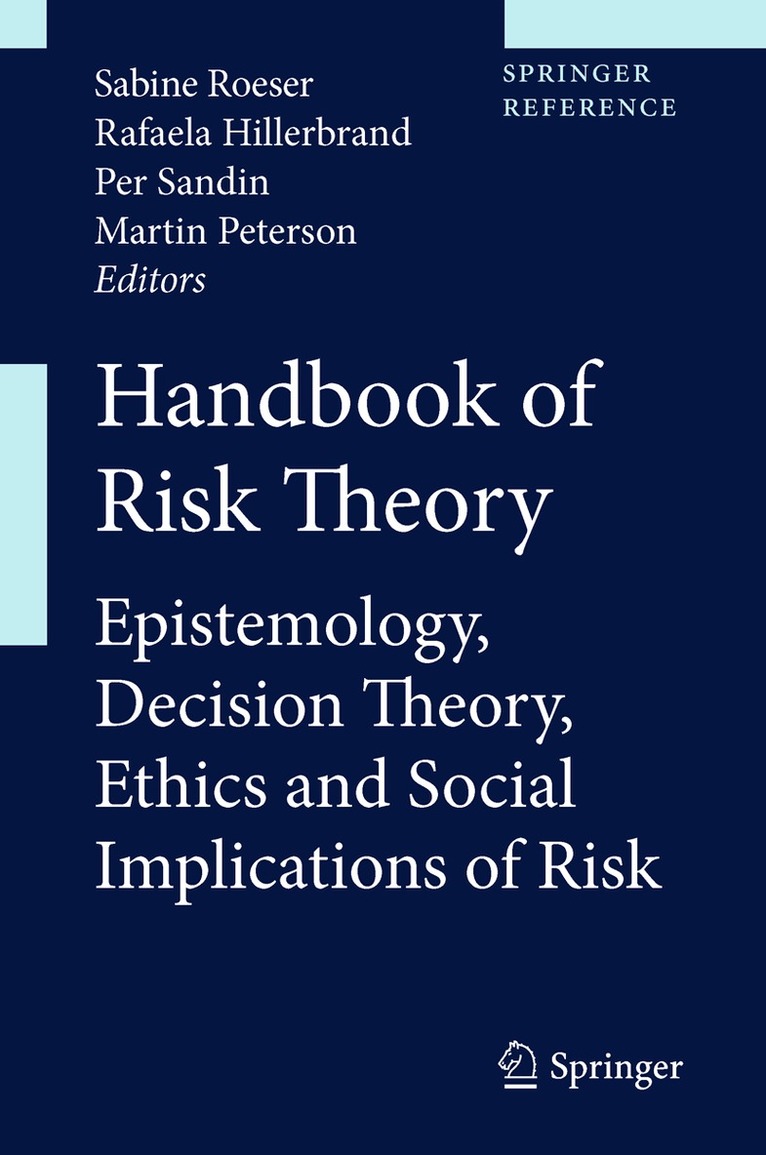
    Handbook of Risk Theory

    Epistemology, Decision Theory, Ethics, and Social Implications of Risk

    AvRafaela Hillerbrand,Per Sandin

    Springer

    2012

    10 043 kr

    Beställningsvara. Skickas inom 10-15 vardagar. Fri frakt över 249 kr.

    Beskrivning

    Risk has become one of the main topics in fields as diverse as engineering, medicine and economics, and it is also studied by social scientists, psychologists and legal scholars. But the topic of risk also leads to more fundamental questions such as: What is risk? What can decision theory contribute to the analysis of risk? What does the human perception of risk mean for society? How should we judge whether a risk is morally acceptable or not? Over the last couple of decades questions like these have attracted interest from philosophers and other scholars into risk theory.This handbook provides for an overview into key topics in a major new field of research. It addresses a wide range of topics, ranging from decision theory, risk perception to ethics and social implications of risk, and it also addresses specific case studies. It aims to promote communication and information among all those who are interested in theoetical issues concerning risk and uncertainty.This handbook brings together internationally leading philosophers and scholars from other disciplines who work on risk theory. The contributions are accessibly written and highly relevant to issues that are studied by risk scholars. We hope that the Handbook of Risk Theory will be a helpful starting point for all risk scholars who are interested in broadening and deepening their current perspectives.

    Produktinformation

    • Märke:Springer
    • Utgivningsdatum:2012-01-17
    • Höjd:155 x 235 x 77 mm
    • Vikt:2 154 g
    • Språk:Engelska
    • Antal sidor:1 187
    • Upplaga:2012
    • Förlag:Springer
    • Medarbetare:Sabine Roeser
    • EAN:9789400714328

    Utforska kategorier

    • Referensverk och tvärvetenskap inom Samhälle och politik

    Mer om författaren

    Sabine Roeser is Professor of Political Philosophy and Ethics at Twente University (Socrates Chair, part-time), Associate Professor of Ethics at TU Delft, and managing director of the 3TU.Centre for Ethics and Technology. She has been trained in fine arts, philosophy and political science, with a PhD in ethical theory. She has obtained various prestigious research grants for her innovative research on risk and moral emotions. She currently leads a research group on 'Moral Emotions and Risk Politics'. She is regularly interviewed for popular media in the Netherlands. She has organized many international conferences. Roeser has given more than 100 presentations at international conferences and other academic events. Roeser has published numerous articles in e.g. The Journal of Value Inquiry, The Journal of Risk Research and Science and Engineering Ethics. Roeser has (co-)edited the following books: Emotions and Risky Technologies, Springer (2010), Thomas Reid on Ethics, Palgrave Macmillan (2010), The Ethics ofTechnological Risk, Earthscan (2009), and Basic Belief and Basic Knowledge: Papers inEpistemology, Ontos (2005). She is author of the monograph Moral Emotions and Intuitions, Palgrave Macmillan(2011).Personal website: www.tbm.tudelft.nl/sroeser Rafaela Hillerbrand is head of the research group Ethics for Energy Technology. Before joining HumTec Rafaela Hillerbrand was working as a senior research fellow at the University of Oxford on epistemological and ethical problems for decions under risk and uncertainty. Hillerbrand's research traverse epistemological problems related to the interpretations of probabilities, quantitative modelling, and foundational aspect of statistical mechanics. Hillerbrand holds a PhD in theoretical physics as well as a PhD in philosophy. For her book on the ethics of technology, which covers aspects of applied ethics just as well as genuine theoretical normative ethics, she received the Lilli-Bechmann-Rahn-Preis of the University Erlangen Nurnberg in 2005. Her PhD in physics was awarded the Ingrid-zu-Solms Naturwissenschaftspreis 2008. She is an elected member of the German Young Academy of Sciences (Junge Akademie). Per Sandin received his PhD from the Royal Institute of Technology, Stockholm, in 2005 on a thesis entitled Better Safe than Sorry: Applying Philosophical Methods to the Debate on Risk and the Precautionary Principle. He has mainly worked in applied ethics and topics on risk and policy, and his work has appeared in journals such as Human and Ecological Risk Assessment, Philosophia, Journal of Risk Research and Ethical Theory and Moral Practice. Between 1999 and 2005 he was editorial assistant of Theoria and associate editor for the same journal between 2005 and 2007. In the spring of 2009 he is a Visiting Fellow in the Centre for Applied Philosophy and Public Ethics (CAPPE) in Canberra, Australia.Personal website: www.infra.kth.se/~sandin Martin Peterson is author of two books, An Introduction to Decision Theory (Cambridge University Press, 2009) and Non-Bayesian Decision Theory (Springer, 2008). He has published about 40 articles in peer-reviewed journals such as Risk Analysis, the Journal of Philosophy, and the Journal of Risk Research. Peterson received his PhD in philosophy in 2003 from the Royal Institute of Technology, Stockholm. He is currently an associate professor of philosophy at Eindhoven University of Technology. Between 2005 and 2008 he worked for three years at the University of Cambridge, where he was a Research Fellow in the Department of History and Philosophy of Science and Director of Studies in Philosophy at St Edmund's College. He has also held teaching and research positions at the Royal Institute of Technology and at Lulea University of Technology.Personal website: http://www.martinpeterson.org

    Recensioner i media

    From the reviews: "The editors have managed to compile an excellent handbook with contributions by leading scholars in risk theory. Although aimed at experts with a scientific background in risk, many of the book chapters would not be misplaced in (post)graduate courses on risk theory. In addition to the content, the book is carefully edited, with a brief table of content and list of references for each of the chapters, making the chapters also easily accessible on an individual basis." (Neelke Doorn, Science and Engineering Ethics, April, 2012) "The Handbook of Risk Theory takes it to the big city, right downtown, and explicates it from the expansive perspectives of leading academics and theorists from a wide range of disciplines. This anthology attempts, admirably, to capture the boundlessness of risk-like trying to catch lightning in a bottle-through the lens of risk theory. ... It is ... a magnum opus in the field of risk theory. Once you've read through the book's 1187 pages, you'll certainly know 'risk' well before you see it." (Outward Bound International Journal, 2012)

    Innehållsförteckning

    • Part 1: General Issues in Risk Theory. - Part 2: Specific Risks. - Part 3: Decision Theory and Risk. - Part 4: Risk perception. - Part 5: Risk Ethics. - Part 6: Risk in Society.