• Fri frakt över 249 kr
  • •
  • Snabba leveranser
  • •
  • Billiga böcker
Kundservice

Du är på sajten för privatpersoner.

Företag, bibliotek eller offentlig verksamhet?

Du handlar på classic.bokus.com, där alla dina funktioner finns intakta.
Till classic.bokus.com
Bokus logotyp. Gå till startsidan.
  • Erbjudanden
  • Nyheter
  • Student
  • Topplistor
  • Barn & ungdom
  • Bokus Play
  • E-böcker
  • Pocketböcker
  • Spel & pussel

10% studentrabatt med kod TERM26

Sidfot

Mina sidor

    Hjälp

    • Kundservice
    • Vanliga frågor och svar
    • Frakt och leverans
    • Retur vid ångerrätt
    • Reklamera vara
    • Betalning
    • Köpvillkor
    • Allmänna villkor
    • Information om webbplatsens tillgänglighet

    Om Bokus

    • Om oss
    • Pressrum
    • För studenter
    • För företag
    • För bibliotek och offentlig verksamhet
    • För leverantörer
    • Hållbarhet

    Populärt

    • Aktuella erbjudanden
    • Presentkort
    • Studentlitteratur
    • Nya böcker
    • Topplistor
    • Signerade böcker
    • Engelska böcker

    Inspiration

    • Boktips
    • BookTok
    • Populära bokserier
    • Barnbokskaraktärer
    • Populära författare
    Logotyp för Bokus
    Följ oss på Facebook (extern länk)Följ oss på Instagram (extern länk)Följ oss på YouTube (extern länk)Följ oss på TikTok (extern länk)
    bokus @ CookiesAnpassa cookiesIntegritetspolicyKöpvillkor
    Till Citymail hemsida (extern länk)Till Budbee hemsida (extern länk)Till Postnord hemsida (extern länk)Till Schenker hemsida (extern länk)Till Early Bird hemsida (extern länk)Till Walleys hemsida (extern länk)
    1. Juridik
    2. Särskilda rättsområden
    3. Författningsrätt och förvaltningsrätt

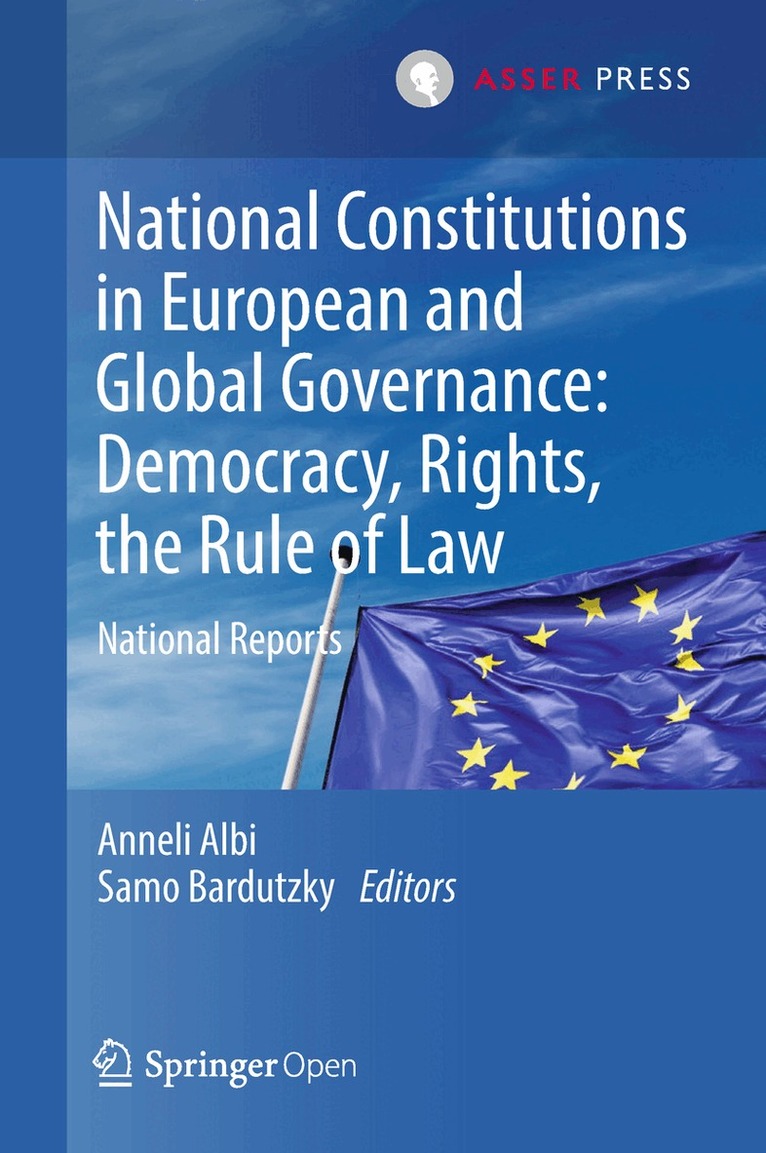
    National Constitutions in European and Global Governance: Democracy, Rights, the Rule of Law

    National Reports

    AvAnneli Albi,Samo Bardutzky

    T.M.C. Asser Press

    2019

    596 kr

    Beställningsvara. Skickas inom 10-15 vardagar. Fri frakt över 249 kr.

    Beskrivning

    This two-volume book, published open access, brings together leading scholars of constitutional law from twenty-nine European countries to revisit the role of national constitutions at a time when decision-making has increasingly shifted to the European and transnational level. It offers important insights into three areas. First, it explores how constitutions reflect the transfer of powers from domestic to European and global institutions. Secondly, it revisits substantive constitutional values, such as the protection of constitutional rights, the rule of law, democratic participation and constitutional review, along with constitutional court judgments that tackle the protection of these rights and values in the transnational context, e.g. with regard to the Data Retention Directive, the European Arrest Warrant, the ESM Treaty, and EU and IMF austerity measures. The responsiveness of the ECJ regarding the above rights and values, along with the standard of protection, is also assessed. Thirdly, challenges in the context of global governance in relation to judicial review, democratic control and accountability are examined. On a broader level, the contributors were also invited to reflect on what has increasingly been described as the erosion or ‘twilight’ of constitutionalism, or a shift to a thin version of the rule of law, democracy and judicial review in the context of Europeanisation and globalisation processes.The national reports are complemented by a separately published comparative study, which identifies a number of broader trends and challenges that are shared across several Member States and warrant wider discussion. The research for this publication and the comparative study were carried out within the framework of the ERC-funded project ‘The Role and Future of National Constitutions in European and Global Governance’.The book is aimed at scholars, researchers, judges and legal advisors working on the interface between national constitutional law and EU and transnational law. The extradition cases are also of interest to scholars and practitioners in the field of criminal law.Anneli Albi is Professor of European Law at the University of Kent, United Kingdom.Samo Bardutzky is Assistant Professor of Constitutional Law at the University of Ljubljana, Slovenia.

    Produktinformation

    • Märke:T.M.C. Asser Press
    • Utgivningsdatum:2019-06-13
    • Höjd:155 x 235 x 97 mm
    • Vikt:2 690 g
    • Språk:Engelska
    • Antal sidor:1 522
    • Förlag:T.M.C. Asser Press
    • EAN:9789462652729

    Utforska kategorier

    • Författningsrätt och förvaltningsrätt inom Juridik
    • Komparativ rätt inom Juridik

    Mer om författaren

    Anneli Albi is Professor of European Law at the University of Kent, United Kingdom. Samo Bardutzky is Assistant Professor of Constitutional Law at the University of Ljubljana, Slovenia.

    Innehållsförteckning

    • Part I: Introduction.- Chapter 1. Revisiting the Role and Future of National Constitutions in European and Global Governance: Introduction to the Research Project.- Chapter 2. Questionnaire for the Network of Constitutional Experts of the Research Project ‘The Role of National Constitutions in European and Global Governance’.- Part II. Political/Evolutionary Constitutions: The Predominant Role of Parliament with the Absence of or a Weak Role for a Constitutional Court, and a Generic or ECHR-Based Bill of Rights.- Chapter 3. Europe’s Gift to the United Kingdom’s Unwritten Constitution – Juridification.- Chapter 4. The Constitution of Malta: Reflections on New Mechanisms for Synchrony of Values in Different Levels of Governance.- Chapter 5. The Netherlands: The Pragmatics of a Flexible, Europeanised Constitution.- Chapter 6. The Constitution of Luxembourg in the Context of EU and International Law as ‘Higher Law’.- Chapter 7. The Role of the Danish Constitution in European and Transnational Governance.- Chapter 8. The Constitution of Sweden and European Influences: The Changing Balance between Democratic and Judicial Power.- Chapter 9. Finland: European Integration and International Human Rights Treaties as Sources of Domestic Constitutional Change and Dynamism.- Part III: The Post-Totalitarian Constitutions of the ‘Old’ Member States: An Extensive Bill of Rights, Rule of Law Safeguards and Constitutional Review by a Constitutional Court.- Chapter 10. European Constitutionalism and the German Basic Law.- Chapter 11. The Constitution of Italy: Axiological Continuity between the Domestic and International Levels of Governance?.- Chapter 12. The Constitution of Spain: The Challenges for the Constitutional Order under European and Global Governance.- Chapter 13. Portugal: The Impact of European Integration and the Economic Crisis on the Identity of the Constitution.- Chapter 14. The Constitution of Greece: EU Membership Perspectives.- Part IV: The Post-Totalitarian Constitutions of the ‘New’ Member States from the Post-Communist Area: A Detailed Bill of Rights, Rule of Law Safeguards and Constitutional Review Entrenched after the Recent Memory of Arbitrary Exercise of Power.- Chapter 15. The Future Mandate of the Constitution of Slovenia: A Potent Tradition Under Strain.- Chapter 16. The Role of the Polish Constitution (Pre-2016): Development of a Liberal Democracy in the European and International Context.- Chapter 17. The Czech Republic: From a Euro-Friendly Approach of the Constitutional Court to Proclaiming a Court of Justice Judgment Ultra Vires.- Chapter 18. Slovakia: Between Euro-Optimism and Euro-Concerns.- Chapter 19. The Constitution of Estonia: The Unexpected Challenges of Unlimited Primacy of EU Law.- Chapter 20. The Constitution of Latvia – A Bridge Between Traditions and Modernity.- Chapter 21. The Constitutional Experience of Lithuania in the Context of European and Global Governance Challenges.- Chapter 22. Romania – The Vagaries ofInternational Grafts on Unsettled Constitutions.- Chapter 23. The Bulgarian Constitutional Order, Supranational Constitutionalism and European Governance.- Chapter 24. The Constitution of Croatia in the Perspective of European and Global Governance.- Part V: Normative-Hybrid Constitutions: Combining Strong and Elastic Elements, e.g. an Older or ECHR-Based Bill of Rights.- Chapter 25. The Constitution of France in the Context of EU and Transnational Law: An Ongoing Adjustment and Dialogue to be Improved.- Chapter 26. The Belgian Constitution: The Efficacy Approach to European and Global Governance.- Chapter 27. The Constitution of Austria in International Constitutional Networks: Pluralism, Dialogues and Diversity.- Chapter 28. Ireland: The Constitution of Ireland and EU Law: The Complex Constitutional Debates of a Small Country.- Chapter 29. The Cypriot Constitution under the Impact of EU Law: An Asymmetrical Formation.- Part VI: Specific Constitutional Developments.- Chapter 30. Introductory Editorial Note to the Hungarian Report: The Pre-2010 Rule of Law Achievements and Post-2010 Illiberal Turn.- Chapter 31. Hungary: Constitutional (R)evolution or Regression?.- Part VII: Reforming the National Constitution in View of Global Governance.- Chapter 32. Constitutionalisation and Democratisation of Foreign Affairs: The Case of Switzerland.