Advances in Earthquake Engineering – serie
Visar alla böcker i serien Advances in Earthquake Engineering. Handla med fri frakt och snabb leverans.
5 produkter
5 produkter
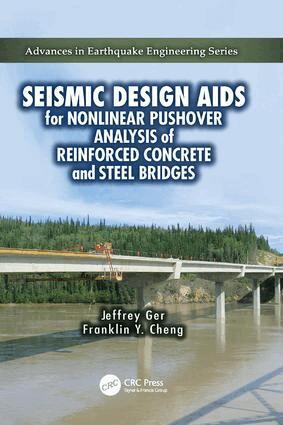
Seismic Design Aids for Nonlinear Pushover Analysis of Reinforced Concrete and Steel Bridges
Häftad, Engelska, 2017
1 107 kr
Skickas inom 10-15 vardagar
Nonlinear static monotonic (pushover) analysis has become a common practice in performance-based bridge seismic design. The popularity of pushover analysis is due to its ability to identify the failure modes and the design limit states of bridge piers and to provide the progressive collapse sequence of damaged bridges when subjected to major earthquakes. Seismic Design Aids for Nonlinear Pushover Analysis of Reinforced Concrete and Steel Bridges fills the need for a complete reference on pushover analysis for practicing engineers. This technical reference covers the pushover analysis of reinforced concrete and steel bridges with confined and unconfined concrete column members of either circular or rectangular cross sections as well as steel members of standard shapes. It provides step-by-step procedures for pushover analysis with various nonlinear member stiffness formulations, including: Finite segment–finite string (FSFS)Finite segment–moment curvature (FSMC) Axial load–moment interaction (PM) Constant moment ratio (CMR) Plastic hinge length (PHL) Ranging from the simplest to the most sophisticated, the methods are suitable for engineers with varying levels of experience in nonlinear structural analysis.The authors also provide a downloadable computer program, INSTRUCT (INelastic STRUCTural Analysis of Reinforced-Concrete and Steel Structures), that allows readers to perform their own pushover analyses. Numerous real-world examples demonstrate the accuracy of analytical prediction by comparing numerical results with full- or large-scale test results. A useful reference for researchers and engineers working in structural engineering, this book also offers an organized collection of nonlinear pushover analysis applications for students.
2 317 kr
Skickas inom 10-15 vardagar
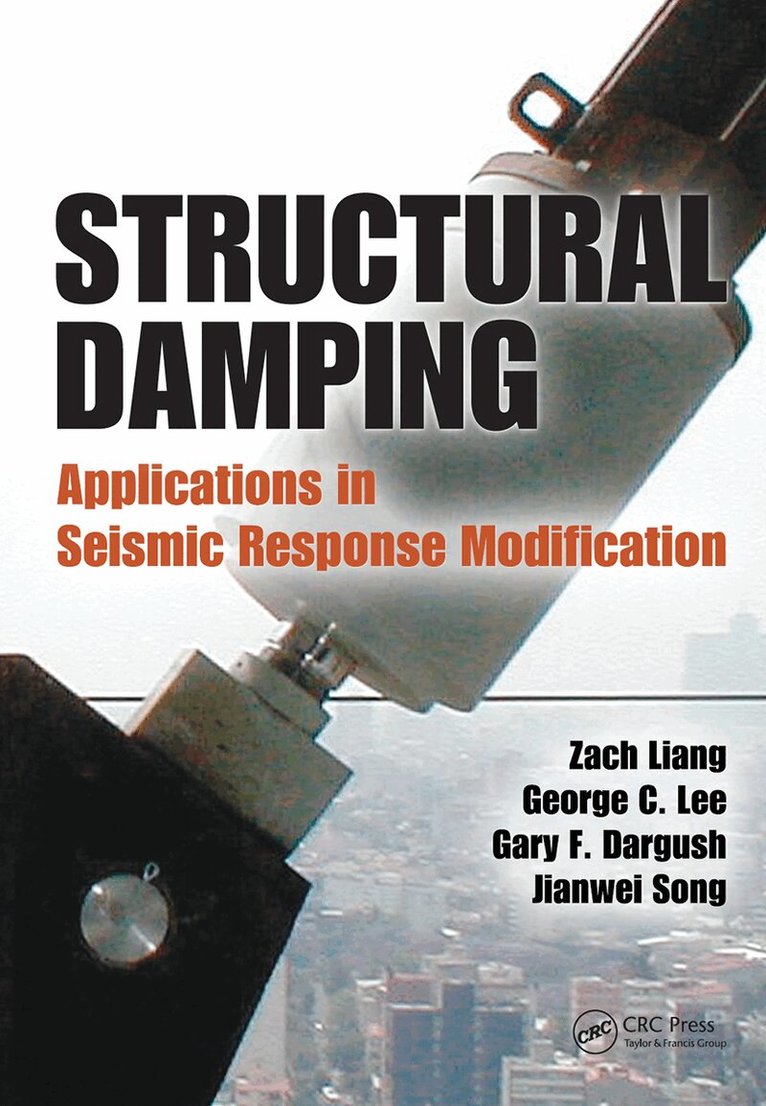
Rapid advances have been made during the past few decades in earthquake response modification technologies for structures, most notably in base isolation and energy dissipation systems. Many practical applications of various dampers can be found worldwide and, in the United States, damper design has been included in building codes. The current design process is simple and useful for adding supplemental damping up to a reasonable level—but it is not as useful with higher levels of damping.Taking a different approach, Structural Damping: Applications in Seismic Response Modification considers the dynamic responses of structures with added damping devices as systems governed by the combined effect of the static stiffness, period, and damping—or "dynamic stiffness"—of the structure-device system. This formulation supplies additional information for higher-level supplemental damping design that current provisions may not adequately cover. The authors also propose a more comprehensive consideration of the core issues in structural damping, which provides a useful foundation for continued research and development in seismic response modification technologies for performance-based engineering.The book includes design examples, based on the authors’ research and practical experience, to illustrate approaches that include higher-level supplemental damping to complement the use of the current NEHRP/ASCE-7 provisions. A self-contained resource on damping design principles, this book helps earthquake engineers select the most effective type of damper and determine the amount and configuration of damping under given working conditions.
Seismic Design Aids for Nonlinear Pushover Analysis of Reinforced Concrete and Steel Bridges
Inbunden, Engelska, 2011
3 200 kr
Skickas inom 10-15 vardagar
Nonlinear static monotonic (pushover) analysis has become a common practice in performance-based bridge seismic design. The popularity of pushover analysis is due to its ability to identify the failure modes and the design limit states of bridge piers and to provide the progressive collapse sequence of damaged bridges when subjected to major earthquakes. Seismic Design Aids for Nonlinear Pushover Analysis of Reinforced Concrete and Steel Bridges fills the need for a complete reference on pushover analysis for practicing engineers. This technical reference covers the pushover analysis of reinforced concrete and steel bridges with confined and unconfined concrete column members of either circular or rectangular cross sections as well as steel members of standard shapes. It provides step-by-step procedures for pushover analysis with various nonlinear member stiffness formulations, including: Finite segment–finite string (FSFS)Finite segment–moment curvature (FSMC) Axial load–moment interaction (PM) Constant moment ratio (CMR) Plastic hinge length (PHL) Ranging from the simplest to the most sophisticated, the methods are suitable for engineers with varying levels of experience in nonlinear structural analysis.The authors also provide a downloadable computer program, INSTRUCT (INelastic STRUCTural Analysis of Reinforced-Concrete and Steel Structures), that allows readers to perform their own pushover analyses. Numerous real-world examples demonstrate the accuracy of analytical prediction by comparing numerical results with full- or large-scale test results. A useful reference for researchers and engineers working in structural engineering, this book also offers an organized collection of nonlinear pushover analysis applications for students.
Random Vibration
Mechanical, Structural, and Earthquake Engineering Applications
Inbunden, Engelska, 2015
2 317 kr
Skickas inom 10-15 vardagar
Most textbooks on random vibrations are very mathematically intensive, and are often difficult for senior/graduate students to digest in the learning period of a single semester course. This book is designed to focus on basic methodologies to handle random process in engineering practices. Based on our teaching experience, this book can help students to directly gain the necessary knowledge and basic concept of random process, which used to be very difficult through math-intensive logic-rigorous training with conventional textbooks.
1 812 kr
Skickas inom 5-8 vardagar
Ground motion due to earthquake excitation often induces disastrous disturbances that severely damage structures and their contents. Conventional earthquake-resistant design focuses on the strengthening of structures to avoid collapse, while little attention is paid to the prevention of damage as it is almost impossible to construct completely "earthquake proof" structures at reasonable cost. This state-of-the-art volume explores seismic isolation as an alternative and performance-based design approach to minimise earthquake induced loads and resulting damage in low to medium-rise buildings. A discussion of the characteristics, advantages and limitations of seismic isolation is followed by a demonstration of its capability to decouple a structure from the damaging effects of ground acceleration. Describes currently used seismic isolation systems in detail. Evaluates the performance of seismically isolated structures and provides examples of their response under earthquake action. Proposes a preliminary design methodology for seismically isolated structures. Accessible to both students and practising structural engineers who need to familiarise themselves with this approach.