Advances in Opto-Electronics (Closed) - Böcker
Visar alla böcker i serien Advances in Opto-Electronics (Closed). Handla med fri frakt och snabb leverans.
2 produkter
2 produkter
850 kr
Skickas inom 10-15 vardagar
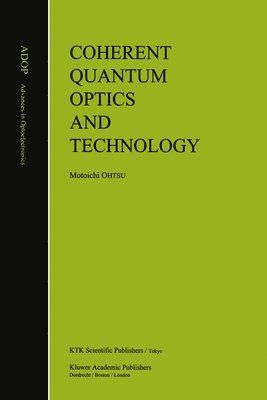
Coherent quantum optics and technology can be defined as the investigation of the principles of and methods for generating a very smooth lightwave with low fluctuations, controlling and manipulating atoms and photons and their application systems. Generation of nonclassical photons by this lightwave is also part of this area. Chapter 1 provides the reader with the definition of the coherent state of light. Chapter 2 is devoted to the principle of laser oscillation described by using the density matrix method. Chapter 3 reviews the structures and performances of representative lasers, that is gas, dye, solid-state, and semiconductor lasers. Chapter 4 defines the measures of representing the magnitude of noises and the specific noises in lasers. Chapter 5 treats the general ideas and methods of the principle of reducing the frequency fluctuations of lasers and their experimental results. Chapter 7 demonstrates several advanced lightwave application systems for communications, sensing, spectroscopy, atomic clock, quantum optics, atomic physics and test of the theory of relativity.For future progress of this field of research, Chapter 8 introduces several novel ideas for expanding the laser oscilation wavelength range, the generation of nonclassical photons, the manipulation of atoms and photons, and photonic energy storage. Chapters 1-5 form a tutorial textbook for undergraduate students, graduate students, and junior engineers. Chapters 6-8 introduce the topics which are still progressing rapidly.
850 kr
Skickas inom 10-15 vardagar
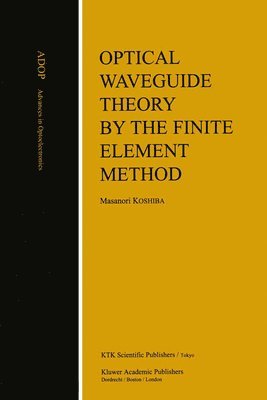
Recent advances in the field of guided-wave optics, such as fibre optics and integrated optics, have included the introduction of various optical waveguides. Computational tools for modelling and simulation are essential for a successful design, optimization, and realization of the optical waveguides. Despite its relatively brief existence, the finite element method has grown into a powerful and efficient tool for solving the most general optical waveguide problems. In this book, starting with a brief review of electromagnetic theory for optical waveguide analysis, the concepts of the finite element method and its fundamentals are discussed in detail. Current topics of the application of the finite element method to various optical waveguide problems, such as planar optical waveguides, optical channel waveguides, optical fibres, polarization-maintaining optical fibres, optical gratings, optical waveguide discontinuities, nonlinear optical waveguides, optical solitons and quantum well structures, are described, including many illustrations.