Brigham Young University - Islamic Translation Series – serie
Visar alla böcker i serien Brigham Young University - Islamic Translation Series. Handla med fri frakt och snabb leverans.
11 produkter
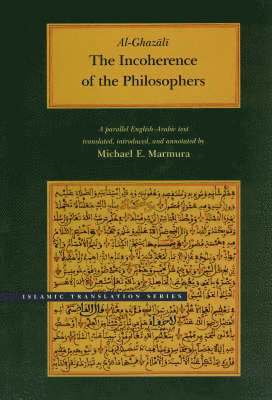
Incoherence of the Philosophers, 2nd Edition
Av Abu Hamid Muhammad Al-Ghazali
Inbunden, 2002
542 kr
Lägg i varukorg
Although Abu Hamid Muhammad al-Ghazali lived a relatively short life (1058-1111), he established himself as one of the most important thinkers in the history of Islam. The Incoherence of the Philosophers, written after more than a decade of travel and ascetic contemplation, contends that while such …
Elixir of the Gnostics
A parallel English-Arabic text
Av Mulla Sadra
Inbunden, 2002
345 kr
Lägg i varukorg
Sadr al-Din Muhammad Shirazi (1572-1640), more commonly called Mulla Sadra was one of the grand scholars of later-period Islamic philosophy and has grown to become one of the best-known Muslim philosophers. "Iksir al-Arifin" or "Elixir of the Gnostics", is unique among Sadra's writings in that it …
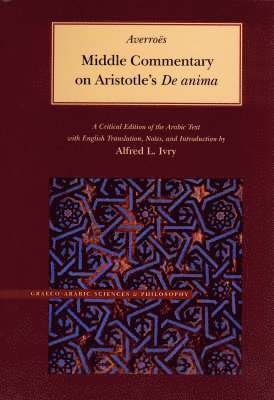
MIDDLE COMMENTARY ON ARISTOTLE'S DE ANIMA
Av Averroes
Inbunden, 2001
430 kr
Tillfälligt slut
Averroës, the greatest Aristotelian of the Islamic philosophical tradition, composed some thirty-eight commentaries on the "First Teacher's" corpus, including three separate treatments of De Anima ("On the Soul"): the works commonly referred to as the Short, Middle, and Long Commentaries. The …
Philosophy of Illumination
Inbunden, 2000
430 kr
Lägg i varukorg
Shihab al-Din al-Suhrawardi was born around 1154, probably in Northwestern Iran. Spurred by a dream in which Aristotle appeared to him, he rejected the Avicennan Peripatetic philosophy of his youth and undertook the task of reviving the philosophical tradition of the "Ancients." His philosophy …
Decisive Treatise and Epistle Dedicatory
Av Averroes
Inbunden, 2001
221 kr
Lägg i varukorg
Averroës (Ibn Rushd, 1126-1198) emerged from an eminent family in Muslim Spain to become the first and last great Aristotelian of the classical Islamic world; his meticulous commentaries influenced Christian thinkers and earned him favorable mention (and a relatively pleasant fate) in Dante's …
Physics of The Healing
A Parallel English-Arabic Text in Two Volumes
Av Avicenna
Inbunden, 2010
1083 kr
Lägg i varukorg
"Avicenna's Physics" is the very first volume that he wrote when he began his monumental encyclopedia of science and philosophy, "The Healing". Avicenna's reasons for beginning with "Physics" are numerous: it offers up the principles needed to understand such special natural sciences as psychology; …
Classical Foundations of Islamic Educational Thought
A Compendium of Parallel English-Arabic Texts
Av Bradley J. Cook, Fathi H. Malkawi
Inbunden, 2011
430 kr
Lägg i varukorg
Education has always been an important pursuit in Islam. The Prophet Muhammad enjoined his followers to 'seek knowledge, even unto China.' Within the religion, educational theory and practice were founded on the work of itinerant teachers who taught the fundamental tenets of the faith in exchange …
Metaphysical Penetrations
A Parallel English-Arabic Text
Inbunden, 2014
345 kr
Lägg i varukorg
Mulla Sadra (ca. 1572-1640) is one of the most prominent figures of post-Avicennan Islamic philosophy and among the most important philosophers of Safavid Persia. He was a prolific writer whose work advanced the fields of intellectual and religious science in Islamic philosophy, but arguably his …
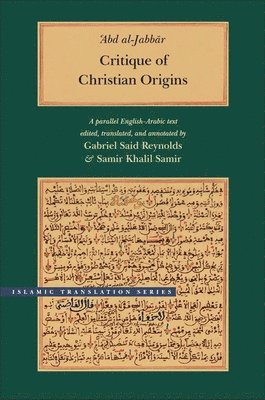
Critique of Christian Origins
A Parallel English-Arabic Text
Inbunden, 2010
434 kr
Tillfälligt slut
In the "Critique of Christian Origins" Abd al-Jabbar - a leading Muslim intellectual of the late tenth century - develops what might be considered the first Islamic history of Christianity, analyzing the Bible, church rituals, and miracles. Unlike Muslim scholars before him, Abd al-Jabbar …
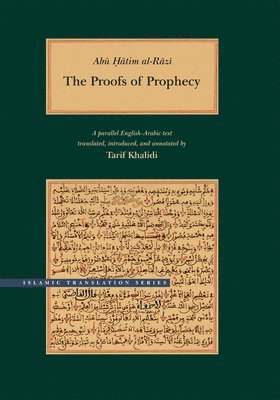
Abu Hatim al-Razi: The Proofs of Prophecy
A Parallel Arabic-English Text
Inbunden, 2012
434 kr
Tillfälligt slut
This book is the record of a debate that took place in the early tenth century between the famous Ismaili missionary Abu Hatim al-Razi and the even more celebrated Abu Bakr al-Razi, a physician and philosopher who was known to medieval Europe as "Rhazes." These two were towering figures of …
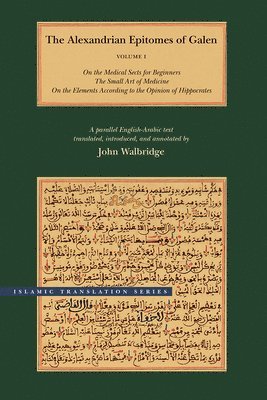
Alexandrian Epitomes of Galen
Volume 1: On the Medical Sects for Beginners; The Small Art of Medicine; On the Elements According to the Opinion of Hippocrates. A Parallel English-Arabic Text
Av Galen
Inbunden, 2015
616 kr
Tillfälligt slut
The second-century physician and philosopher Galen is not known for brevity. Although his writings on medicine are famously verbose and numerous, for centuries they constituted much of the standard syllabi for medical students. About fourteen hundred years ago, one or possibly several professors …