Categories - Böcker
Visar alla böcker i serien Categories. Handla med fri frakt och snabb leverans.
7 produkter
7 produkter
1 417 kr
Skickas inom 5-8 vardagar
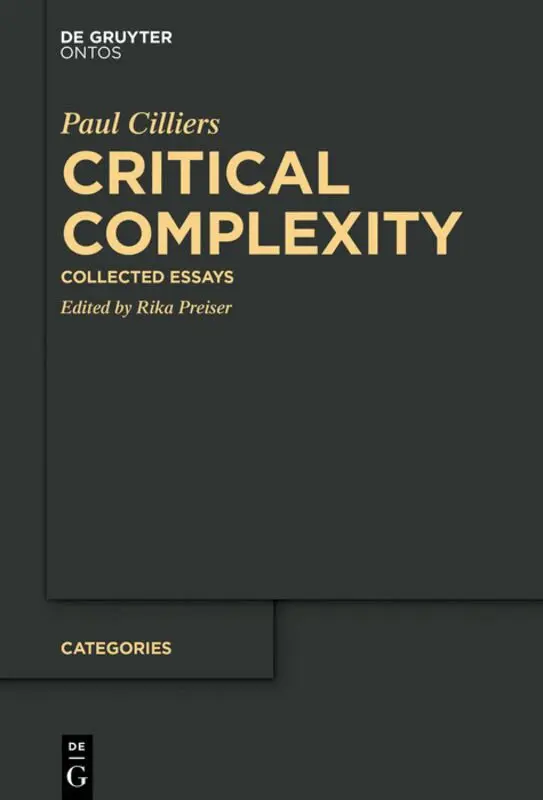
This book is a collection of all the single authored essays by Paul Cilliers, published between 1990-2011. Being one of few authors who approached the study of complexity from a philosophical perspective, the main themes in these papers explore:- Qualitative characterization of complexity and the normative implications of studying complex adaptive systems,- the philosophical and conceptual similarity to post-structural approaches- how any engagement with complexity leads to a critical engagement with how we do science and design interventions- critical and normative implications for how to engage with complex socio-political concerns in the world. What makes this book unique is that it consolidates a body of work that is distributed over a wide range of academic journals. Although his book "Complexity and Postmodernism" (Routledge, 1998) remains a cornerstone in the field of complexity studies, Cilliers’ journal essays really explore the application of the theoretical concepts in more depth. His ground-breaking ideas conceptualized in these essays have served as a continual source of novelty and inspiration in the process of applying complexity thinking to other fields of study.
2 787 kr
Skickas inom 5-8 vardagar
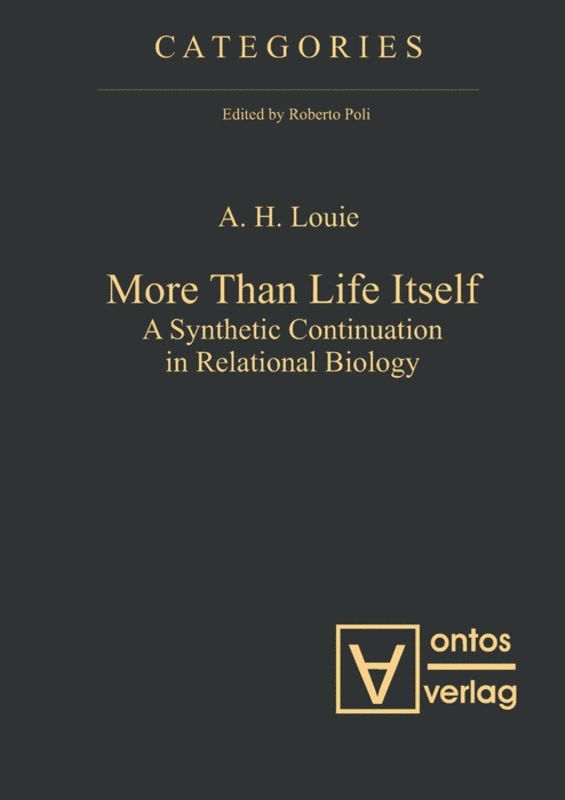
A. H. Louie's More Than Life Itself is an exploratory journey in relational biology, a study of life in terms of the organization of entailment relations in living systems. This book represents a synergy of the mathematical theories of categories, lattices, and modelling, and the result is a synthetic biology that provides a characterization of life. Biology extends physics. Life is not a specialization of mechanism, but an expansive generalization of it. Organisms and machines share some common features, but organisms are not machines. Life is defined by a relational closure that places it beyond the reach of physicochemical and mechanistic dogma, outside the reductionistic universe, and into the realm of impredicativity. Function dictates structure. Complexity brings forth living beings.
2 206 kr
Skickas inom 5-8 vardagar
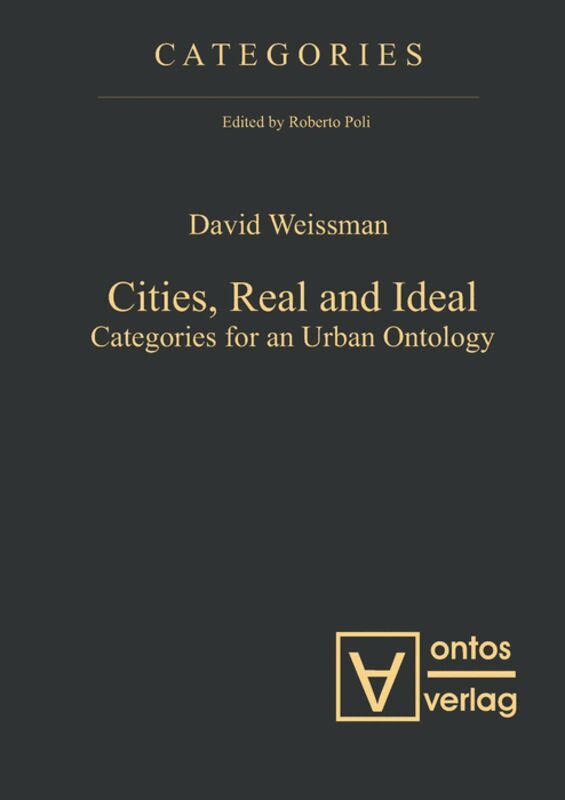
Cities are conspicuous among settlements because of their bulk and pace: Venice, Paris, or New York. Each is distinctive, but all share a social structure that mixes systems (families, businesses, and schools), their members, and a public regulator. Cities alter this structure in ways specific to themselves: orchestras play music too elaborate for a quartet; city densities promote collaborations unachievable in simpler towns. Cities, Real and Ideal avers with von Bertalanffy, Parsons, Simmel, and Wirth that a theory of social structure is empirically testable and confirmed. It proposes a version of social justice appropriate to this structure, thereby updating Marx’s claim that justice is realizable without the intervention of factors additional to society’s material conditions.
1 866 kr
Skickas inom 5-8 vardagar
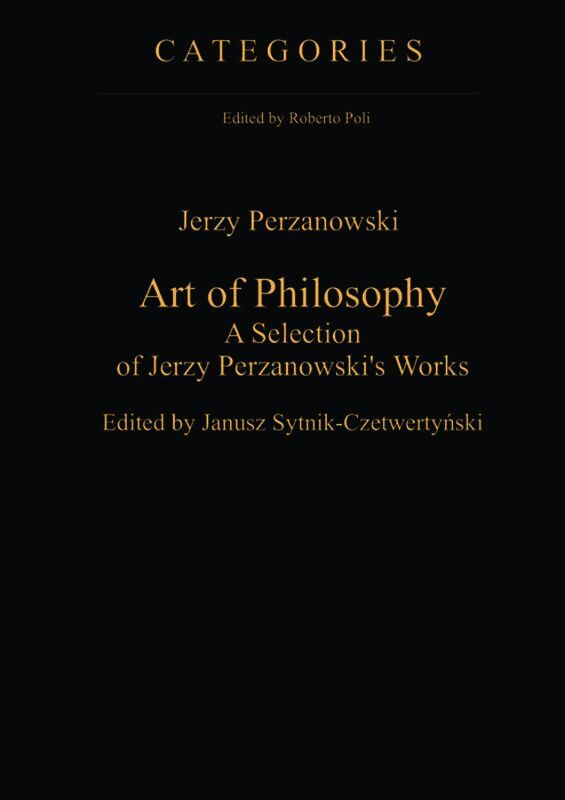
Jerzy Perzanowski’s ideas were based on an original blend of logic and ontology in what he called onto/logic, where the slash is meant to suggest a quotient of ontology by logic. Perzanowski began as a logician, his early works being on modal logic, then gradually shifted his interest to “logical philosophy”, meaning not so much philosophy of logic as philosophy informed by logic. Perzanowski was a rare breed of analytical philosopher who thought that a philosophical “theory of everything” was worthwhile. In this systematic spirit, he began with method. He presented his “method of total analysis and synthesis” quite simply: reduce the object of research to its simplest possible constituents, and then combine them in some way. Better still, combine them in every possible way, thereby producing a space of possibilities analogous to (and in certain cases identical with) the logical space. Thus, analysis and synthesis differ from a trivial disassembly and reassembly.
2 547 kr
Skickas inom 5-8 vardagar
The present collection of seventeen papers, most of them already published in international philosophical journals, deals both with issues in the philosophy of logic, the philosophy of mathematics, the philosophy of language and epistemology. The first part contains critical assessments and somewhat deviant renderings of the work of two seminal philosophers, Frege and Husserl, as well as of the young Carnap and Kripke. The second part contains analyses of central issues in the philosophy of logic, the philosophy of mathematics and semantics, including arguments on behalf of Platonism in the philosophy of mathematics, a defense of second-order logic, a new definition of analyticity, a sketch of a semantics for mathematical statements and a critique of Kripke’s possible world semantics for modal logic.
1 440 kr
Skickas inom 5-8 vardagar
Traditional moral theory usually has either of two emphases: virtuous moral character or principles for distributing duties and goods. Zone Morality introduces a third focus: families and businesses are systems created by the causal reciprocities of their members. These relations embody the duties and permissions of a system’s moral code. Core systems satisfy basic interests and needs; we move easily among them hardly noticing that moral demands vary from system to system. Moral conflicts arise because of discord within or among systems but also because morality has three competing sites: self-assertive, self-regarding people; the moral codes of systems; and regulative principles that enhance social cohesion. Each wants authority to control the other two. Their struggles make governance fragile. A strong church or authoritarian government reduces conflict by imposing its rules, but democracy resists that solution. Procedural democracy is a default position. Its laws and equitable procedures defend people or systems having diverse interests when society fails to create a public that would govern for the common interest.
1 533 kr
Skickas inom 5-8 vardagar
Meaning (significance) and nature are this book’s principal topics. They seem an odd couple, like raisins and numbers, though they elide when meanings of a global sort—ideologies and religions, for example—promote ontologies that subordinate nature. Setting one against the other makes reality contentious. It signifies workmates and a coal face to miners, gluons to physicists, prayer and redemption to priests. Are there many realities, or many perspectives on one? The answer I prefer is the comprehensive naturalism anticipated by Aristotle and Spinoza: "natura naturans, natura naturata." Nature naturing is an array of mutually conditioning material processes in spacetime. Each structure or event—storm clouds forming, nature natured—is self-differentiating, self-stabilizing, and sometimes self-disassembling; each alters or transforms a pre-existing state of affairs. This surmise anticipated discoveries and analyses to which neither thinker had access, though physics and biology confirm their hypothesis beyond reasonable doubt. Hence the question this book considers: Is reality divided:nature vrs. lived experience? Or is experience, with all its meanings and values, the complex expression of natural processes?