Chapman and Hall Advanced Industrial Technology Series - Böcker
Visar alla böcker i serien Chapman and Hall Advanced Industrial Technology Series. Handla med fri frakt och snabb leverans.
9 produkter
9 produkter
2 117 kr
Skickas inom 10-15 vardagar
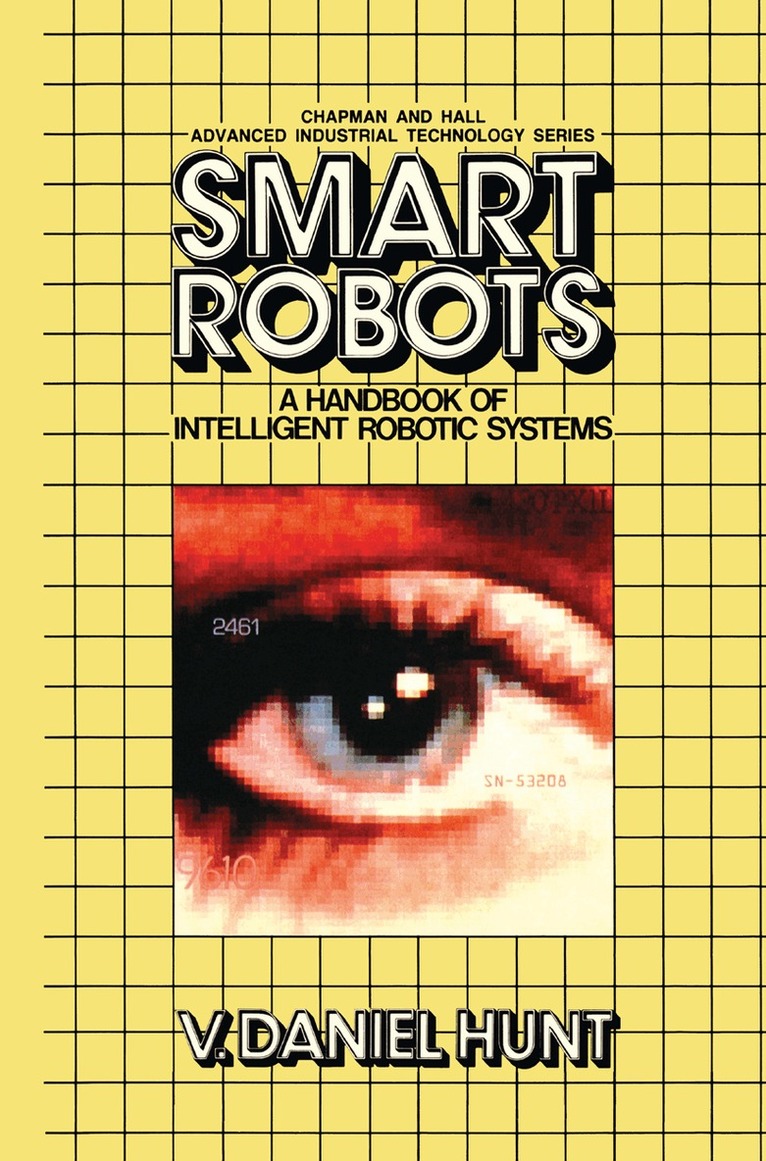
This comprehensive volume provides an overview of the rapidly expanding field of intelligent computers, explaining what a 'smart' robot is, how it is selected and what must be done to operate such a system. It is designed to help the reader develop an understanding of the industrial applications of smart robots as well as the new technological developments and future trends. This book should be of interest to computer scientists and engineers.
2 117 kr
Skickas inom 10-15 vardagar
This book should be of interest to designers and procirers of automated systems in all engineering fields (electrical, mechanical, optical and automotive engineering).
550 kr
Skickas inom 10-15 vardagar
This book is written for software engineers, software project leaders, and software managers who would like to introduce a new advanced software technology, expert systems, into their product. Expert system technology brings into programming a new dimension in which "rule of thumb" or heuristic expert knowledge is encoded in the program. In contrast to conventional procedural languages {e. g. , Fortran or C}, expert systems employ high-level programming languages {Le. , expert system shells} that enable us to capture the judgmental knowledge of experts such as geologists, doctors, lawyers, bankers, or insurance underwriters. Past expert systems have been more successfully applied in the problem areas of analysis and synthesis where the boundary of lo;nowledge is well defined and where experts are available and can be identified. Early successful applications include diagnosis systems such as MYCIN, geological systems such as PROSPECTOR, or design/configu ration systems such as XC ON. These early expert systems were mainly applicable to scientific and engineering problems, which are not theoreti cally well understood in terms of decisionmaking processes by their experts and which therefore require judgmental assessment. The more recent expert systems are being applied to sophisticated synthesis problems that involve a large number of choices, such as how the elements are to be compared. These problems normally entailed a large search space and slower speed for the expert systems designed. Examples of these systems include factory scheduling applications such as ISIS, or legal reasoning applications such as TAXMAN.
2 117 kr
Skickas inom 10-15 vardagar
The authors and editors of this Handbook have attempted to fill a serious gap in the professional literature on industrial automation. Much past attention has been directed to the general concepts and philosophy of automation as a way to convince owners and managers of manufacturing facilities that automation is indeed one of the few avenues available to increase productivity and improve competitive position. Seventy-three contributors share their knowledge in this Handbook. Less attention has been given to the "What" and "How" of automation. To the extent feasible and practical within the confines of the pages allowed, this Handbook concentrates on the implementation of automation. Once the "Go" signal has been given by management, concrete details-not broad definitions and philosophical discussions-are required. To be found in this distinctly different book in the field are detailed parameters for designing and specifying equipment, the options available with an evaluation of their relative advantages and limitations, and insights for engineers and production managers on the operation and capabilities of present-generation automation system components, subsystems, and total systems. In a number of instances, the logical extension of current technology into the future is given. A total of 445 diagrams and photos and 57 tables augments detailed discussions. In addition to its use as a ready reference for technical and management personnel, the book has wide potential for training and group discussions at the college and university level and for special education programs as may be provided by consultants or by "in-house" training personnel.
1 062 kr
Skickas inom 10-15 vardagar
The latest information indicates that the United States now spends in excess of $150 billion annually to perform its metal removal tasks using conventional machining technology. That estimate is increased from $115 billion 5 years ago. It becomes clear that metal removal technology is a very important candidate for rigorous investigation looking toward improvement of productivity within the manufacturing system. To aid in that endeavor, an extensive program of research has developed within the industrial community with the express purpose of establishing a new scientific and applied base that will provide principles upon which new manufacturing decisions can be made. One of the metal removal techniques that has the potential for great economic advantages is high-rate metal removal with related technologies. This text is concerned with the field of grinding as a subset of the general field of high-rate metal removal. Related processes (not covered in this text) include such topics asturning, drilling, and milling. In the final evaluation, the correct decision in the determination of a grinding process must necessarily include an understanding of the other methods of metal removal. The term grinding, as used herein, includes polishing, buffing, lapping, and honing as well as conventional definition: "... removing either metallic or other materials by the use of a solid grinding wheel".
2 117 kr
Skickas inom 10-15 vardagar
Here is one of the first really thorough presentations on smart robots. Robots, machine vision systems, sensors, manipulators, expert systems, and artificial intelligence concepts combined in state-of-the-art computer integrated manufacturing systems. These "smart" robots increase produc tivity and improve the quality of our products. This comprehensive volume, which is extensively illustrated, provides a unique synthesis and overview of the emerging field of smart robots, the basic approaches for each of the constituents systems, the techniques used, applications, the descriptions of current hardware or software projects, a review of the state-of-the-art of the technology, current research and development efforts, and trends in the development of smart robots. All of the information has been compiled from a wide variety of knowledgeable sources and recent government reports. An extensive selection of photo graphs, diagrams and charts amplify this book. The contents of major chapters include: • Introduction to smart robots • Artificial intelligence for smart robots • Smart robot systems • Sensor-controlled robots • Machine vision systems • Robot manipulators • Natural language processing • Expert systems and • Computer integrated manufacturing Smart Robots presents the state-of-the-art in intelligent robots. It is designed to help the reader develop an understanding of industrial applications of smart robots as well as the new technological develop ments. Smart Robots is an outstanding introduction to the integration and application of machine vision systems, sensors, expert systems, and artificial intelligence technology.
Encyclopedic Dictionary of Industrial Technology
Materials, Processes and Equipment
Häftad, Engelska, 2012
527 kr
Skickas inom 10-15 vardagar
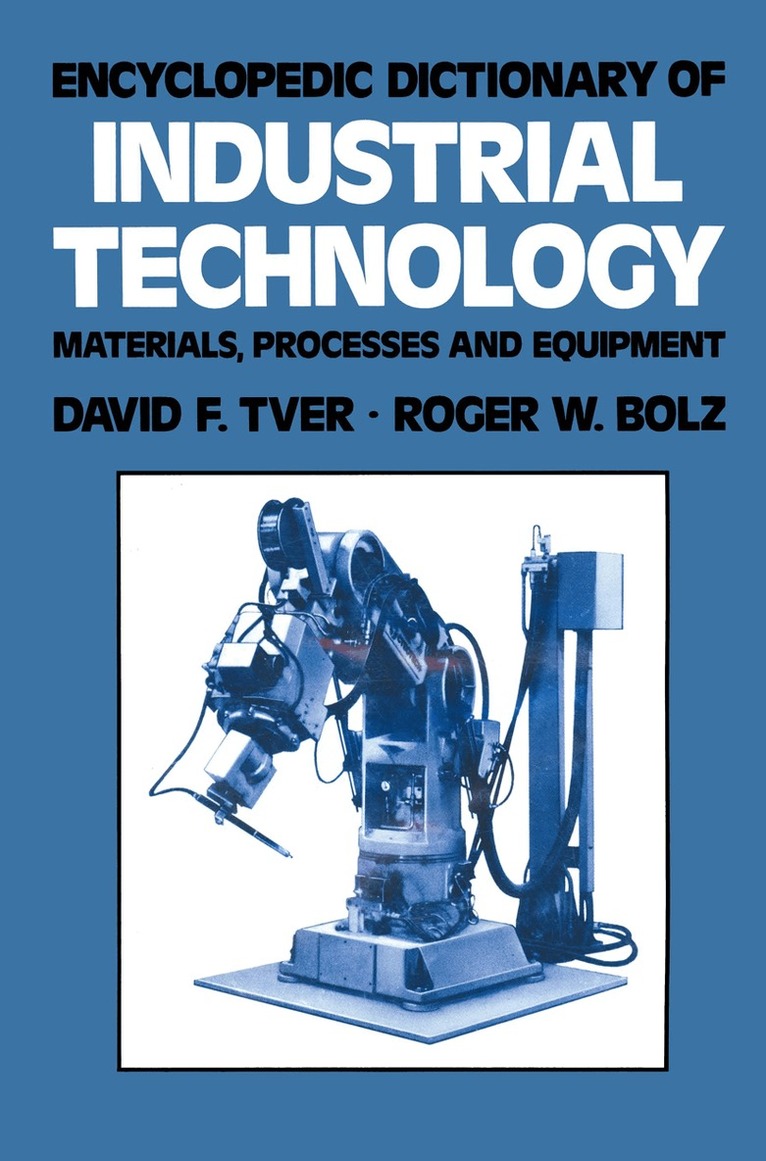
This volume has been prepared as a reference guide for all engineering, industrial and technical management personnel who are in any way involved in the manufacturing process, in product design, or in converting of raw materials to finished products. This Encyclopedic Dictionary covers a wide range of subjects from industrial materials, minerals, metals, plastics and synthetic fibers to machine tools, computers, lasers, robots and other production equipment as well as manufacturing processes. Some of the materials reviewed are brass, steel, nickel, copper, bronze, cast iron, cements, clay, coal, coke, petroleum and petrochemicals, glass, limestone, rubber, paper, metal alloys, chemicals, synthetic fibers, textiles, plastics, resins, lubricants, and thermoplastics. Various processes are reviewed such as metal casting, forming, machining, anneal ing, extrusion, heat treating, injection molding, papermaking and steel processing. In heat treating such areas as martempering, annealing, spheroidizing, tempering and austempering are included. Different types of equipment related to the products are defined. In plastics such pro ducts are covered as nylons, polyesters, rayons, Teflon, Vinyon, Saran, acetates and acrylics. Many of the manufacturing processes and equipment involved in the conversion of material to finished products are described along with products and their ultimate uses. Also, important associated manufacturing activities such as inspection, handling, and control are included to make the references as complete as is practicable.
527 kr
Skickas inom 10-15 vardagar
The United States now spends approximately $115 billion annually to perform its metal removal tasks using conventional machining technology. Of this total amount, about $14 billion is invested in the aerospace and associated industries. It becomes clear that metal removal technology is a very important candidate for rigorous investigation looking toward improvement of productivity within the manufacturing system. To aid in this endeavor, work has begun to establish a new scientific and technical base that will provide principles upon which manufacturing decisions may be based. One of the metal removal areas that has the potential for great economic advantages is high-speed machining and related technology. This text is concerned with discussions of ways in which high-speed machining systems can solve immediate problems of profiling, pocketing, slotting, sculpturing, facing, turning, drilling, and thin-walled sectioning. Benefits to many existing programs are provided by aiding in solving a current management production problem, that of efficiently removing large volumes of metal by chip removal. The injection of new high-rate metal removal techniques into conventional production procedures, which have remained basically unchanged for a century, presents a formidable systems problem, both technically and man agerially.The proper solution requires a sophisticated, difficult process whereby management-worker relationships are reassessed, age-old machine deSigns reevaluated, and a new vista of product/process planning and design admitted.
527 kr
The first chapter of this book traces the history of the development of walking machines from the original ideas of man-amplifiers and military rough-ground transport to today's diverse academic and industrial research and development projects. It concludes with a brief account of research on other unusual methods of locomotion. The heart of the book is the next three chapters on the theory and engineering of legged robots. Chapter 2 presents the basics of land loco motion, going on to consider the energetics of legged movement and the description and classification of gaits. Chapter 3, dealing with the mechanics of legged vehicles, goes into leg number and arrangement, and discusses mechanical design and actuation methods. Chapter 4 deals with analysis and control, describing the aims of control theory and the methods of modelling and control which have been used for both highly dynamic robots and multi-legged machines. Having dealt with the theory of control it is necessary to discuss the computing system on which control is to be implemented. This is done in Chapter 5, which covers architectures, sensing, algorithms and pro gramming languages. Chapter 6 brings together the threads of the theory and engineering discussed in earlier chapters and summarizes the current walking machine research projects. Finally, the applications, both actual and potential, of legged locomotion are described. Introduction Research into legged machines is expanding rapidly. There are several reasons why this is happening at this particular time.