Clarendon Lectures in Geography and Environmental Studies - Böcker
Visar alla böcker i serien Clarendon Lectures in Geography and Environmental Studies. Handla med fri frakt och snabb leverans.
5 produkter
5 produkter
2 890 kr
Skickas inom 5-8 vardagar
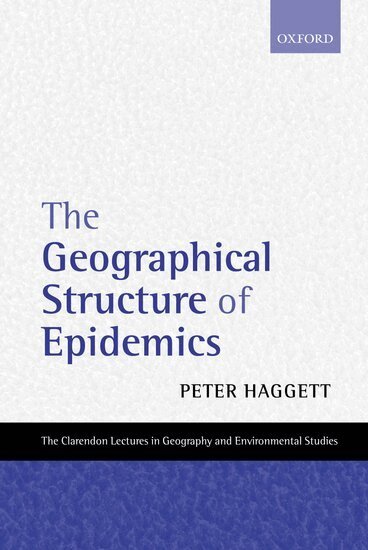
The ways in which the great plagues of the past and present have spread around the world remains only partly understood. Peter Haggett's research over the last thirty years has focused on mapping and modelling the paths by which epidemics spread through human communities. In 1998 this led to him being invited to give the inaugural lectures in a new series, the Clarendon Lectures in Geography and Environmental Studies. The resulting book, Geographical Structure of Epidemics, presents an accessible, concise, and well illustrated account of how environmental and geographical concepts can be used to enhance our knowledge of the origins and progress of epidemics, and sometimes to slow to slow or halt their spread.
Integrated Land-Change Science and Tropical Deforestation in the Southern Yucatan
Final Frontiers
Inbunden, Engelska, 2004
5 970 kr
Skickas inom 7-10 vardagar
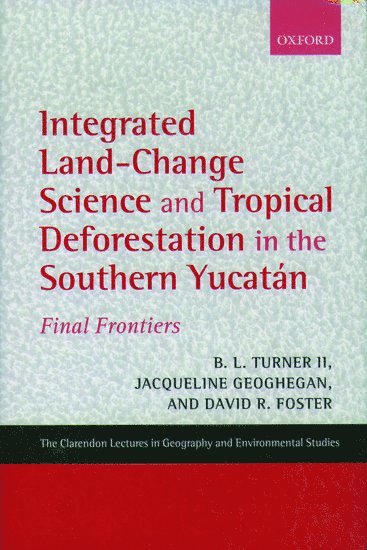
This highly topical study of tropical deforestation in Mexico reports on the first phase of the Land-Cover and Land-Use Change in the Southern Yucatan Peninsular Region Project (LCLUC-SYPR): a large, multi-institutional, and team-based study designed to understand and project land changes in a development frontier that pits the rapidly growing needs of smallholder farmers to cut down forests for cultivation against federally sponsored initiatives committed to various international programmes of forest preservation and complementary economic programmes.The SYPR project is a response to inderdisciplinary defined research themes deemed critical to global environmental change and complementary international research agendas (e.g. environment and development, ecosystem assessment, biotic diversity). Pivotal among these agendas are those posed by the Land-Use/Cover Change (LUCC) effort of the International Geosphere-Biosphere Programme and the International Human Dimensions of Global Environmental Change Programme as it is linked through such US sponsors as the National Aeronautics and Space Administration (NASA) and the National Science Foundation (NSF). The themes (i.e. questions and subjects) posed by these programmes and organization are 'integrated' or 'synthesis' in kind, meaning that they rest within the intersection of formal disciplines and are intended to fit into a larger, systems framework about human-environment relationships and the structure and function of the biosphere.The editors of this volume, as most of its contributors, come from the disciplines of geography, ecology, and economics. The lead editor, the geographer B. L. Turner II, has spent most of his career in pursuit of understanding different aspects of tropical deforestation and agriculture.
1 222 kr
Skickas inom 7-10 vardagar
People around the world are confused and concerned. Is it a sign of strength of or of weakness that the US has suddenly shifted from a politics of consensus to one of coercion on the world stage? What was really at stake in the war on Iraq? Was it all about oil and, if not, what else was involved? What role has a sagging economy played in pushing the US into foreign adventurism and what difference does it make that neo-conservatives rather than neo-liberals are now in power? What exactly is the relationship between US militarism abroad and domestic politics? These are the questions taken up in this compelling and original book. Closely argued but clearly written, David Harvey, a leading social theorist of his generation, builds a conceputal framework to expose the underlying forces at work behind these momentous shifts in US policies and politics. The compulsions behind the projection of US power on the world as a 'new imperialism' are here, for the first time, laid bare for all to see.'David Harvey has written a profound, and profoundly disturbing, book. For thirty years his writings have taken aim at the complacent conviction that what exists works. Harvey is a scholarly radical; his writing is free of journalistic cliches, full of facts and carefully thought-through ideas. This book is beautifully crafted, its prose accessible, its narrative one of mounting intensity and urgency. The New Imperalism mounts a stunning indictment of our present institutions of power, while offering hopeful insights about how these institutions could be changed.'RICHARD SENNETT, Professor of Sociology, London School of Economics'Navigating effortlessly between history, economics, geography and politics, with persuasive argument and lucid prose, David Harvey places today's headlines in context and makes sense of the early twenty-first century maelstrom we're all caught up in. His concept of accumulation by dispossession will go far. The New Imperialism is a truly useful book.'SUSAN GEORGE, Associate Director, The Transnational Institute, Amsterdam
411 kr
Skickas inom 5-8 vardagar
People around the world are confused and concerned. Is it a sign of strength or of weakness that the US has suddenly shifted from a politics of consensus to one of coercion on the world stage? What was really at stake in the war on Iraq? Was it all about oil and, if not, what else was involved? What role has a sagging economy played in pushing the US into foreign adventurism and what difference does it make that neo-conservatives rather than neo-liberals are now in power? What exactly is the relationship between US militarism abroad and domestic politics?These are the questions taken up in this compelling and original book. Closely argued but clearly written, 'The New Imperialism' builds a conceptual framework to expose the underlying forces at work behind these momentous shifts in US policies and politics. The compulsions behind the projection of US power on the world as a 'new imperialism' are here, for the first time, laid bare for all to see.This new paperback edition contains an Afterword written to coincide with the result of the 2004 American presidental election.
1 426 kr
Skickas inom 5-8 vardagar
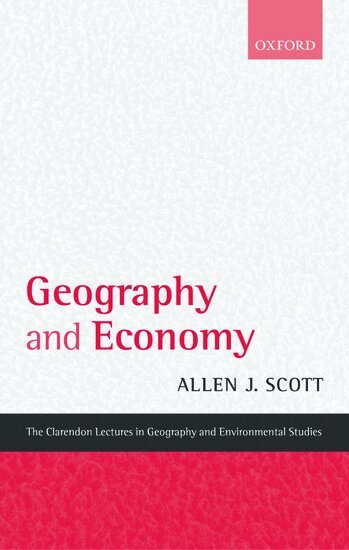
This book focuses on the theme of the mutually constitutive relations between geographic space and the economic order. Three principle lines of investigation are identified and explored. First, Allen J. Scott sketches out the general theory of the division of labour and the ways in which it is reflected in geographic patterns of specialization and interaction. He examines, in particular, the role of the division of labour in the formation of large-scale agglomerations of economic activity and the ways in which their internal and external relationships are played out. Second, he considers the structure of geographic space as a fountainhead of creativity, learning, and innovation. A theory of the creative field is presented, and its application to the investigation of entrepreneurship, technological change, and the dynamics of the cultural economy is considered. Third, he offers an account of the regional question in less developed parts of the world. Here, he recovers some of the arguments of high development theory and shows how they can be revitalized in the light of a specifically geographic approach. These three lines of investigation are, of course, tightly intertwined with one another. The argument in general demonstrates that geographic space is not just an inert dimension in which the economy unfolds, but plays an active role in the eventuation of economic outcomes. This state of affairs raises many difficult policy questions about growth and development in both more and less economically advanced countries. Some of the more important of these questions are also broached in the book.