Complex and Enterprise Systems Engineering – serie
Visar alla böcker i serien Complex and Enterprise Systems Engineering. Handla med fri frakt och snabb leverans.
15 produkter
15 produkter
Inbunden, Engelska, 2019
1 919 kr
Skickas inom 10-15 vardagar
This book enhances learning about complex project management principles and practices through the introduction and discussion of a portfolio of tools presented as an evolving toolbox. Throughout the book, industry practitioners examine the toolsets that are part of the toolbox to develop a broader understanding of complex project management challenges and the available tools to address them. This approach establishes a dynamic, structured platform for a comprehensive analysis and assessment of the modern, rapidly changing, multifaceted business environment to teach the next generation of project managers to successfully cope with the ever increasing complexity of the 21st century.
Häftad, Engelska, 2019
859 kr
Skickas inom 10-15 vardagar
Without standardized construction elements such as nuts, bolts, bearings, beams, resistors and the like, the design of physical equipment is hopelessly inefficient, and engineers are continually bogged down with re-designing these elements over and over again. The same can be said for the domain of ideas and performance requirements. Only through a process of standardization of the corresponding functional elements will systems engineering truly live up to its potential of increased efficiency and quality. Designing Complex Systems: Foundations of Design in the Functional Domain introduces students and practitioners in the field of system design to a particular methodology that addresses design issues in a rigorous and consistent top-down fashion. It also reassesses the characteristics of engineering and its place within the field of intellectual activity, in particular, examining the creative aspects of design as reflected in the difference between engineers and technicians.Erik W. Aslaksen brings forty years of experience to the table with this groundbreaking work. He examines how the concept of value can provide a quantitative measure of that wider interaction of the engineered object with its environment. With its forward-looking approach and holistic perspective, this volume is sure to advance the field of knowledge of systems engineering for years to come.
Inbunden, Engelska, 2020
828 kr
Skickas inom 10-15 vardagar
This book serves three basic purposes: (1) a tutorial-type reference for complex systems engineering (CSE) concepts and associated terminology, (2) a recommendation of a proposed methodology showing how the evolving practice of CSE can lead to a more unified theory, and (3) a complex systems (CSs) initiative for organizations to invest some of their resources toward helping to make the world a better place.A wide variety of technical practitioners—e.g., developers of new or improved systems (particularly systems engineers), program and project managers, associated staff/workers, funders and overseers, government executives, military officers, systems acquisition personnel, contract specialists, owners of large and small businesses, professional society members, and CS researchers—may be interested in further exploring these topics.Readers will learn more about CS characteristics and behaviors and CSE principles and will therefore be able to focus on techniques that will better serve them in their everyday work environments in dealing with complexity. The fundamental observation is that many systems inherently involve a deeper complexity because stakeholders are engaged in the enterprise. This means that such CSs are more difficult to invent, create, or improve upon because no one can be in total control since people cannot be completely controlled. Therefore, one needs to concentrate on trying to influence progress, then wait a suitable amount of time to see what happens, iterating as necessary. With just three chapters in this book, it seems to make sense to provide a tutorial introduction that readers can peruse only as necessary, considering their background and understanding, then a chapter laying out the suggested artifacts and methodology, followed by a chapter emphasizing worthwhile areas of application.
Inbunden, Engelska, 2021
1 657 kr
Skickas inom 10-15 vardagar
In the modern world, most gross product is created within Enterprise firms, project programs, state agencies, transnational corporations and their divisions, as well as various associations and compositions of the above entities. Enterprises, being, on the one hand, complex, and, on the other hand, widespread systems, are the subject matter of cybernetics, system theory, operations research, management sciences and many other fields of knowledge.However, the complexity of the system obstructs the development of mathematically rigorous foundations for Enterprise control. Moreover, methods of operations research and related sciences, which are widely used in practice, provide optimization of the constituents of an Enterprise, without modeling it as a whole system. But the optimization of parts does not lead to the optimality of the whole, and, also, the absence of top-down and holistic mathematical models of Enterprise contradicts the principle of holism and the system approach.The approach in this book looks first at Enterprise Systems and their essential aspects as complex sociotechnical systems composed of integrated sets of structural and process models (Chapters 1 and 2). A uniform description of all the heterogeneous fields of the modern Enterprise (marketing, sales, manufacturing, HR, finance, etc.) is then made, and the Enterprise Control Problem is posed as a top-down and holistic mathematical optimization problem (Chapter 3). Original models and methods of contract theory (Chapter 4), technology management (Chapter 5), human behavior and human capital (Chapter 6) and complex activity and resource planning (Chapter 7) are developed to solve the problem. Structural processes and mathematical models constitute an Optimal Enterprise Control Framework (Chapter 8) that provides a practical solution to the Enterprise Control Problem.This book is a resource for postgraduate and doctoral students, postdoctoral researchers and professors with research interests in the following fields of science: Fundamental Complex Systems study, Complex Systems Engineering, Enterprise Systems Engineering Applications of Operations Research, Optimization, Probability and Stochastic processes to Management Science, Economics and Business Theory of the Firm Business and Management – general, strategy/leadership, organization management, operations management and management information systems Theory of Business Processes, Business Processes Improvement and Reengineering
Häftad, Engelska, 2022
276 kr
Skickas inom 10-15 vardagar
This book serves three basic purposes: (1) a tutorial-type reference for complex systems engineering (CSE) concepts and associated terminology, (2) a recommendation of a proposed methodology showing how the evolving practice of CSE can lead to a more unified theory, and (3) a complex systems (CSs) initiative for organizations to invest some of their resources toward helping to make the world a better place.A wide variety of technical practitioners—e.g., developers of new or improved systems (particularly systems engineers), program and project managers, associated staff/workers, funders and overseers, government executives, military officers, systems acquisition personnel, contract specialists, owners of large and small businesses, professional society members, and CS researchers—may be interested in further exploring these topics.Readers will learn more about CS characteristics and behaviors and CSE principles and will therefore be able to focus on techniques that will better serve them in their everyday work environments in dealing with complexity. The fundamental observation is that many systems inherently involve a deeper complexity because stakeholders are engaged in the enterprise. This means that such CSs are more difficult to invent, create, or improve upon because no one can be in total control since people cannot be completely controlled. Therefore, one needs to concentrate on trying to influence progress, then wait a suitable amount of time to see what happens, iterating as necessary. With just three chapters in this book, it seems to make sense to provide a tutorial introduction that readers can peruse only as necessary, considering their background and understanding, then a chapter laying out the suggested artifacts and methodology, followed by a chapter emphasizing worthwhile areas of application.
Häftad, Engelska, 2023
667 kr
Skickas inom 10-15 vardagar
In the modern world, most gross product is created within Enterprise firms, project programs, state agencies, transnational corporations and their divisions, as well as various associations and compositions of the above entities. Enterprises, being, on the one hand, complex, and, on the other hand, widespread systems, are the subject matter of cybernetics, system theory, operations research, management sciences and many other fields of knowledge.However, the complexity of the system obstructs the development of mathematically rigorous foundations for Enterprise control. Moreover, methods of operations research and related sciences, which are widely used in practice, provide optimization of the constituents of an Enterprise, without modeling it as a whole system. But the optimization of parts does not lead to the optimality of the whole, and, also, the absence of top-down and holistic mathematical models of Enterprise contradicts the principle of holism and the system approach.The approach in this book looks first at Enterprise Systems and their essential aspects as complex sociotechnical systems composed of integrated sets of structural and process models (Chapters 1 and 2). A uniform description of all the heterogeneous fields of the modern Enterprise (marketing, sales, manufacturing, HR, finance, etc.) is then made, and the Enterprise Control Problem is posed as a top-down and holistic mathematical optimization problem (Chapter 3). Original models and methods of contract theory (Chapter 4), technology management (Chapter 5), human behavior and human capital (Chapter 6) and complex activity and resource planning (Chapter 7) are developed to solve the problem. Structural processes and mathematical models constitute an Optimal Enterprise Control Framework (Chapter 8) that provides a practical solution to the Enterprise Control Problem.This book is a resource for postgraduate and doctoral students, postdoctoral researchers and professors with research interests in the following fields of science: Fundamental Complex Systems study, Complex Systems Engineering, Enterprise Systems Engineering Applications of Operations Research, Optimization, Probability and Stochastic processes to Management Science, Economics and Business Theory of the Firm Business and Management – general, strategy/leadership, organization management, operations management and management information systems Theory of Business Processes, Business Processes Improvement and Reengineering
Häftad, Engelska, 2022
715 kr
Skickas inom 10-15 vardagar
This book enhances learning about complex project management principles and practices through the introduction and discussion of a portfolio of tools presented as an evolving toolbox. Throughout the book, industry practitioners examine the toolsets that are part of the toolbox to develop a broader understanding of complex project management challenges and the available tools to address them. This approach establishes a dynamic, structured platform for a comprehensive analysis and assessment of the modern, rapidly changing, multifaceted business environment to teach the next generation of project managers to successfully cope with the ever increasing complexity of the 21st century.
Häftad, Engelska, 2017
722 kr
Skickas inom 10-15 vardagar
Suitable as a reference for industry practitioners and as a textbook for classroom use, Case Studies in System of Systems, Enterprise Systems, and Complex Systems Engineering provides a clear understanding of the principles and practice of system of systems engineering (SoSE), enterprise systems engineering (ESE), and complex systems engineering (CSE).Multiple domain practitioners present and analyze case studies from a range of applications that demonstrate underlying principles and best practices of transdisciplinary systems engineering. A number of the case studies focus on addressing real human needs. Diverse approaches such as use of soft systems skills are illustrated, and other helpful techniques are also provided. The case studies describe, examine, analyze, and assess applications across a range of domains, including: Engineering management and systems engineering educationInformation technology business transformation and infrastructure engineering Cooperative framework for and cost management in the construction industrySupply chain modeling and decision analysis in distribution centers and logisticsInternational development assistance in a foreign culture of educationValue analysis in generating electrical energy through wind powerSystemic risk and reliability assessment in bankingAssessing emergencies and reducing errors in hospitals and health care systemsInformation fusion and operational resilience in disaster response systemsStrategy and investment for capability developments in defense acquisitionLayered, flexible, and decentralized enterprise architectures in military systemsEnterprise transformation of the air traffic management and transport networkSupplying you with a better understanding of SoSE, ESE, and CSE concepts and principles, the book highlights best practices and lessons learned as benchmarks that are applicable to other cases. If adopted correctly, the approaches outlined can facilitate significant progress in human affairs.The study of complex systems is still in its infancy, and it is likely to evolve for decades to come. While this book does not provide all the answers, it does establish a platform, through which analysis and knowledge application can take place and conclusions can be made in order to educate the next generation of systems engineers.
Inbunden, Engelska, 2009
1 863 kr
Skickas inom 10-15 vardagar
Systems engineering (SE) is experiencing a significant expansion that encompasses increasingly complex systems. However, a common body of knowledge on how to apply complex systems engineering (CSE) has yet to be developed. A combination of people and other autonomous agents, crossing organization boundaries and continually changing, these hybrid systems are less predictable while being more self-organizing and adaptive than traditional systems. The growing pains of this evolution and the ever-widening reach of SE technology require an effective foundation for integrating traditional and complex engineering methods, addressing machine and human interaction, as well as scaling up and down, from nano scale to the macro system-of-systems level. Model-oriented Systems Engineering Science: A Unifying Framework for Traditional and Complex Systems addresses solutions to that expansion and integration problem. This text takes advantage of better-understood systems science (SS) to support the transition, identifying and using commonalities between complex systems and other sciences, such as biology, sociology, cognitive science, organizational theory, and computational science. The author defines Model-oriented Systems Engineering Science (MOSES), an organized system that selects appropriate information from these disciplines and unifies it into a coherent framework. The result is a seamless approach to the class of systems across the extended scope of the new SE—a foundation upon which to develop an enhanced and unified SE.Modeling orientation (MO) provides a common perspective on the entire SES/SE enterprise, including all supporting sciences, engineering for the full range of traditional, complex, and hybrid systems, and their management. This book extends existing modeling approaches into an MO that views all science artifacts and engineering artifacts as models of systems. It organizes them into a virtual structured repository called the "SE model space"—effectively a container for the accumulating body of SE and SES knowledge in the form of models and patterns. By organizing and integrating all these elements into a common framework, the author makes the material not only easily accessible but also immediately applicable, and provides a well-grounded basis for future growth and evolution of the SE discipline.
Inbunden, Engelska, 2009
1 863 kr
Skickas inom 10-15 vardagar
The rapid evolution of technical capabilities in the systems engineering (SE) community requires constant clarification of how to answer the following questions: What is Systems Architecture? How does it relate to Systems Engineering? What is the role of a Systems Architect? How should Systems Architecture be practiced?A perpetual reassessment of concepts and practices is taking place across various systems disciplines at every level in the SE community. Architecture and Principles of Systems Engineering addresses these integral issues and prepares you for changes that will be occurring for years to come. With their simplified discussion of SE, the authors avoid an overly broad analysis of concepts and terminology. Applying their substantial experience in the academic, government, and commercial R&D sectors, this book is organized into detailed sections on: Foundations of Architecture and Systems Engineering Modeling Languages, Frameworks, and Graphical Tools Using Architecture Models in Systems Analysis and Design Aerospace and Defense Systems EngineeringDescribing ways to improve methods of reasoning and thinking about architecture and systems, the text integrates concepts, standards, and terminologies that embody emerging model-based approaches but remain rooted in the long-standing practices of engineering, science, and mathematics. With an emphasis on maintaining conceptual integrity in system design, this text describes succinct practical approaches that can be applied to the vast array of issues that readers must resolve on a regular basis. An exploration of the important questions above, this book presents the authors’ invaluable experience and insights regarding the path to the future, based on what they have seen work through the power of model-based approaches to architecture and systems engineering.
Inbunden, Engelska, 2010
2 001 kr
Skickas inom 10-15 vardagar
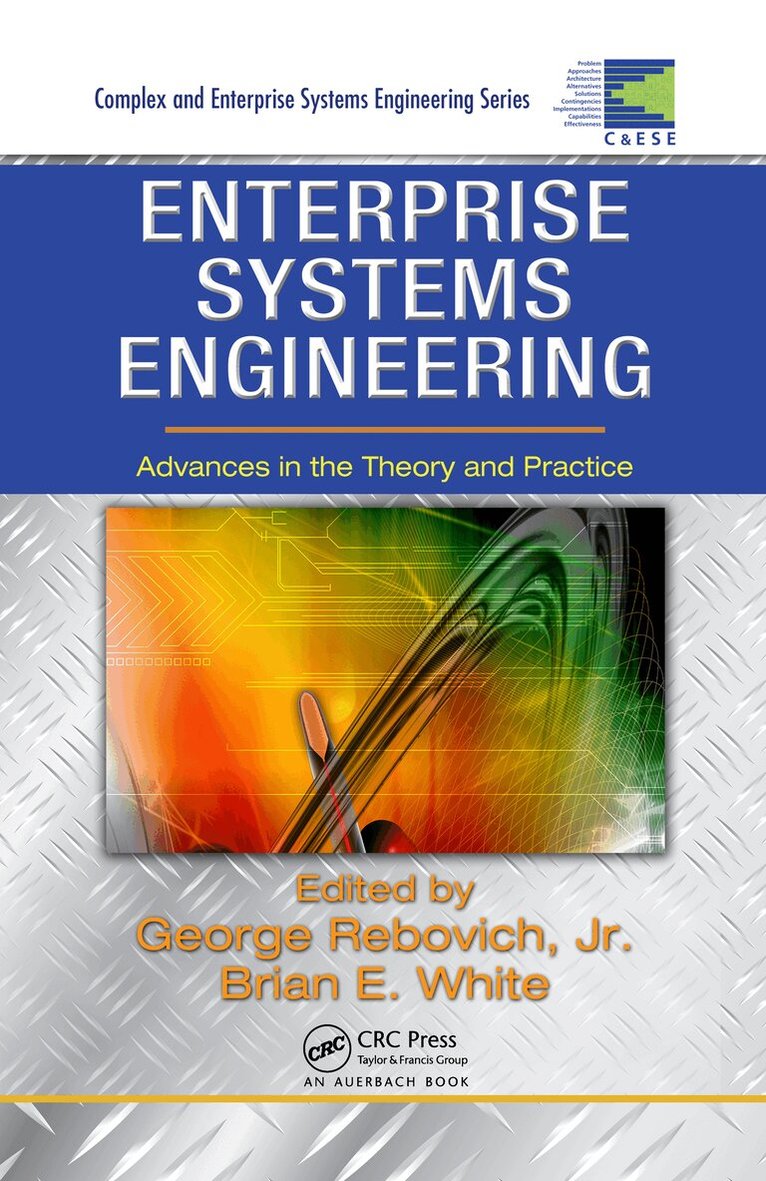
Although usually well-funded, systems development projects are often late to market and over budget. Worse still, many are obsolete before they can be deployed or the program is cancelled before delivery. Clearly, it is time for a new approach. With coverage ranging from the complex characteristics and behaviors of enterprises to the challenges they pose for engineering and technology, Enterprise Systems Engineering: Advances in the Theory and Practice examines the impacts of enterprise processes and leading-edge technologies on the evolution of an enterprise. As much about history as it is about systems engineering, this book provides a snapshot of the early thinking in enterprise systems engineering—a snapshot taken before the memory of its perspective is corrupted by time. It discusses emerging methods essential to successful systems engineering. The editors define and examine key building blocks of the evolving field of enterprise systems engineering. They address the issues of the changing nature of systems engineering, lay out a recommended direction for the future, and provide a unified basis for moving toward a mature discipline with the expanded scope. During the last decade, something has changed in the way people work together. Seldom do isolated groups work on local problems to build stove-pipe solutions and systems seldom are developed in a social, political, economic, or technical vacuum. Yet concerted attempts to better implement systems engineering seemed not to improve the situation. Standing on the threshold of a new era in systems engineering, the editors point an arrow in the direction of systems engineering evolution, a direction that is equal parts social change and technological change.
Inbunden, Engelska, 2012
1 083 kr
Skickas inom 10-15 vardagar
Supplying a clear vision of how to build high-performance teams, Leadership in Chaordic Organizations presents methods for improving operations through the application of complex systems engineering principles and psychological counseling techniques. Ideal for systems engineers, organizational managers, coaches, and psychologists, it addresses the fundamental issue of the human condition in systems development.The book considers the dynamic variables inherent in the human condition and how they impact group dynamics. Helping you to demystify complex system behaviors, it details an approach to leadership that integrates elements of neurobiology, systems engineering, complexity science, philosophy, and evolutionary and social psychology. It defines complexity and its impact on the organization and also explains how conflict can actually be constructive in group settings. Sharing helpful tips on how to build trust in today’s environment, the book also: Describes how the human condition affects group dynamicsLays out current problems and outlines workable solutionsShares a new vision of high-performance teamsIlluminates theory with applicationsIllustrating what teams and collaborative groups look like in a decentralized environment, the text introduces a highly effective group communications process invented by Richard Knowles—describing its use in designing 3D Immersive Learning Environments that enable complex emergence in dynamic interactive simulations. It also discusses complex human systems (Wicked Problems) and the potential of multi-user virtual environments to provide the transformative vision needed to fully engage all employees in your drive to make your organization more effective, efficient, and sustainable.
Inbunden, Engelska, 2010
1 313 kr
Skickas inom 10-15 vardagar
With their ability to cross traditional boundaries and achieve a level of functionality greater than their component elements, mega-systems have helped corporations and government organizations around the world resolve complex challenges that they otherwise couldn’t address with stand-alone systems. Engineering Mega-Systems: The Challenge of Systems Engineering in the Information Age provides a clear understanding of the engineering of this class of systems—a process that demands consideration of increasing program scale and the rapid change of underlying technologies. Written by Renee Stevens, a Senior Principal Engineer at The MITRE Corporation with decades of experience analyzing, engineering, and acquiring large-scale systems for the U.S. Department of Defense and other government agencies, this book explains how the engineering of mega-systems is inherently different from that of large-scale monolithic systems. It supplies the vocabulary and framework needed to explore the issues relevant to mega-systems. This framework then evolves into the Profiler diagnostic tool that helps you understand the nature and context of the system at hand and, on that basis, select the most appropriate processes, tools, and techniques.Stevens examines commercial and government applications of mega-systems to provide insight into the contemporary challenges of engineering these systems in three critical dimensions: engineering processes, management processes, and the larger context in which these systems are developed and deployed. Complete with two case studies in engineering mega-systems that illustrate valuable lessons learned and highlight emerging practices, this book supplies the understanding and the tools needed to begin engineering, characterizing, and acquiring mega-systems across multiple dimensions.
Inbunden, Engelska, 2008
1 148 kr
Skickas inom 10-15 vardagar
Without standardized construction elements such as nuts, bolts, bearings, beams, resistors and the like, the design of physical equipment is hopelessly inefficient, and engineers are continually bogged down with re-designing these elements over and over again. The same can be said for the domain of ideas and performance requirements. Only through a process of standardization of the corresponding functional elements will systems engineering truly live up to its potential of increased efficiency and quality. Designing Complex Systems: Foundations of Design in the Functional Domain introduces students and practitioners in the field of system design to a particular methodology that addresses design issues in a rigorous and consistent top-down fashion. It also reassesses the characteristics of engineering and its place within the field of intellectual activity, in particular, examining the creative aspects of design as reflected in the difference between engineers and technicians.Erik W. Aslaksen brings forty years of experience to the table with this groundbreaking work. He examines how the concept of value can provide a quantitative measure of that wider interaction of the engineered object with its environment. With its forward-looking approach and holistic perspective, this volume is sure to advance the field of knowledge of systems engineering for years to come.
Inbunden, Engelska, 2014
2 138 kr
Skickas inom 10-15 vardagar
Suitable as a reference for industry practitioners and as a textbook for classroom use, Case Studies in System of Systems, Enterprise Systems, and Complex Systems Engineering provides a clear understanding of the principles and practice of system of systems engineering (SoSE), enterprise systems engineering (ESE), and complex systems engineering (CSE).Multiple domain practitioners present and analyze case studies from a range of applications that demonstrate underlying principles and best practices of transdisciplinary systems engineering. A number of the case studies focus on addressing real human needs. Diverse approaches such as use of soft systems skills are illustrated, and other helpful techniques are also provided. The case studies describe, examine, analyze, and assess applications across a range of domains, including: Engineering management and systems engineering educationInformation technology business transformation and infrastructure engineering Cooperative framework for and cost management in the construction industrySupply chain modeling and decision analysis in distribution centers and logisticsInternational development assistance in a foreign culture of educationValue analysis in generating electrical energy through wind powerSystemic risk and reliability assessment in bankingAssessing emergencies and reducing errors in hospitals and health care systemsInformation fusion and operational resilience in disaster response systemsStrategy and investment for capability developments in defense acquisitionLayered, flexible, and decentralized enterprise architectures in military systemsEnterprise transformation of the air traffic management and transport networkSupplying you with a better understanding of SoSE, ESE, and CSE concepts and principles, the book highlights best practices and lessons learned as benchmarks that are applicable to other cases. If adopted correctly, the approaches outlined can facilitate significant progress in human affairs.The study of complex systems is still in its infancy, and it is likely to evolve for decades to come. While this book does not provide all the answers, it does establish a platform, through which analysis and knowledge application can take place and conclusions can be made in order to educate the next generation of systems engineers.