• Fri frakt över 249 kr
  • •
  • Snabba leveranser
  • •
  • Billiga böcker
Kundservice

Du är på sajten för privatpersoner.

Företag, bibliotek eller offentlig verksamhet?

Du handlar på classic.bokus.com, där alla dina funktioner finns intakta.
Till classic.bokus.com
Bokus logotyp. Gå till startsidan.
  • Erbjudanden
  • Student
  • Topplistor
  • Barn & ungdom
  • Bokus Play
  • E-böcker
  • Ljudböcker
  • Pocketböcker
  • Spel och pussel

Pocketfynda! Hundratals böcker för 49 kr/st →

Sidfot

Mina sidor

    Hjälp

    • Kundservice
    • Vanliga frågor och svar
    • Frakt och leverans
    • Retur vid ångerrätt
    • Reklamera vara
    • Betalning
    • Köpvillkor
    • Allmänna villkor
    • Information om webbplatsens tillgänglighet

    Om Bokus

    • Om oss
    • Pressrum
    • För studenter
    • För företag
    • För bibliotek och offentlig verksamhet
    • För leverantörer
    • Hållbarhet

    Populärt

    • Aktuella erbjudanden
    • Presentkort
    • Studentlitteratur
    • Nya böcker
    • Topplistor
    • Signerade böcker
    • Engelska böcker

    Inspiration

    • Boktips
    • BookTok
    • Barnbokskaraktärer
    • Populära författare
    Logotyp för Bokus
    Följ oss på Facebook (extern länk)Följ oss på Instagram (extern länk)Följ oss på YouTube (extern länk)Följ oss på TikTok (extern länk)
    bokus @ CookiesAnpassa cookiesIntegritetspolicyKöpvillkor
    Till Citymail hemsida (extern länk)Till Budbee hemsida (extern länk)Till Postnord hemsida (extern länk)Till Schenker hemsida (extern länk)Till Early Bird hemsida (extern länk)Till Walleys hemsida (extern länk)
    1. Ekonomi och Ledarskap
    2. Företagsekonomi
    3. Organisation och ägarskap

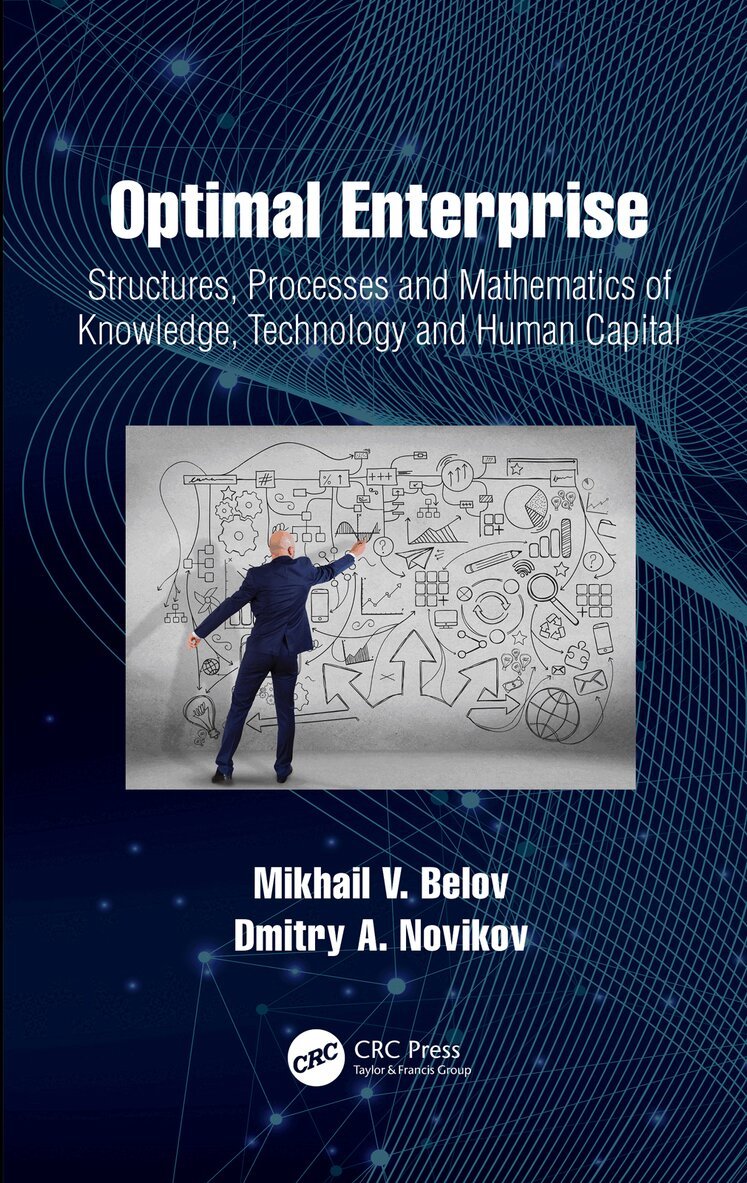
    Optimal Enterprise

    Structures, Processes and Mathematics of Knowledge, Technology and Human Capital

    AvMikhail V. Belov,Dmitry A. Novikov

    Häftad, Engelska, 2023

    Del i serien Complex and Enterprise Systems Engineering

    706 kr

    Beställningsvara. Skickas inom 10-15 vardagar. Fri frakt över 249 kr.

    Fler format och utgåvor

    Inbunden

    1 754 kr

    Beskrivning

    In the modern world, most gross product is created within Enterprise firms, project programs, state agencies, transnational corporations and their divisions, as well as various associations and compositions of the above entities. Enterprises, being, on the one hand, complex, and, on the other hand, widespread systems, are the subject matter of cybernetics, system theory, operations research, management sciences and many other fields of knowledge.However, the complexity of the system obstructs the development of mathematically rigorous foundations for Enterprise control. Moreover, methods of operations research and related sciences, which are widely used in practice, provide optimization of the constituents of an Enterprise, without modeling it as a whole system. But the optimization of parts does not lead to the optimality of the whole, and, also, the absence of top-down and holistic mathematical models of Enterprise contradicts the principle of holism and the system approach.The approach in this book looks first at Enterprise Systems and their essential aspects as complex sociotechnical systems composed of integrated sets of structural and process models (Chapters 1 and 2). A uniform description of all the heterogeneous fields of the modern Enterprise (marketing, sales, manufacturing, HR, finance, etc.) is then made, and the Enterprise Control Problem is posed as a top-down and holistic mathematical optimization problem (Chapter 3). Original models and methods of contract theory (Chapter 4), technology management (Chapter 5), human behavior and human capital (Chapter 6) and complex activity and resource planning (Chapter 7) are developed to solve the problem. Structural processes and mathematical models constitute an Optimal Enterprise Control Framework (Chapter 8) that provides a practical solution to the Enterprise Control Problem.This book is a resource for postgraduate and doctoral students, postdoctoral researchers and professors with research interests in the following fields of science: Fundamental Complex Systems study, Complex Systems Engineering, Enterprise Systems Engineering Applications of Operations Research, Optimization, Probability and Stochastic processes to Management Science, Economics and Business Theory of the Firm Business and Management – general, strategy/leadership, organization management, operations management and management information systems Theory of Business Processes, Business Processes Improvement and Reengineering

    Produktinformation

    • Utgivningsdatum:2023-07-24
    • Mått:156 x 234 x 23 mm
    • Vikt:560 g
    • Format:Häftad
    • Språk:Engelska
    • Serie:Complex and Enterprise Systems Engineering
    • Antal sidor:350
    • Förlag:Taylor & Francis Ltd
    • ISBN:9780367702632

    Utforska kategorier

    • Organisation och ägarskap inom Ekonomi och Ledarskap
    • Informationsteknik: allmänt inom Data och IT
    • Matematik inom Naturvetenskap och teknik

    Mer om författaren

    Mikhail Belov is Deputy CEO of IBS, responsible for new technology and business development in the area of engineering IT systems, PLM and other industrial IT systems. His 38-year career has centered on systems engineering, operations research, economics and finance, IT, electronics.Mikhail was Vice-President of Metrosvyaz, Deputy Finance Director of TOKOBANK, and President & Owner of Geliosoft Consulting, a startup company focused on cutting-edge technologies, such as an ultra-wideband multi-radar system.Mikhail holds an MS in electronics from Moscow Engineering Physics Institute and a PhD in operations research and applied math statistics from the Central Scientific Research Institute.Doctor of Science (Techn.), he also holds an MBA in finance.Dmitry Novikov is director of Institute of Control Sciences of Russian Academy of Sciences. His scientific interests cover: Control Theory, Cybernetics, Game Theory, Decision-making, Collective Behavior. More than 500 publications (see the full publication history), including more than 20 monographs (Springer, CRC, etc), textbooks and brochures; more than 100 papers in leading journals.He has more than 25 year’s extensive experience in the field of scientific and technological projects and company management (manufacturing sphere, research, teaching, consulting).Dmitry is Doctor of Science (Techn.), Professor, Corresponding member of Russian Academy of Sciences, Head of Control Sciences Department of Moscow Institute of Physics and Technology

    Innehållsförteckning

    • Part I. Methodology. Foundations of Enterprise ControlChapter 1 Enterprise and Complex Activity. Qualitative models1.1 Introduction1.2 Structural models of complex activity and Enterprise1.3 Uncertainty and creation of elements of complex activity1.4 Lifecycles of complex activity1.5 Implementation of the management processes1.6 ConclusionReferencesChapter 2 Enterprise management and lifecycles compatibility2.1 A sociotechnical system, complex activity, and purposefulness2.2 Subject matter of Enterprise management2.3 Means of and factors involved in Enterprise management2.4 Ordering of management actions along the lifecycle of complex activity2.5 Compatibility of complex activity lifecycles2.6 ConclusionReferencesPart II. Mathematics. Mathematical models and methods of Enterprise ControlChapter 3 Enterprise Control Problem – the Statement3.1 Concept of optimization3.2 Enterprise Control Problem – qualitative model3.3 Enterprise Control Problem among related knowledge domains3.4 Enterprise Control Problem as an optimization problem3.5 ConclusionReferencesChapter 4 Contracts4.1 Static principal – agent models4.2 Static multi-agent models4.3 Dynamic multi-agent models4.4 ConclusionReferencesChapter 5 Technology5.1 Technology management problem5.2 Known models and methods in related scientific domains5.3 Technology evolution and management5.4 Integration of technology components5.5 Technology in an external environment5.6 ConclusionAppendixesReferencesChapter 6 Human capital6.1 Problem of human capital management6.2 Pools of active resources as a formal representation of human capital6.3 Statistics of the active resource traffic6.4 ConclusionAppendixesReferencesChapter 7 Planning7.1 Algorithmic models of planning process in hierarchical dynamic multi-agent active system7.2 Planning of transition from design phase to execution phase in dynamic active system7.3 Planning and control in dynamic multi-agent active system with changing characteristics7.4 Planning of Human Capital7.5 ConclusionAppendixesReferencesPart III. Practice. Business Tools and ApplicationsChapter 8 Optimal Enterprise Control Framework and Practical Implementation8.1 Optimal Enterprise Control Framework8.2 Some applications of contracts8.3 Practical technology development optimization8.4 Optimal planning in practice8.5 ConclusionAppendixesReferencesAfterwordSubject Index