Computer Methods in the Geosciences – serie
Visar alla böcker i serien Computer Methods in the Geosciences. Handla med fri frakt och snabb leverans.
5 produkter
5 produkter
Inbunden, Engelska, 1998
1 090 kr
Skickas inom 10-15 vardagar
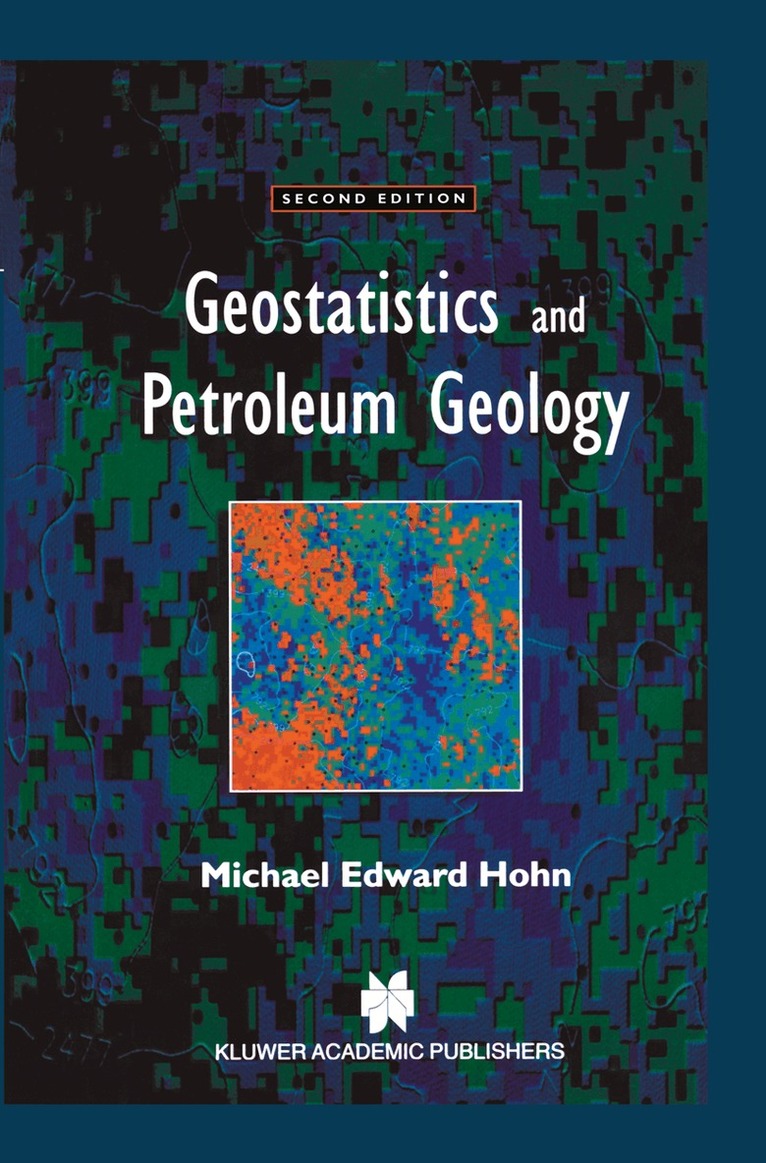
This is an extensive revision of a book that I wrote over ten years ago. My purpose then has remained unchanged: to introduce the concepts and methods of spatial statistics to geologists and engineers working with oil and gas data. I believe I have accomplished more than that; just as I learned the basics of variography and kriging from books for mining engineers, this book could be used by scientists from many fields to learn the basics of the subject. I have tried to adopt an introductory and practical approach to the subject, knowing that books that detail the theory are available. What I say and write comes from my own experience. As a geologist working in the public sector, I have had the privilege of using geostatistics in funded research, in answering service requests from industry, and in short courses. I have taught geostatistics in the university classroom, and advised graduate students in theses and dissertations. I have attempted to anticipate the needs and questions of theenquiring scientist because I was there myself, and know the kind of questions and concerns I had at the time I was trying to learn the subject.
Häftad, Engelska, 2011
548 kr
Skickas inom 10-15 vardagar
Here is another contribution in the continuing series on Computer Methods in the Geosciences. As its title suggests, this volume will be of interest to explorational geochemists who want to analyze their own data on a personal computer (PC). To make it easy for the user, the programs and two trial data sets are provided on the accompanying diskettes. And, by supplying the diskettes, another first is accom plished for the series: instant involvement and interaction for the user. Although other books in the series have provided listings of computer pro grams, Exploration-Geochemical Data Analysis with the IBM PC is the first to supply diskettes. The diskettes, along with the instructions outlined in the text, eliminate the bother (and errors) of pu tting the programs in man ually. The suite of programs for handling and sorting data files; computing and displaying summary statistics; and working with logarithms, geochemical thresholds, and regression - will give geochemists a good repertoire for geochemical exploration data analysis. The diskettes are easy to use and have been tested thoroughly.
Häftad, Engelska, 2012
548 kr
Skickas inom 10-15 vardagar
This is the sixth contribution to the Computer Methods in the Geosciences series and it continues the tradition of being practical, germaine, and easy to read. Michael Hohn in his presentation, Geostatistics and Petroleum Geology, nicely compliments the other books in the series and brings to the readers some new techniques by which to analyze their data. New approaches always result in new ideas or enhancement of old ones. The French School of Geostatistiques (Fontainebleau, France) was founded and developed by Georges Matheron in response to problems in mining explo ration and exploitation. This approach has been used successfully in that industry since the mid-1960s, but only recently applied to similar problems in petroleum. Likewise, these applications have been successful in this applied field as well and here Hohn gives examples. Standard subjects of the field of geostatistics are explored and discussed-the semivariogram, kriging, cokriging, nonlinear and parametric estimation, and conditional simulation. These may be unrecognizable terms to the readers now, but upon completion of reading the book, they will be fimiliar ones. Each subject is discussed in detail with appropriate and pertinent case studies, taken from the author's own research or from the literature. The author notes the book is for working geologists in the petroleum industry.
Häftad, Engelska, 2012
1 090 kr
Skickas inom 10-15 vardagar
Simulation. "Why simulate?" we might ask. Dan Tetzlaff and John Harbaugh answer that question in Simulating Clastic Sedimentation, and answer it effec tively. Readers will have no trouble following this well-documented, clear ex pose on clastic-sedimentation simulation. The sophistication in simulation since 1970, compared to the early work, is enormous. The development and availability of hardware, especially graphics, has made such advancement pos sible. The authors' presentation allows us to share in this exciting new approach to geological problem solving. The book contains a glossary, notation conven tion, program listings, plenty of illustrations, and chapter summaries to en lighten the users. Everything is readily available to make this a self-contained, how-to and how-to-interpret book. After introducing the subject of simulation, the authors take the reader step-by-step through the computation and reasoning of the erosion, transporta tion, and deposition of clastic sediments. Fluid flow, transport, boundary con ditions, and space and time are all explained, and details are given as to how each of these factors were accounted for in the simulation. The simulation is compared to different known situations, such as braided streams and deltas, for assessment as to realism. The final chapter gives two real-world applications where a simulated model is compared to the Simpson Canyon Field in north ern Alaska and the Golden Meadow Field in southern Louisiana. From these simulations was gained some understanding of the conditions under which c- ix Series Editor's Foreword tain sedimentary units were formed.
Häftad, Engelska, 2012
1 090 kr
Skickas inom 10-15 vardagar
This is an extensive revision of a book that I wrote over ten years ago. My purpose then has remained unchanged: to introduce the concepts and methods of spatial statistics to geologists and engineers working with oil and gas data. I believe I have accomplished more than that; just as I learned the basics of variography and kriging from books for mining engineers, this book could be used by scientists from many fields to learn the basics of the subject. I have tried to adopt an introductory and practical approach to the subject, knowing that books that detail the theory are available. What I say and write comes from my own experience. As a geologist working in the public sector, I have had the privilege of using geostatistics in funded research, in answering service requests from industry, and in short courses. I have taught geostatistics in the university classroom, and advised graduate students in theses and dissertations. I have attempted to anticipate the needs and questions of theenquiring scientist because I was there myself, and know the kind of questions and concerns I had at the time I was trying to learn the subject.