Contemporary Social Theory - Böcker
Visar alla böcker i serien Contemporary Social Theory. Handla med fri frakt och snabb leverans.
7 produkter
7 produkter
Central Problems in Social Theory
Action, structure and contradiction in social analysis
Häftad, Engelska, 1979
712 kr
Skickas inom 5-8 vardagar
665 kr
Skickas inom 5-8 vardagar
Sociological research methods are a key component of teaching and courses at all levels, yet courses often fail to catch light for lack of effective student books or provoke smouldering resentment from students at misplaced enthusiasm for recondite statistics.Gerry Rose's new book should go a long way to remedy these problems. It is a complete teaching course with a clear rationale and a distinctive approach to the topic, unblemished by epistemological or prescriptive polemic. Its method is to present through the analysis of twelve pieces of published research reprinted in the book the systematic deciphering of research in relation to the key issues of methodology.The first nine discursive chapters discuss the main research methods topics - including concepts and indicators, sampling, data analysis and the relationship of theory to evidence - balancing the problems of quantitative data with the treatment of qualitative data and fieldwork studies. The papers - shortened articles from British, US and Australian journals - are put through the methodological hoops and systematically compared and assessed. Additionally, each chapter is provided with a full set of exercises and the book also includes a glossary of terms.This straightforward and business-like book will be welcomed by all teachers and professional sociologists and also by social researchers who are concerned with examining or preparing research reports. Even authors and journal editors will find it provoking and useful.
3 173 kr
Skickas inom 3-6 vardagar
Feminist theory has undergone continuous evolution since its recognized establishment in 1963. Sondra Farganis's insightful volume revisits feminist philosophy's turbulent beginnings, and explores the myriad political and social factors influencing its development during the past three decades. The author also considers the interaction between feminism and the greater women's movement, discussing not only the commonalities but the differences among women of various cultures and experiences. Finally, she recounts four of the most controversial, women-centered court cases of recent years, identifying elements of feminist theory--and how they affected, or were affected by--the social and political context in which they occurred. Inspiring new directions in critical thought and theoretical advancement, Situating Feminism will prove an essential resource for students and professionals in the areas of women's and culture studies, political science, social work, communication, and psychology. " Sondra Farganis does not shy away from rigorous arguments or moral issues, dealing directly with the relationship of postmodernism and feminism, and the concerns that the former undermines the latter. She capably moves among writers like Berger and Luckman, Freire, Habermas, and Butler. . . .Ultimately, the strength of this book is its ability to present a wide range of feminist political and social theories in a coherent fashion while demonstrating its application to actual real-life situations." --Affilia "Sondra Farganis has written a concise study on the situation of feminist thought in relation to contemporary social controversies. She analyzes the Nussbaum (domestic violence and victimization), Baby M (motherhood and surrogacy), Sears (employment and affirmative action), and Hill/Thomas (race and sexual harassment) cases in a broad theoretical context. Farganis outlines major themes . . . and conflicts . . . within feminist thought, illustrating how these played out in the resolution of the cases." --Choice
2 304 kr
Skickas inom 3-6 vardagar
Feminist theory has undergone continuous evolution since its recognized establishment in 1963. Sondra Farganis's insightful volume revisits feminist philosophy's turbulent beginnings, and explores the myriad political and social factors influencing its development during the past three decades. The author also considers the interaction between feminism and the greater women's movement, discussing not only the commonalities but the differences among women of various cultures and experiences. Finally, she recounts four of the most controversial, women-centered court cases of recent years, identifying elements of feminist theory--and how they affected, or were affected by--the social and political context in which they occurred. Inspiring new directions in critical thought and theoretical advancement, Situating Feminism will prove an essential resource for students and professionals in the areas of women's and culture studies, political science, social work, communication, and psychology. " Sondra Farganis does not shy away from rigorous arguments or moral issues, dealing directly with the relationship of postmodernism and feminism, and the concerns that the former undermines the latter. She capably moves among writers like Berger and Luckman, Freire, Habermas, and Butler. . . .Ultimately, the strength of this book is its ability to present a wide range of feminist political and social theories in a coherent fashion while demonstrating its application to actual real-life situations." --Affilia "Sondra Farganis has written a concise study on the situation of feminist thought in relation to contemporary social controversies. She analyzes the Nussbaum (domestic violence and victimization), Baby M (motherhood and surrogacy), Sears (employment and affirmative action), and Hill/Thomas (race and sexual harassment) cases in a broad theoretical context. Farganis outlines major themes . . . and conflicts . . . within feminist thought, illustrating how these played out in the resolution of the cases." --Choice
3 173 kr
Skickas inom 3-6 vardagar
Analytical Marxism blends the tenets of Marxist theory with many of the more traditional methods of social science. In this brief introduction to the major ideas and scholars in the Analytical Marxist school, Thomas F. Mayer assesses the achievements, strengths, and criticisms of their work. Focusing on the work of Elster, Roemer, Wright, and others, Mayer examines their writing on class, the state, exploitation, and revolution. Sections addressing communism and socialism define these terms in historical and current contexts, enabling the author to establish the patterns from which political predictions may be drawn. The book also explores the challenge to Marxist thought brought about by contemporary developments in Eastern Europe and suggests how the future of Marxism is shaped by these events. "Designed to help undergraduates understand the complex literature on the topic, this volume is written in an accessible style, and includes a glossary and annotated reading list. The language is exceptionally clear and free of mathematical equations. Thomas F. Mayer demonstrates in fact how needless equations so often are. Thomas F. Mayer's Analytical Marxism is a theoretical statement in its own right. As such, it is far more compelling than the edited volume with the same title that came out in 1986. What makes Mayer's book superior is that it has abandoned or muted many of the philosophically objectionable positions associated with its predecessor." -Contemporary Sociology "Thomas F. Mayer's book admirably demonstrates the robust and provacative results wrought by Cohen, ELster, Przeworski, Roemer, and Wright with their chosen tools. The liveliness and intensity of the debates provoked by these theorists' assertions suggests that the Marxian analytical tradition has a robust future." --Science and Society
2 304 kr
Skickas inom 3-6 vardagar
Analytical Marxism blends the tenets of Marxist theory with many of the more traditional methods of social science. In this brief introduction to the major ideas and scholars in the Analytical Marxist school, Thomas F. Mayer assesses the achievements, strengths, and criticisms of their work. Focusing on the work of Elster, Roemer, Wright, and others, Mayer examines their writing on class, the state, exploitation, and revolution. Sections addressing communism and socialism define these terms in historical and current contexts, enabling the author to establish the patterns from which political predictions may be drawn. The book also explores the challenge to Marxist thought brought about by contemporary developments in Eastern Europe and suggests how the future of Marxism is shaped by these events. "Designed to help undergraduates understand the complex literature on the topic, this volume is written in an accessible style, and includes a glossary and annotated reading list. The language is exceptionally clear and free of mathematical equations. Thomas F. Mayer demonstrates in fact how needless equations so often are. Thomas F. Mayer's Analytical Marxism is a theoretical statement in its own right. As such, it is far more compelling than the edited volume with the same title that came out in 1986. What makes Mayer's book superior is that it has abandoned or muted many of the philosophically objectionable positions associated with its predecessor." -Contemporary Sociology "Thomas F. Mayer's book admirably demonstrates the robust and provacative results wrought by Cohen, ELster, Przeworski, Roemer, and Wright with their chosen tools. The liveliness and intensity of the debates provoked by these theorists' assertions suggests that the Marxian analytical tradition has a robust future." --Science and Society
2 699 kr
Skickas inom 3-6 vardagar
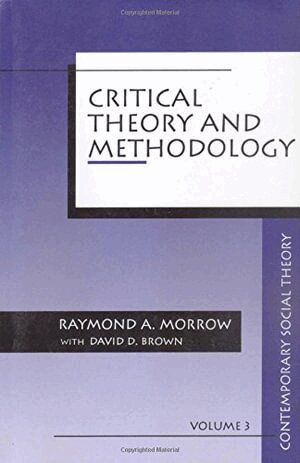
Recipient of Choice Magazine's 1996 Outstanding Academic Book Award Author Raymond Morrow outlines and recounts the development of the major tenets of critical theory, exemplifying them through the works of two of their most influential, recent adherents: Jürgen Habermas and Anthony Giddens. Beginning with a comprehensive yet meticulous explication of critical theory and its history, the author next discusses it within the context of a research program; his work concludes with an examination of empirical methods. Emphasizing the connections between critical theory, empirical research, and social science methodology, Morrow's volume offers refreshing insights on traditional and current material.