
Economic History of Japan 1660-1990 – serie
Visar alla böcker i serien Economic History of Japan 1660-1990. Handla med fri frakt och snabb leverans.
2 produkter
2 produkter
The Economic History of Japan: 1600-1990
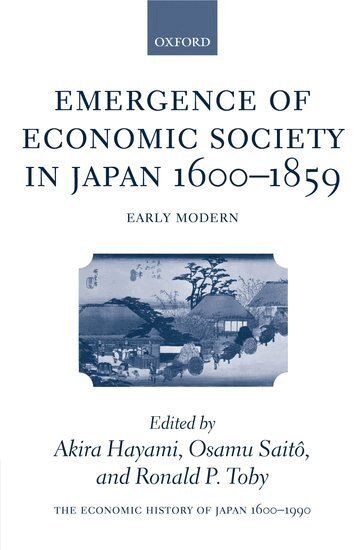
Volume 1: Emergence of Economic Society in Japan, 1600-1859
Inbunden, Engelska, 2004
3 335 kr
Skickas inom 5-8 vardagar
This multi-volume series of modern Japanese economic history encompasses both the institutional aspects of Japanese economic development, and the results of econometric and cliometric research to place the key moments of Japanese economic history in a more general context.Volume one, The Emergence of Economic Society in Japan, focuses on the period from the start of the seventeenth century, when a discernible consumer population begins to form within cities, to the 1870s when the start of rapid industrialization is witnessed. This industrialization was unique amongst non-Western countries, facilitated by the emergence of their market economy. The contributors examine the reasons for these developments, tracing the emergence of a national economy in which agricultural produce begins to be produced specifically for the purpose of sale to the newly-forming urban consumer populations, and considerations of efficiency and competition are introduced into agriculture.Seventeenth century Japan is shown to be a society that was almost immediately able to provide key components of a market economy, such as communications, transport, and currency, so that economic laws began to operate spontaneously. Following its encounters with industrialized Western powers, Japan was quick to embrace their example, and uniquely was able to rapidly industrialize. Focusing on the foundations of modernity laid in this period, the volume explores whether this was a process of 'alternative modernization' to that experienced in the West.Written by leading Japanese scholars, and available for the first time in English-translation, the contributions have been abridged and re-written for a non-Japanese readership.
Del 3 - Economic History of Japan 1660-1990
The Economic History of Japan: 1600-1990
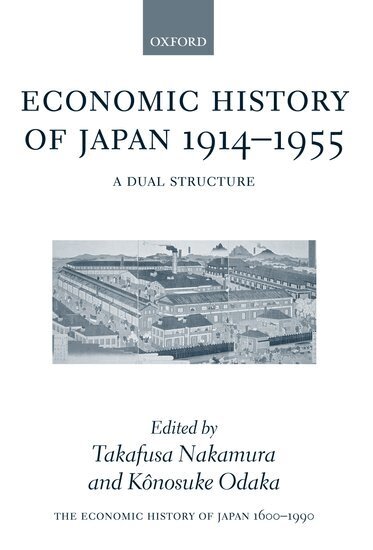
Volume 3: Economic History of Japan, 1914-1955
Inbunden, Engelska, 2003
3 111 kr
Skickas inom 5-8 vardagar
This multi-volume series covers the whole of modern Japanese economic history. The series encompasses both the institutional aspects of Japanese economic development, and the results of econometric and cliometric research to place the key moments of Japanese economic history in a more general context.Volume three, A Dual Structure, covers the first half of the twentieth century when Japan's economic modernization brought the country into the circle of world powers between the two world wars; the economic system established in the Second World War transformed the economy; and postwar reconstruction provided the foundations for an extraordinary economic dynamism. Where appropriate the book looks back to the nineteenth century and forward to the 1960s.Thematic in its approach, A Dual Structure explores how it was that during a prolonged period of hardship for the world economy, particularly during the deflation of the 1920s and the worldwide depression in the early 1930s, Japan's economy managed to overcome these crises and turbulence, before entering into a period of remarkable high-speed economic growth. Issues examined in particular include the development and transformation of Japan's financial system and monetary policy, the emergence of big business as an economic power, the Japanese empire and its colonies, wartime controls, and the economic democratization, reconstruction, and high-speed growth that followed. At the centre of this study is a consideration of the 'dual structure' of the Japanese economy which emerges in this inter-war period, of small-scale companies on the one hand, large industrial firms on the other, and the increasing flow of labor into the cities which resulted. Written by leading Japanese scholars, and available for the first time in English-translation, the contributions have been abridged and re-written for a non-Japanese readership.