Elements in Intercultural Communication - Böcker
Visar alla böcker i serien Elements in Intercultural Communication. Handla med fri frakt och snabb leverans.
13 produkter
13 produkter
227 kr
Skickas inom 7-10 vardagar
This Element asserts how identity as a construct enables a critical awareness of how speakers position themselves and are positioned by others in intercultural encounters. It discusses how identity vis-...-vis culture has been theorized through social psychological, poststructuralist, and critical lenses, and how identity is discursively constructed and mediated. Rejecting essentialist notions of language and culture, this Element demonstrates how inscriptions of identity such as race, ethnicity, nationality, and class can be used to critically examine the dynamics of situated intercultural encounters and to understand how such interactions can index competing and colluding ideologies. By examining identity research from different parts of the world, it casts a light on how identities are performed in diverse intercultural contexts and discusses research methodologies that have been employed to examine identity in intercultural communication.
241 kr
Skickas inom 7-10 vardagar
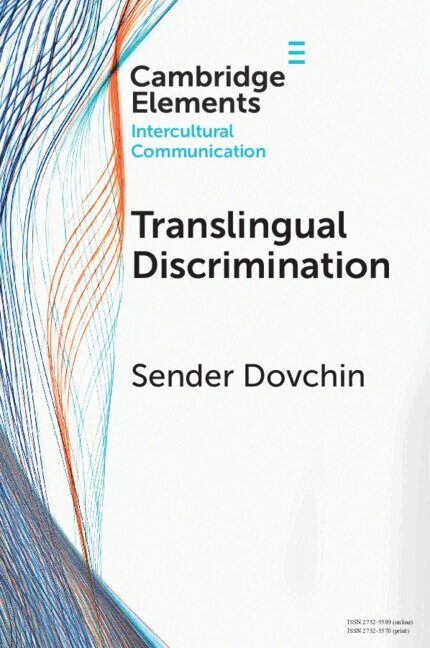
Moving beyond two main concepts of 'interlingual' and 'intralingual' discrimination, this Cambridge Element addresses the concept of 'translingual discrimination', which refers to inequality based on transnational migrants' specific linguistic and communicative repertoires that are (il)legitimized by the national order of things. Translingual discrimination adds intensity to transnational processes, with transnational migrants showing two main characteristics of exclusion - 'translingual name discrimination' and its associated elements such as 'name stigma' and 'name microaggression'; and 'translingual English discrimination' and its elements such as 'accentism', 'stereotyping' and 'hallucination'. The accumulation of these characteristics of translingual discrimination causes negative emotionality in its victims, including 'foreign language anxiety' and 'translingual inferiority complexes'. Consequently, transnational migrants adopt coping strategies such as 'CV whitening', 'renaming practices', 'purification', and 'ethnic evasion' while searching for translingual safe spaces. The Element concludes with the social and pedagogical implications of translingual discrimination in relation to transnational migrants.
234 kr
Skickas inom 7-10 vardagar
Global Citizenship Education (GCE) plays a central role within UNESCO's education sector, focusing on cultivating the values and knowledge essential for students to evolve into well-informed and responsible global citizens. This Element conceptualises an ethical GCE framework grounded in critical, cosmopolitan, humanistic, value-creating, and transformative principles. Guided by those principles, ethical GCE goes beyond the banking model of education by emphasising a global ethic. Ethical GCE is inclusive, ethically reflective, and socially responsible. It extends beyond imparting knowledge and employable skills, important as they are, focusing on holistic and sustainable development. With further theoretical development and implementation strategies, the ethical GCE framework holds promise for future research and evaluation of the intricate teaching and learning processes within global citizenship, particularly from a values-based perspective.
234 kr
Skickas inom 7-10 vardagar
Short-term student exchanges can offer valuable opportunities for intercultural learning and to engage in intercultural communication using English (the language focus in this Element). However, research and educational practices often assume that the most effective intercultural learning occurs through interactions with local individuals in 'target' culture learning and adherence to standard English language norms. These assumptions overlook important learning opportunities from interactions in culturally and linguistically diverse settings as features of many international exchange experiences. This Element proposes a perspective in student exchange research and practice that reflects this diversity and encompasses the intercultural learning model of intercultural awareness, intercultural citizenship education, and Global Englishes.
234 kr
Skickas inom 7-10 vardagar
Virtual exchange is an educational approach that uses technology to bring together people from geographically and/or culturally distant locations in sustained online interactions, often intended to develop their intercultural awareness and understanding. Though the practice has existed for several decades, it has gained popularity in recent years, in part due to the recent Covid-19 pandemic and recourse to online tools for international and intercultural learning. This Element explores intercultural communication in virtual exchange by looking at how and why culture is made relevant in the pedagogical design and framing of virtual exchanges and what impact this might have on student positioning, power dynamics, and on intercultural learning. From this framework three broad approaches are outlined, which are defined as comparative, challenge-based, and dialogue-based. Each approach is explored through examples and the opportunities, limitations, and risks for intercultural learning.
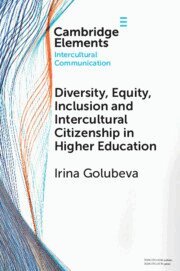
Diversity, Equity, Inclusion and Intercultural Citizenship in Higher Education
Häftad, Engelska, 2025
227 kr
Skickas inom 7-10 vardagar
Traditionally, the fields of Diversity, Equity, and Inclusion (DEI) and Intercultural Citizenship Education (ICitE) have been treated separately in Higher Education (HE) and beyond, with DEI often being associated with domestic diversity, while ICitE is often situated within international contexts. Although such binary perception is no longer adequate due to the superdiversity that characterizes today's university communities, the origins of this categorical distinction can be explained through an examination of the disciplinary roots, theoretical foundations, primary focus, and implementation approaches. Despite this difference in perspectives between the two fields, the Element argues that DEI and ICitE can complement each other in a variety of positive and productive ways. It does so by identifying the intersections between these two distinct yet interrelated fields and by providing an example of how they can be intentionally synergized in HE practice.
753 kr
Skickas inom 7-10 vardagar
Short-term student exchanges can offer valuable opportunities for intercultural learning and to engage in intercultural communication using English (the language focus in this Element). However, research and educational practices often assume that the most effective intercultural learning occurs through interactions with local individuals in 'target' culture learning and adherence to standard English language norms. These assumptions overlook important learning opportunities from interactions in culturally and linguistically diverse settings as features of many international exchange experiences. This Element proposes a perspective in student exchange research and practice that reflects this diversity and encompasses the intercultural learning model of intercultural awareness, intercultural citizenship education, and Global Englishes.
731 kr
Skickas inom 7-10 vardagar
This Element asserts how identity as a construct enables a critical awareness of how speakers position themselves and are positioned by others in intercultural encounters. It discusses how identity vis-...-vis culture has been theorized through social psychological, poststructuralist, and critical lenses, and how identity is discursively constructed and mediated. Rejecting essentialist notions of language and culture, this Element demonstrates how inscriptions of identity such as race, ethnicity, nationality, and class can be used to critically examine the dynamics of situated intercultural encounters and to understand how such interactions can index competing and colluding ideologies. By examining identity research from different parts of the world, it casts a light on how identities are performed in diverse intercultural contexts and discusses research methodologies that have been employed to examine identity in intercultural communication.
753 kr
Skickas inom 7-10 vardagar
Global Citizenship Education (GCE) plays a central role within UNESCO's education sector, focusing on cultivating the values and knowledge essential for students to evolve into well-informed and responsible global citizens. This Element conceptualises an ethical GCE framework grounded in critical, cosmopolitan, humanistic, value-creating, and transformative principles. Guided by those principles, ethical GCE goes beyond the banking model of education by emphasising a global ethic. Ethical GCE is inclusive, ethically reflective, and socially responsible. It extends beyond imparting knowledge and employable skills, important as they are, focusing on holistic and sustainable development. With further theoretical development and implementation strategies, the ethical GCE framework holds promise for future research and evaluation of the intricate teaching and learning processes within global citizenship, particularly from a values-based perspective.
Diversity, Equity, Inclusion and Intercultural Citizenship in Higher Education
Inbunden, Engelska, 2025
731 kr
Skickas inom 7-10 vardagar
Traditionally, the fields of Diversity, Equity, and Inclusion (DEI) and Intercultural Citizenship Education (ICitE) have been treated separately in Higher Education (HE) and beyond, with DEI often being associated with domestic diversity, while ICitE is often situated within international contexts. Although such binary perception is no longer adequate due to the superdiversity that characterizes today's university communities, the origins of this categorical distinction can be explained through an examination of the disciplinary roots, theoretical foundations, primary focus, and implementation approaches. Despite this difference in perspectives between the two fields, the Element argues that DEI and ICitE can complement each other in a variety of positive and productive ways. It does so by identifying the intersections between these two distinct yet interrelated fields and by providing an example of how they can be intentionally synergized in HE practice.
753 kr
Skickas inom 7-10 vardagar
Virtual exchange is an educational approach that uses technology to bring together people from geographically and/or culturally distant locations in sustained online interactions, often intended to develop their intercultural awareness and understanding. Though the practice has existed for several decades, it has gained popularity in recent years, in part due to the recent Covid-19 pandemic and recourse to online tools for international and intercultural learning. This Element explores intercultural communication in virtual exchange by looking at how and why culture is made relevant in the pedagogical design and framing of virtual exchanges and what impact this might have on student positioning, power dynamics, and on intercultural learning. From this framework three broad approaches are outlined, which are defined as comparative, challenge-based, and dialogue-based. Each approach is explored through examples and the opportunities, limitations, and risks for intercultural learning.
234 kr
Skickas inom 7-10 vardagar
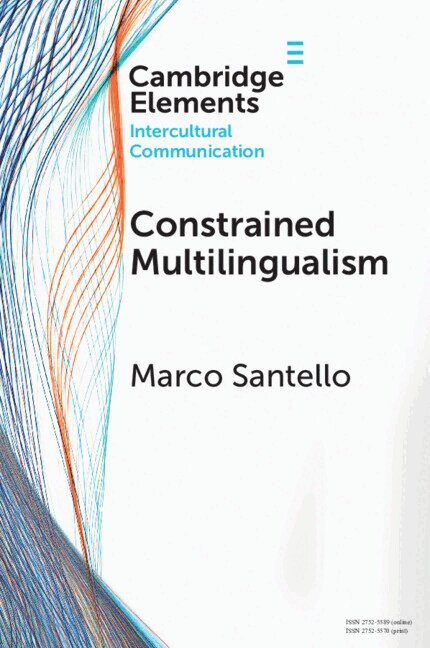
This Element highlights the role of constraints in shaping multilingualism. It discusses their conceptualisation, starting from Michel de Certeau's view of action in everyday life, and operationalisation for the study of migrants. The results of the research conducted among Gambian migrants in Italy show not only constraints but also the tactics to inhabit them, as well as non-language related aspects, for example suffering, which are grouped into five clusters. These are (1) lack of support; (2) limited interaction in the 'local' language; (3) immigration status in conjunction with life events; (4) others' behaviour; and (5) other concerns and suffering. The conclusion presents a discussion on the wider significance of what incorporating constraints means for our understanding of multilingualism and migration, including policy implications, and for intercultural communication research.
753 kr
Skickas inom 7-10 vardagar
This Element highlights the role of constraints in shaping multilingualism. It discusses their conceptualisation, starting from Michel de Certeau's view of action in everyday life, and operationalisation for the study of migrants. The results of the research conducted among Gambian migrants in Italy show not only constraints but also the tactics to inhabit them, as well as non-language related aspects, for example suffering, which are grouped into five clusters. These are (1) lack of support; (2) limited interaction in the 'local' language; (3) immigration status in conjunction with life events; (4) others' behaviour; and (5) other concerns and suffering. The conclusion presents a discussion on the wider significance of what incorporating constraints means for our understanding of multilingualism and migration, including policy implications, and for intercultural communication research.