Europe-Asia-Pacific Studies in Economy and Technology – serie
Visar alla böcker i serien Europe-Asia-Pacific Studies in Economy and Technology. Handla med fri frakt och snabb leverans.
5 produkter
5 produkter
Political Economy of Trade Conflicts
The Management of Trade Relations in the US-EU-Japan Triad
Häftad, Engelska, 2012
1 062 kr
Skickas inom 10-15 vardagar
David Ricardo's law of comparative advantage and his finding that free trade increases the wealth of all participating nations is one of the very few economic laws which is accepted by almost all economists. But economic reason and economic policy do not always follow the same path. This especially applies to trade policies. A substantial and growing part of trade between Japan, Europe and the US does not follow the principles of free trade, but is more accurately managed trade. The management of international trade, international trade negotiations, and the political dynamics of trade conflicts create a complex reality which follows its own laws without regard to economic policy prescriptions. This political-economic reality was the subject of the conference 'The Political Economy of Trade Conflicts' organizedjoindy by the German Institute for Japanese Studies and the Friedrich-Ebert-Foundation together with the Institute of Modern Political Science and Economics of Waseda University in December 1993. We present the results of the conference in this reader. Three issues were of special importance: the US-Japanese conflict over the reduction of trade imbalances via quantitative import targets; the liberalization of trade in agricultural products, especially the opening of the Japanese rice market; and the trade tensions between the European Union, the US and Japan in high technology industries. The conference took place immediately before the conclusion of the Uruguay Round, and yet its subject continues to be of high political importance. In early 1994, the US-Japan conflict around quantitative import targets became more tense.
1 094 kr
Skickas inom 10-15 vardagar
In our quickly changing world, authors who are analyzing the so cial, economic, and political processes going on in different countries often find themselves in a situation where the deve lopment of processes they have already described take a turn in another direction before their work is in final form or appears in print. As a consequence, some of their statements are no lon ger valid. More rarely it occurs that after the writing of a book presenting a reform process covering 10 years (the writing itself taking one and a half years), exceptional events take place in the given country (within 1 or 2 months of the delivery of the manuscript) that indicate a sharp break in this process, one that makes it doubtful whether the process can continue along the same channel. This is what has happened to this text and to its author at the beginning of June, 1989, when in Beijing - after the brutal suppression of student demonstrations and of protests lasting several weeks - the General Secretary of the Communist Party of China, Zhao Ziyang, was relieved of his office and arrested, along with several other prominent repre sentatives of reform policy and reform endeavors of the past decade. The manuscript of this book was handed over to the pub lisher on May 4, 1989, for editing. Immediately thereafter I left for nearly 2 months in the United States; consequently, I did not receive the manuscript again until in early July.
550 kr
Skickas inom 10-15 vardagar
Access to science and technology worldwide is achieved by active participation in open international scientific research, as well as through technological capability that is decisive in catching up with world developments in science and technology. In other words, it is the "national system of innovation" which determines a country's assimilation capacity. The universities, research institutions, the technological infrastructure, industrial training schemes, information networks and technical institutions in general provide the foundation for a solid, steady development. Therefore policies directed toward strengthening the national system of innovation are essential for a catching-up strategy. But even more important is the presence of skilled and experienced people with the necessary connections to the scientific and technological infrastructure of the world at large. this applies to China in particular. Whether or not the technological potential will be developed, depends on the technological and industrial strategies promoted by the Chinese leadership. In addition, the costs and benefits of technological development are affected by the prevalent evolutionary stage of a country's political framework and fiscal regime. There must be a strong coordination between overall economic policies and technology policy. A sucessful management of technology is only possible through a "technological package" including management, financial and marketing skills.
1 094 kr
Skickas inom 10-15 vardagar
Where development is concerned, our language and perhaps our way of thinking often ap pear somewhat distorted. If anything, the Asian economies with their most impressive and dynamic growth should logically be called developing countries. Instead, we call them threshold countries, newly industrializing countries (NICs) or newly industrializing eco nomies (NIEs), the latter term taking into account the Chinese argument that Hong Kong and Taiwan should not be considered countries. During the eighties, when Latin American NICs became the main victims of the debt crisis, the NIEs of East Asia (EANIEs), the little tigers or dragons, presented most impres sive examples of growth through orientation to world trade, fitting well into the Japanese 'flying-geese' concept. Naturally, questions were raised as to the reasons for this success, the lessons other countries could draw from it, and the outlook for the future. At the same time, the establis hed industrial countries wanted to know what NIE competition might mean for them. In 1988, the OECD published a study entitled "The NIEs -Challenge and Opportunity for OECD Industries". The NIBs had become a fashionable object of research and debate. In Western Europe, where countries are preparing for a period offurtherintegration and East-West cooperation, it seems worth-while to also consider the role ofthe EANIEs and the options for cooperation they represent. Moreover, the NIEs themselves are following development in Europe with some concern and are trying to adjust to the new situation as it emerges.
1 094 kr
Skickas inom 10-15 vardagar
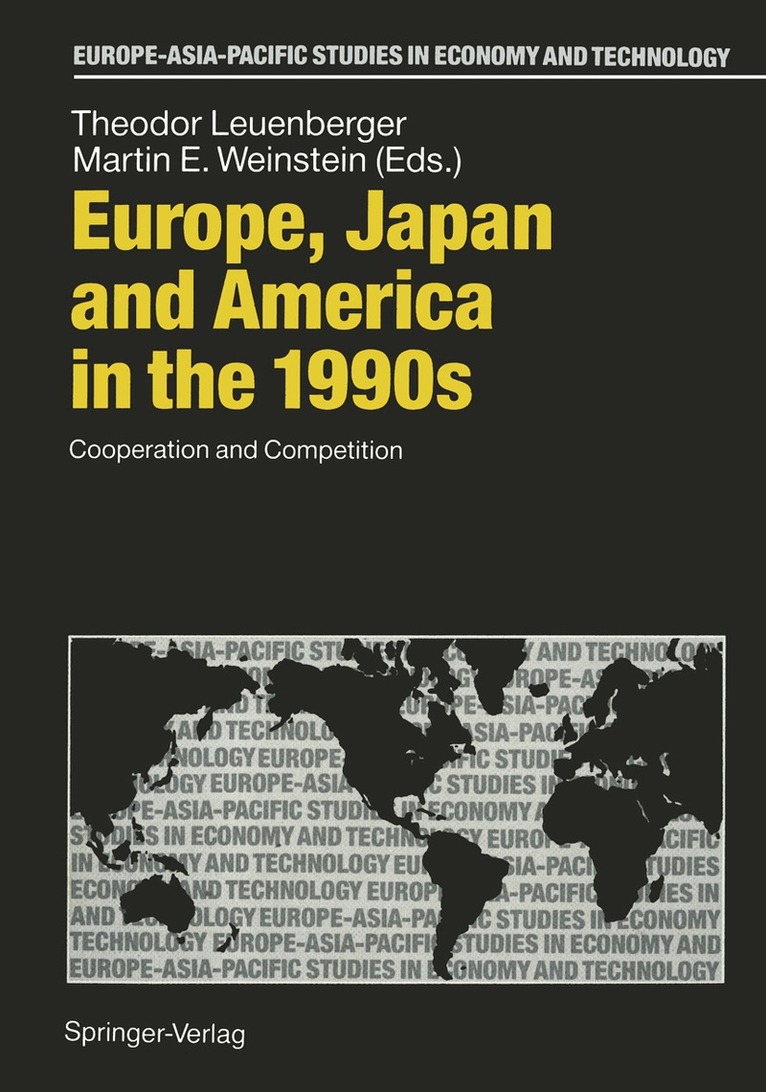
Competition and cooperation between Japan, Europe and USA isthe key issue of this book - both at government and businesslevels. Both short-term and long-termin competitivecooperation between Western and Japanese firms andinstitutions can be fruitful. Cooperation however, providesno easy solutions to problems which Western economies havebeen unable to solve on their own. Governments as well ascompanies are often unprepared for cooperation with Japanwithin the framework of larger-scale projects. On theotherhand, Japan itself still lacks the leadership capacities tomatch its present economic and technological dominance. Thusthe Japanese strategyfor a Number Two role in cooperationwith the USA and the EC is described. The discussion focuseson the implications of US/Japanese relations for Europe. Itfurther highlights future relations between the US and Japanin the field of technology, and also deals with the EC/Japancontext.