Germany and the Second World War – serie
Visar alla böcker i serien Germany and the Second World War. Handla med fri frakt och snabb leverans.
11 produkter
11 produkter
Häftad, Engelska, 2015
1 218 kr
Skickas inom 7-10 vardagar
By the spring of 1943, after the defeat at Stalingrad, the writing was on the wall. But while commanders close to the troops on Germany's various fronts were beginning to read it, those at the top were resolutely looking the other way. This seventh volume in the magisterial 10-volume series from the Militärgeschichtliches Forschungsamt [Research Institute for Military History] shows both Germany and her Japanese ally on the defensive, from 1943 into early 1945. It looks in depth at the strategic air war over the Reich and the mounting toll taken in the Battles of the Ruhr, Hamburg, and Berlin, and at the "Battle of the Radar Sets" so central to them all. The collapse of the Luftwaffe in its retaliatory role led to hopes being pinned on the revolutionary V-weapons, whose dramatic but ultimately fruitless achievements are chronicled. The Luftwaffe's weakness in defence is seen during the Normandy invasion, Operation overlord, an account of the planning, preparation and execution of which form the central part of this volume together with the landings in the south of France, the setback suffered at Arnhem, and the German counter-offensive in the Ardennes. The final part follows the fortunes of Germany's ally fighting in the Pacific, Burma, Thailand, and China, with American forces capturing islands ever closer to Japan's homeland, and culminates in her capitulation and the creation of a new postwar order in the Far East. The struggle between internal factions in the Japanese high command and imperial court is studied in detail, and highlights an interesting contrast with the intolerance of all dissent that typified the Nazi power structure. Based on meticulous research by MGFA's team of historians at Potsdam, this analysis of events is illustrated by a wealth of tables and maps covering aspects ranging from Germany's radar defence system and the targets of RAF Bomber Command and the US 8th Air Force, through the break-out from the Normandy beachhead, to the battles for Iwo Jima and Okinawa.
Häftad, Engelska, 2015
1 328 kr
Skickas inom 7-10 vardagar
Volume V Part II of the comprehensive and authoritative Germany and the Second World War series spans the years 1942 to 1945, and looks in closely researched detail, and against a background of growing military setbacks and disasters leading to final defeat, at the administration and ruthless exploitation of the occupied countries and of Germany's own allies, and the effect on their populations (in particular their Jews, Roma, and Sinti) and national economies. This comprehensive study of the meteoric rise to prominence of Hitler's crown prince Albert Speer, and his struggle to implement a 'total war' armaments policy in the face of opposition from the Party's Gauleiters and political rivals in the Nazi leadership, documents with a wealth of maps, diagrams, and tables the achievements of the arms drive he masterminded; a large part of this success is shown to have relied on the forced or slave labour of those under German domination. The conflicting claims of industry and the Wehrmacht for dwindling manpower resources are also considered.
Häftad, Engelska, 2015
1 328 kr
Skickas inom 7-10 vardagar
This volume is concerned with developments in wartime administration, economy, and manpower resources in Germany and its occupied territories from 1939-1941. It examines the mobilization of material and personnel resources in the German sphere of power for an industrialized conduct of the war. Indissolubly linked with this issue is the question of the way in which the regime's ideology affected that mobilization process, and why the 'opportunity' which the war offered for an organizational restructuring of this sector was not taken. The authors have produced a problem-oriented account, providing - by a detailed presentation of government practice - a multitude of insights into the regime's governmental structures.
Häftad, Engelska, 2015
1 328 kr
Skickas inom 7-10 vardagar
Volume VI of the 'Germany and the Second World War' series deals with the extension of a European war into a global one in the period from 1941 to 1943. It focuses on the politics, strategy, and operations of the belligerent powers as Germany lost the initiative to the Allies, and it represents, both in content and in composition, the climax and turning points of the war.An account is given of the development of the war at sea in the Atlantic and the Mediterranean until the spring of 1943, of the changeable course of events in the North African theatre of war until the establishment of the bridgehead in Tunisia, and finally of Hitler's 'second campaign' against the Soviet Union until the stabilization of the front following the catastrophe at Stalingrad. Moreover, the United States' transition to open belligerence, after Pearl Harbor, calls for an account of the political developments leading up to that point on the Japanese and the American sides. The opening of new theatres of operations in the Pacific and over Germany, owing to the intensified strategic aerial warfare of the Allies, along with the organization of the Reich's air defences are also treated.
Häftad, Engelska, 2015
1 328 kr
Skickas inom 7-10 vardagar
Nine months after the beginning of the Second World War, German dominance over much of Europe seemed assured. Hitler not only stood on the pinnacle of his popularity in Germany but more than ever his ideological fixations and political calculations determined German war policy. This volume, the fourth in the acclaimed Germany and the Second World War series, examines the thinking behind the decision to go to war with the Soviet Union which was to prove the undoing of the German war effort. The authors examine in revealing detail the military and political policies behind the attack on the Soviet Union and the strategic conduct of the war. They explore not only the command principles and practices, but also the expenditure and attrition of the forces, and show that by the end of 1941 it was clear that it was in the eastern theatre that the Second World War would be decided and the map of Europe redrawn.
Häftad, Engelska, 2015
1 218 kr
Skickas inom 7-10 vardagar
This is the third in the comprehensive ten-volume Germany and the Second World War. The volumes so far published have achieved international acclaim as a major contribution to historical study. Under the auspices of the Militargeschichtliches Forschungsamt (Research Institute for Military History), a team of renowned historians has combined a full synthesis of existing material with the latest research to produce what will be the definitive history of the Second World War.Volume 3 explores the conduct of the war in the Mediterranean region and examines the dramatic military events of this period. It shows how German policy in this area was largely determined by the attitude of the German leadership, especially Hitler, towards Mussolini's Italy, and the volume thus sheds important new light on the alliance policy of theThird Reich. The comprehensive analysis, based on detailed scholarly research, is underpinned by a full apparatus of maps, diagrams, and tables.Intensively researched and documented, Germany and the Second World War is an undertaking of unparalleled scope and authority. It will prove indispensable to all historians of the twentieth century.
Häftad, Engelska, 2015
1 218 kr
Skickas inom 7-10 vardagar
This is the first of a comprehensive ten-volume history of the Second World War, written from the German perspective and translated for the first time into English. The volumes so far published have achieved international acclaim as a major contribution to historical study. Under the auspices of the Militärgeschichtliches Forschungsamt (Research Institute for Military History), a team of renowned historians has combined a full synthesis of existing material with the latest research to produce what will be the definitive history of the Second World War.This volume, The Build-up of German Aggression, surveys the forces both within and outside Weimar Germany which paved the way for Hitler. The authors examine the systematic preparation for war, from the outset of Nazi rule, through rearmament, economic autarky, diplomacy, and the penetration of German society at all levels. They consider the extent to which the movement can be regarded as a continuation of historic German nationalism; the limits of Hitler's involvement with the army and big business; and the lack of coordination between the administration and the armed services. The book demonstrates that, despite Nazi propaganda and in stark contrast to 1914, most Germans in 1939 opposed a war which they nevertheless endured with such tragic consequences.Intensively researched and documented, Germany and the Second World War is an undertaking of unparalleled scope and authority. It will prove indispensable to all historians of the twentieth century.
Häftad, Engelska, 2015
1 094 kr
Skickas inom 7-10 vardagar
This is the second in the comprehensive ten-volume Germany and the Second World War. The volumes so far published have achieved international acclaim as a major contribution to historical study. Under the auspices of the Militärgeschichtliches Forschungsamt (Research Institute for Military History), a team of renowned historians has combined a full synthesis of existing material with the latest research to produce what will be the definitive history of the Second World War.Germany's Initial Conquests in Europe surveys the first year of the war deliberately begun by Nazi Germany. The authors examine the train of interconnected political and military events, and set military operations against the background of Hitler's war policy and general aims, both immediate and long term. Their comprehensive analysis, based on detailed scholarly research, is underpinned by a full apparatus of maps, diagrams, and tables. The conflict took a course quite different from that which Hitler had intended, but nevertheless resulted in a series of conquests for the Third Reich. At the same time, the establishment of hegemony on the European continent confronted the aggressor with new problems.Intensively researched and documented, Germany and the Second World War is an undertaking of unparalleled scope and authority. It will prove indispensable to all historians of the twentieth century.
Häftad, Engelska, 2015
1 204 kr
Skickas inom 7-10 vardagar
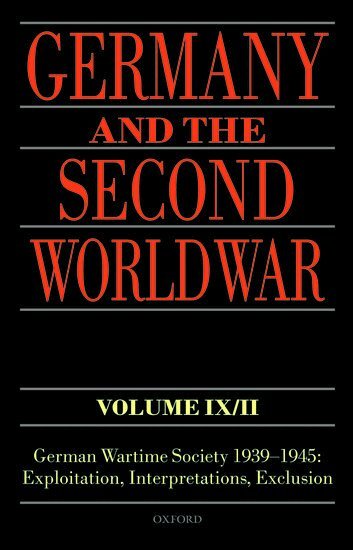
The Second World War affected the lives and shaped the experience of millions of individuals in Germany - soldiers at the front, women, children and the elderly sheltering in cellars, slave labourers toiling in factories, and concentration-camp prisoners and POWs clearing rubble in the Reich's devastated cities. Taking a 'history from below' approach, the volume examines how the minds and behaviour of individuals were moulded by the Party as the Reich took the road to Total War. The ever-increasing numbers of German workers conscripted into the Wehrmacht were replaced with forced foreign workers and slave labourers and concentration camp prisoners. The interaction in everyday life between German civilian society and these coerced groups is explored, as is that society's relationship to the Holocaust. From early 1943, the war on the home front was increasingly dominated by attack from the air. The role of the Party, administration, police, and courts in providing for the vast numbers of those rendered homeless, in bolstering civilian morale with 'miracle revenge weapons' propaganda, and in maintaining order in a society in disintegration is reviewed in detail. For society in uniform, the war in the east was one of ideology and annihilation, with intensified indoctrination of the troops after Stalingrad. The social profile of this army is analysed through study of a typical infantry division. The volume concludes with an account of the various forms of resistance to Hitler's regime, in society and the military, culminating in the failed attempt on his life in July 1944.
Inbunden, Engelska, 2008
6 073 kr
Skickas inom 5-8 vardagar
The Second World War affected the lives and shaped the experience of millions of individuals in Germany - soldiers at the front, women, children and the elderly sheltering in cellars, slave labourers toiling in factories, and concentration-camp prisoners and POWs clearing rubble in the Reich's devastated cities. Taking a 'history from below' approach, the volume examines how the minds and behaviour of individuals were moulded by the Party as the Reich took the road to Total War. The ever-increasing numbers of German workers conscripted into the Wehrmacht were replaced with forced foreign workers and slave labourers and concentration camp prisoners. The interaction in everyday life between German civilian society and these coerced groups is explored, as is that society's relationship to the Holocaust. From early 1943, the war on the home front was increasingly dominated by attack from the air. The role of the Party, administration, police, and courts in providing for the vast numbers of those rendered homeless, in bolstering civilian morale with 'miracle revenge weapons' propaganda, and in maintaining order in a society in disintegration is reviewed in detail. For society in uniform, the war in the east was one of ideology and annihilation, with intensified indoctrination of the troops after Stalingrad. The social profile of this army is analysed through study of a typical infantry division. The volume concludes with an account of the various forms of resistance to Hitler's regime, in society and the military, culminating in the failed attempt on his life in July 1944.
Inbunden, Engelska, 2014
5 498 kr
Skickas inom 5-8 vardagar
The Second World War affected the lives and shaped the experience of millions of individuals in Germany - soldiers at the front, women, children, and the elderly sheltering in cellars, slave labourers toiling in factories, and concentration-camp prisoners and POWs clearing rubble in the Reich's devastated cities.Taking a 'history from below' approach, the volume examines how the minds and behaviour of individuals were moulded by the Party as the Reich took the road to Total War. The ever-increasing numbers of German workers conscripted into the Wehrmacht were replaced with forced foreign workers, slave labourers, and concentration camp prisoners. The interaction in everyday life between German civilian society and these coerced groups is explored, as is that society's relationship to the Holocaust.From early 1943, the war on the home front was increasingly dominated by attack from the air. The role of the Party, administration, police, and courts in providing for the vast numbers of those rendered homeless, in bolstering civilian morale with 'miracle revenge weapons' propaganda, and in maintaining order in a society in disintegration is reviewed in detail.For society in uniform, the war in the east was one of ideology and annihilation, with intensified indoctrination of the troops after Stalingrad. The social profile of this army is analysed through study of a typical infantry division. The volume concludes with an account of the various forms of resistance to Hitler's regime, in society and the military, culminating in the failed attempt on his life in July 1944.