Handbook of East Asian Psycholinguistics 3 Volume Paperback Set – serie
Visar alla böcker i serien Handbook of East Asian Psycholinguistics 3 Volume Paperback Set. Handla med fri frakt och snabb leverans.
3 produkter
3 produkter
663 kr
Skickas inom 7-10 vardagar
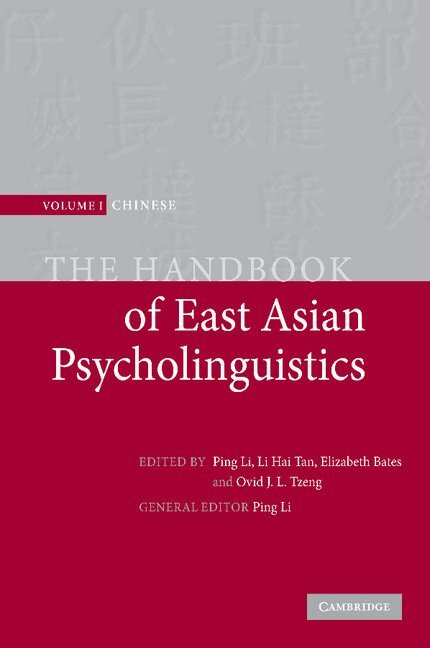
A large body of knowledge has accumulated on the cognitive processes and brain mechanisms underlying language. Much of this knowledge has come from studies of Indo-European languages, in particular English. Chinese, spoken by one-fifth of the world's population, differs significantly from most Indo-European languages in its grammar, its lexicon, and its written and spoken forms - features which have profound implications for the learning, representation and processing of language. This handbook, first published in 2006 as the first in a three-volume set on East Asian psycholinguistics, presents a discussion of the psycholinguistic study of Chinese. With contributions by over fifty leading scholars, it covers topics in first- and second-language acquisition, language processing and reading, language disorders in children and adults, and the relationships between language, brain, culture, and cognition. It will be invaluable to all scholars and students interested in the Chinese language, as well as cognitive psychologists, linguists, and neuroscientists.
672 kr
Skickas inom 7-10 vardagar
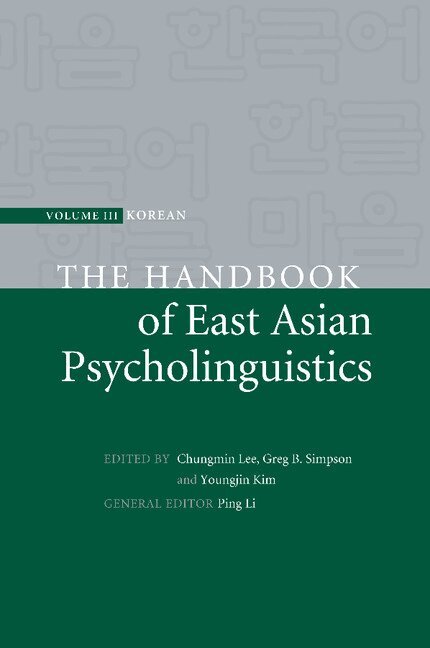
A large body of knowledge has accumulated in recent years on the cognitive processes and brain mechanisms underlying language. Much of this knowledge has come from studies of Indo-European languages, in particular English. Korean, a language of growing interest to linguists, differs significantly from most Indo-European languages in its grammar, its lexicon, and its written and spoken forms - features which have profound implications for the learning, representation and processing of language. This handbook, the third in a three-volume series on East Asian psycholinguistics, presents a state-of-the-art discussion of the psycholinguistic study of Korean. With contributions by over sixty leading scholars, it covers topics in first and second language acquisition, language processing and reading, language disorders in children and adults, and the relationships between language, brain, culture, and cognition. It will be invaluable to all scholars and students interested in the Korean language, as well as cognitive psychologists, linguists, and neuroscientists.
510 kr
Skickas inom 7-10 vardagar
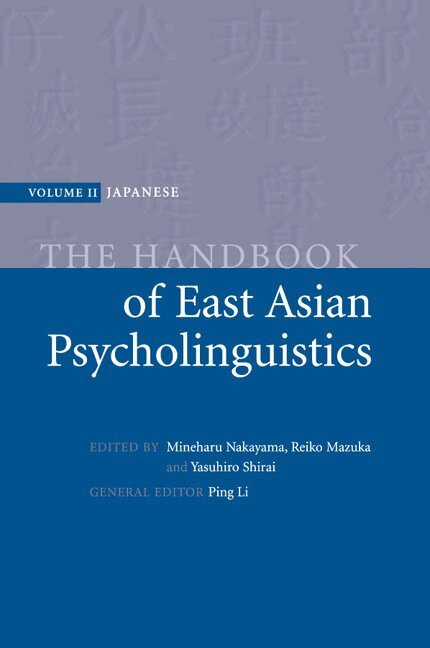
A large body of knowledge has accumulated in recent years on the cognitive processes and brain mechanisms underlying language. Much of this knowledge has come from studies of Indo-European languages, in particular English. Japanese, a language of growing interest to linguists, differs significantly from most Indo-European languages in its grammar, its lexicon, and its written and spoken forms - features which have profound implications for the learning, representation and processing of language. This handbook, the second in a three-volume series on East Asian psycholinguistics, presents a state-of-the-art discussion of the psycholinguistic study of Japanese. With contributions by over fifty leading scholars, it covers topics in first and second language acquisition, language processing and reading, language disorders in children and adults, and the relationships between language, brain, culture, and cognition. It will be invaluable to all scholars and students interested in the Japanese language, as well as cognitive psychologists, linguists, and neuroscientists.